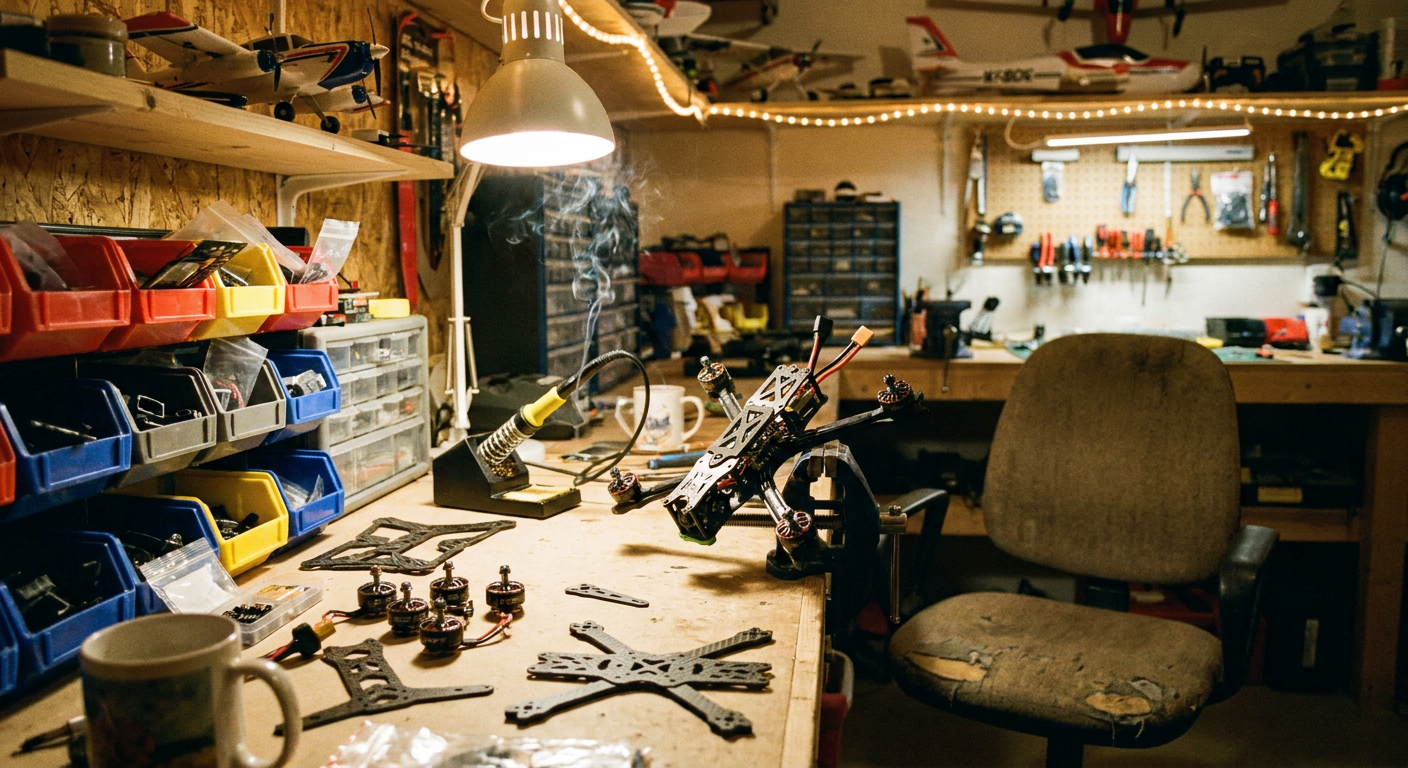
If you tried to order a pack of 2207 brushless motors or a standard 50A stack last week, you probably noticed two things. Half the reputable stores are out of stock, and the ones that do have inventory want six to eight dollars more per motor than they did eighteen months ago.
It is not just your imagination, and it is not regular inflation. The entire supply chain for consumer FPV gear has run headfirst into defense procurement contracts. Defense startups, military suppliers, and state procurement offices are buying the exact same components you put on a weekend five-inch basher, and they are buying them by the shipping container.
For years, hobbyists benefited from massive economies of scale. Shenzen factories pumped out millions of flight controllers, speed controllers, and tiny neodymium brushless motors for racers, freestyle pilots, and fixed-wing tinkerers. Prices hit rock bottom around 2021. You could build a screaming fast five-inch quad for under a hundred and fifty bucks if you shopped smart on AliExpress or Banggood.
That era is over. The global defense market for low-cost drones is projected to blow past forty billion dollars over the next several years. To feed that appetite, defense buyers are cleaning out factory production runs before those parts ever hit the shelves of GetFPV, Pyrodrone, or your local hobby shop.
The Parts Disappearing from Shelves
Not every RC part is under siege. If you fly two-meter balsa thermal gliders or giant-scale gas warbirds, your world has not changed much beyond shipping delays. The squeeze is hitting three specific categories where hobby technology happens to match modern tactical drone requirements.
1. 2207 and 2807 Brushless Motors
The 2207 stator size has been the sweet spot for five-inch freestyle and racing drones for a long time. It delivers torque, handles aggressive prop pitch, and survives hard crashes. The larger 2807 and 2806.5 stators are the standard for seven-inch and eight-inch long-range rigs.
These are precisely the motors defense builders want for lightweight one-way or payload-carrying platforms. When a defense contractor gets an order to build twenty thousand cheap scout frames, they do not design a custom aerospace motor from scratch. That takes two years and costs millions. They call the factory that makes budget hobby motors and buy out the entire factory output for the next six months.
Popular hobby workhorses from brands like Emax, Sunnysky, T-Motor, and BrotherHobby have seen periodic retail shortages. Even budget lines that used to sell for $11 a motor are hovering around $16 to $19. Premium motors that sat at $22 are frequently listed at $28 or $30 if you can even find all four in the same KV rating.
2. High-Current 4-in-1 ESCs (45A to 65A)
A 4-in-1 electronic speed controller running BLHeli_32 or AM32 firmware is an incredible piece of engineering. On a single 30x30mm or 20x20mm PCB, you get four microcontrollers, sixteen to twenty-four MOSFETs, current sensing, and clean power filtering.
Because they pack so much power into such a tiny, light footprint, demand for them has gone through the roof. The semiconductor shortages of a few years ago gave way to a direct component grab. When MOSFET batches come off the line, defense subcontractors get priority. The result is that reliable 50A and 60A 4-in-1 boards from dependable hobby brands like SpeedyBee, Diatone, and Foxeer are constantly slipping into backorder status.
3. ExpressLRS Hardware and High-Power Radios
ExpressLRS started as an open-source project by hobbyists who were tired of paying high prices for proprietary long-range systems. It runs on cheap Semtech SX1280 (2.4GHz) and SX1262 (900MHz) chips, offers incredible range, handles dirty RF environments, and has near-zero latency.
That exact recipe made it a prime target for non-hobby applications. Tiny ceramic antenna receivers like the BetaFPV SuperD or the RadioMaster RP series, which used to sell reliably for $12 to $15, are frequently out of stock at major hobby distributors. Large orders are swept up in bulk, repackaged, and slotted into airframes destined for government testing grounds.
4. 3K Carbon Fiber Sheets and Cut Plates
If you cut your own frames on a desktop CNC or order custom carbon plates from budget milling services, you have likely noticed longer lead times and higher raw material surcharges. High-modulus, clean 3K carbon sheets are being diverted into massive airframe manufacturing lines. Defense drone factories are consuming thousands of square meters of carbon plate every month. Small hobby cutting shops have to wait in line behind defense orders just to buy raw stock.
Why Defense Programs Love Hobby Shelves
Traditional military procurement moves at a glacial pace. A defense contractor building a high-altitude reconnaissance drone might spend five years testing a single gimbal. But the tactical drone boom is entirely different. It runs on volume, speed, and cost efficiency.
Military planners realized that a thousand-dollar quad built with commercial off-the-shelf parts can accomplish tasks that used to require a multi-million-dollar vehicle. When speed matters more than custom mil-spec paperwork, procurement teams go shopping where the parts already exist.
Hobby hardware has twenty years of open-source flight testing behind it. Betaflight, INAV, and ArduPilot have been tuned by hundreds of thousands of weekend flyers. The hardware was refined through crashes, prop strikes, and aggressive backyard testing. The military simply stepped in and bought the mature consumer supply chain.
Some manufacturers in the United States, like Unusual Machines, are expanding local production to serve both defense requirements and domestic retail demand. But building out local component manufacturing takes time. In the meantime, the global supply pool is shared between an enthusiast buying three motors for a Saturday build and a contractor buying three thousand for a contract milestone.
What This Looks Like at the Club Field
Talk to anyone at your local flying field on a Sunday morning and you will hear the same stories.
A few years ago, if you smoked an ESC on a bad landing, you ordered a replacement on Monday and it was on your bench by Thursday. Today, you might find the board is backordered for five weeks. If you look on secondary markets or unverified marketplace sellers, you find people asking double the retail price.
We are also seeing lower-grade silicon creeping into budget hobby batches. When top-tier MOSFETs and genuine STM32 chips are claimed by high-dollar contracts, budget manufacturers sometimes turn to clone chips or lower-spec components to keep their factory lines moving. That means more dead-on-arrival flight controllers, flaky gyro readings, and ESCs that blow a FET on 4S power even though they are rated for 6S.
Builders who have been in the hobby for a decade are feeling a strange sense of deja vu. It feels a bit like the early 2010s, when finding good multirotor parts required patience, clever substitutions, and a willingness to solder discrete components.
How to Keep Flying Without Paying Scalper Prices
Giving up on the hobby is not the answer. You can easily keep a fleet in the air if you change how you shop, design, and repair your models. Here are practical strategies that club pilots are using right now to dodge the shortages.
1. Build with Non-Standard Stator Sizes
Defense buyers buy in bulk, which means they standardize on specific sizes. If thousands of airframes are designed around 2207 1950KV motors, that specific stator and KV will vanish first.
Look at stator sizes that defense procurement ignores. For five-inch quads, 2306, 2208, and even older 2205 or 2408 motors fly brilliantly. A 2306 motor gives you slightly more low-end throttle control, which many freestyle pilots actually prefer over a 2207. Because defense procurement pipelines are not buying 2306 stators in massive batches, these motors are often in stock and still priced normally.
The same trick works for motor KV. While 1950KV (for 6S) and 2450KV (for 4S) sell out instantly, you can often find 1750KV or 2150KV variants sitting on shelves. You can easily adjust your motor output limit in Betaflight or step up your propeller pitch to get the exact thrust curve you want.
2. Switch from 4-in-1 Boards to Individual ESCs
For five-inch frames, 4-in-1 ESCs are tidy and convenient. But for six-inch, seven-inch, and fixed-wing models, individual ESCs soldered directly to the arms are often cheaper, easier to find, and far more resilient.
When one MOSFET burns on a 4-in-1 ESC, the entire $65 board is trash unless you are skilled at hot-air SMD rework. If you burn an individual 35A or 45A arm ESC, you replace a single $12 component and get back in the air. Individual ESCs like the generic BLHeli_S 35A or 45A slim boards are widely available because military integrators rarely use them on tight quadcopter stacks.
3. Look at Fixed-Wing and RC Airplane Components
If you fly fixed-wing models, steer clear of FPV drone retailers for your core electronics. Dedicated airplane motors from brands like Dualsky, SunnySky's airplane series, and BadAss have not seen the same supply pressures as quad motors.
A classic 2212 or 2216 airplane motor with a standard collet adapter costs less than a trendy FPV motor, delivers exceptional efficiency on 8-inch to 10-inch props, and lasts for years on a foamie trainer or a balsa wing.
4. Give 3D-Printed and Foam Airframes a Harder Look
If carbon fiber sheet prices are climbing, stop buying cut carbon for every experimental project. High-density expanded polypropylene (EPP) foam, depron sheet builds, and 3D-printed PETG or LW-PLA airframes cost pennies compared to carbon plate.
A simple twin-motor EPP foam flying wing can take an absolute beating, requires zero expensive carbon plates, and uses standard 9-gram servos that defense buyers never touch. If you break a motor mount on a foamie, you print another one in thirty minutes instead of waiting for a cut carbon spare to ship from overseas.
If you want to sketch out airframe balance or motor matching before buying scarce parts, tools like MyRC offer quick calculators for thrust-to-weight and power setups so you do not waste money ordering gear that does not fit your build.
5. Buy Spares in Pairs, Not in Fours
When you do find a component you like at a normal price, buy one or two extra. You do not need to hoard dozens of parts, but having a single spare motor and one backup flight controller in your field box saves you from being grounded for six weeks when a backorder hits.
Join a local club or an active regional RC group. Club members constantly trade, swap, and sell extra components. If you need a single 2207 1800KV motor to finish a rebuild, chances are someone in your local hangar has two sitting in a parts drawer from a project they never finished.
A Quick Look at Current Component Availability
To make your shopping easier, here is a quick breakdown of where component supply stands across different hobby categories.
| Component Type | Availability Status | Price Trend | Best Strategy |
|---|---|---|---|
| 2207 / 2807 Motors | Tight, frequent backorders | Up 20% to 35% | Use 2306, 2208, or alternate KV ratings |
| 45A-60A 4-in-1 ESCs | Unstable on major brands | Up 15% to 30% | Use individual arm ESCs or AM32 alternatives |
| 2.4GHz ELRS Receivers | Periodic shortages | Moderate (+10%) | Order directly from maker shops or buy multi-packs |
| 2212 / 2216 Plane Motors | Stable and widely available | Flat / Normal | Ideal for foam planes and park flyers |
| 3K Carbon Fiber Plates | Slower shipping, higher lead time | Up 15% to 25% | Use EPP foam, plywood, or 3D printed frames |
| Standard Micro Servos | Very high availability | Flat / Normal | Excellent for budget scratch builds |
What to Watch in the Months Ahead
This squeeze is not going away overnight. Defense programs are only ramping up their small drone initiatives, and supply chains take months to rebalance. However, the manufacturing sector is already responding.
New component fabrication facilities are coming online in North America, Europe, and non-traditional manufacturing hubs across Asia. As dedicated defense suppliers establish their own specialized production lines, the pressure on consumer hobby stock should gradually ease.
Until then, the smartest thing you can do as a builder is to stay flexible. Do not design your builds around one hyper-specific motor or one particular all-in-one flight board. Learn how to tune Betaflight or ArduPilot to handle different motor sizes. Get comfortable using individual ESCs again, and dust off your foam-cutting wire or your 3D printer.
The hobby has always been about making things fly with whatever hardware you have on the bench. A little supply chain crunch is just another reason to get creative with your builds.
Sources
- https://finance.yahoo.com/markets/stocks/articles/unusual-machines-ramps-u-drone-080156267.html
- https://www.financialnewsmedia.com/defense-drone-market-accelerates-toward-40b-opportunity-as-autonomous-warfare-redefines-modern-battlefields/
- https://breakingdefense.com/2026/09/in-the-rush-to-buy-drones-make-sure-not-to-stockpile-obsolescence/
- https://all3dp.com/4/why-the-militarys-need-for-cheap-drones-is-driving-a-900m-3d-printing-boom/
- https://www.youtube.com/watch?v=FAiX0VfeRnk