The FAA recently published its notice of proposed rulemaking for Beyond Visual Line of Sight (BVLOS) operations, and buried inside hundreds of pages of Federal Register text is a proposal that has pilots and club officers talking. The agency wants to rewrite right-of-way rules below 400 feet to make room for commercial delivery drones and automated survey flights.
For decades, the basic hierarchy of the air was simple. Unpowered craft had priority over powered craft, manned airplanes had priority over everything else, and model airplanes yielded to everybody. If a low-flying Piper Cub, a crop duster, or a National Guard helicopter drifted anywhere near your field, you dropped your throttle, cut your altitude, and got out of the way immediately.
The new proposal flips part of that logic on its head to help automated commercial drones fly long distances without a human pilot watching them through binoculars. If you fly park flyers, giant-scale balsa warbirds, scratch-built foamies, or thermal gliders, these proposed changes will affect the airspace you share every Saturday morning.
What the FAA Is Actually Proposing
The core of the proposed rulemaking, titled Normalizing Unmanned Aircraft Systems Beyond Visual Line of Sight Operations, is aimed at commercial operators like Amazon Prime Air, Zipline, Wing, and utility inspection companies. Right now, if a commercial operator wants to fly a drone past where the operator can physically see it, they need a special FAA waiver under Part 107. The FAA wants to eliminate the need for those individual waivers by creating a standard rulebook under a new framework.
To make routine BVLOS flights work without human spotters standing every half-mile along a route, the FAA is proposing that commercial drones equipped with certified Detect and Avoid (DAA) systems get clear operating rules below 400 feet above ground level.
Here is where it gets contentious. Under the proposed rule, the FAA suggests that manned aircraft operating in low-altitude airspace without ADS-B Out or active transponders might no longer automatically have right-of-way priority over automated drones that are following pre-approved BVLOS rules. The proposal also looks at how traditional recreational model flyers fit into that lower 400-foot block.
Historically, federal regulations under 14 CFR Part 91 and the recreational exception under 49 U.S.C. Section 44809 have put the entire burden of collision avoidance on the model flyer. You see a full-scale plane, you yield. You see a drone, you yield. Under the proposed BVLOS structure, commercial delivery drones flying along automated corridors would rely on their onboard sensors and traffic management networks to navigate, while expecting everyone else in the low-altitude band to follow predictable paths or broadcast their positions.
How FRIAs and Club Fields Fit Into the Picture
A lot of modelers assume that because their club field is an approved FAA-Recognized Identification Area (FRIA), they are inside a protected bubble where commercial drones cannot go. That is a misunderstanding of what a FRIA actually is.
A FRIA is strictly an administrative exemption from Remote ID. It means you can take a 20-year-old balsa stick model with an OS .46 glow engine, a vintage radio, and zero digital electronics, and fly it at your club field without taping an eighty-dollar broadcast module to the fuselage. It does not turn your field into restricted airspace.
A commercial drone delivering groceries or medical supplies has legal access to Class G uncontrolled airspace, which extends from the grass up to 700 or 1,200 feet in most rural and suburban areas. If a commercial delivery corridor happens to cross the edge of your flying site, the fact that your patch of grass is a registered FRIA does not automatically block that commercial traffic from passing through.
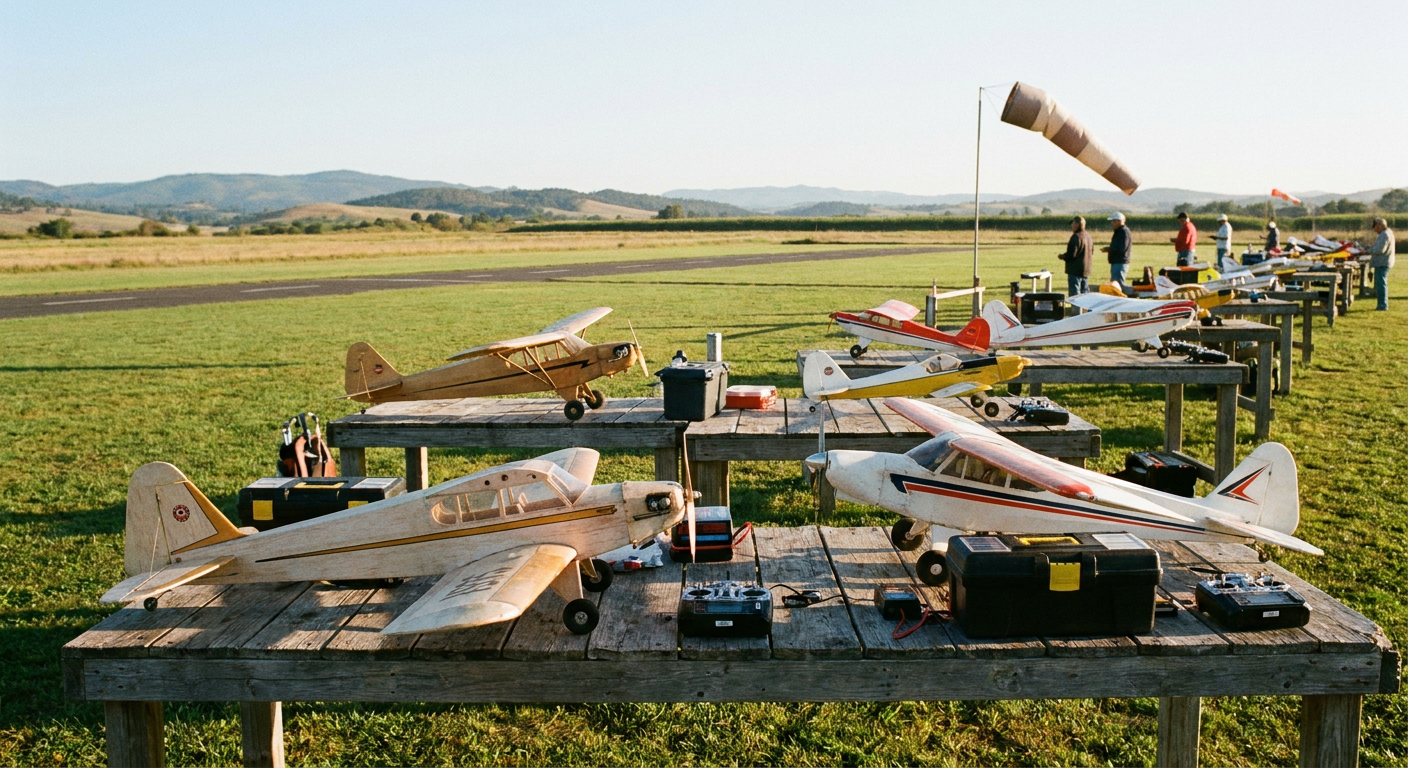
This creates a real practical issue for club flight lines. At a typical club field, you have three or four planes in the air at once. Someone is flying a 3D aerobatic plane doing hovers over the runway, an older flyer is doing touch-and-goes with an electric trainer, and someone else is high up searching for thermals with a two-meter foam glider. None of those models have transponders. None of them are connected to the internet. If an automated drone crosses the field at 250 feet, who gives way to whom?
Under current recreational rules, the recreational pilot must see and avoid. But if a commercial BVLOS drone is flying at 60 miles per hour across your visual boundary, spotting it before it enters your circuit is not simple, especially if you are focused on keeping a fast sport plane in orientation against the sun.
The Manned Aviation Backlash
Recreational modelers are not the only ones pushing back against this proposal. General aviation groups, led by the Aircraft Owners and Pilots Association (AOPA) and the National Agricultural Aviation Association (NAAA), are deeply concerned about the right-of-way language.
Full-scale pilots who spend significant time below 400 feet include crop dusters, pipeline patrol pilots, helicopter emergency medical crews, and backcountry bush pilots. Agricultural pilots frequently work fields at 10 to 50 feet above the crop canopy, popping up to 200 or 300 feet to turn around at the end of each pass. In Class G airspace, full-scale aircraft are not legally required to carry ADS-B Out equipment or keep radios tuned to local frequencies.
The proposal suggests that if a manned aircraft is not broadcasting its position electronically, an automated commercial drone might not be able to yield in time, shifting the safety burden onto the manned pilot. AOPA and other groups have argued strongly that manned life must always take absolute priority over an unmanned delivery vehicle, regardless of whether the manned aircraft has modern electronics installed.
For RC flyers, this manned aviation pushback is important. Model aviation has historically shared a close relationship with general aviation. Many RC pilots are also full-scale pilots, and our safety culture has always been built on the principle that the human in the cockpit has the right of way, no questions asked. If the FAA weakens that principle below 400 feet to accommodate automated logistics, it complicates safety rules for everyone sharing that airspace.
Remote ID Modules and Weight Budgets
For pilots flying outside of FRIA sites, the regulatory load has already been heavy over the last two years. If you fly at a public park, a school soccer field, an empty farm, or a slope-soaring ridge, you are already required to use an FAA-approved Remote ID broadcast module unless your model weighs under 250 grams (0.55 pounds).
If you have bought one of these modules recently, like a Spektrum SkyID, a Holybro standalone unit, or one of the Flite Test modules, you know the trade-offs. They cost between $40 and $100 each. They weigh anywhere from 10 to 30 grams. On a 60-inch balsa plane with a 4S 2200mAh battery, an extra 20 grams is nothing. You velcro it to the top of the battery tray, plug it into a spare receiver port for power, and forget it is there.
On smaller airframes, that weight is a major headache. Take a small 800mm foam warbird or an ultralight park flyer. Adding 20 grams of module and wiring directly changes your wing loading and shifts your center of gravity. You end up having to carve out foam or add nose weight just to balance the plane, which increases your stall speed and cuts your flight time by a minute or two.
When we look at airframe layouts and payload weight budgets on MyRC (myrc.ai), the margin on sub-one-pound planes is razor thin. Forcing traditional RC planes to carry even more complex hardware down the road, like two-way transponders or active detect-and-avoid transceivers, is simply not realistic for foam park flyers or lightweight balsa kits.
Here is a quick look at how the different flying categories stand under current rules versus what is being discussed in the BVLOS docket:
Current Rules vs. Proposed BVLOS Environment
| Flying Category | Current Operating Rule | Remote ID Requirement | Right-of-Way Status under Proposals |
|---|---|---|---|
| FRIA Club Field (Traditional RC) | Section 44809 / CBO Safety Code | Exempt inside FRIA boundaries | Must still yield to all manned aircraft; interaction with BVLOS drones unresolved |
| Park Flyer / Unsanctioned Field | Section 44809 / CBO Safety Code | Broadcast module required if over 250g | Must yield to all manned aircraft and commercial traffic |
| Commercial BVLOS Drone | Part 107 (Waiver required) | Standard built-in Remote ID | Proposing structured right-of-way below 400 ft based on DAA equipment |
| General Aviation (Manned) | 14 CFR Part 91 | ADS-B Out required in controlled airspace only | FAA proposing DAA-equipped drones may not always yield to non-broadcasting manned aircraft |
What This Means for Thermal Soaring and Giant Scale
Two specific segments of the RC hobby are paying especially close attention to these low-altitude proposals: thermal glider pilots and giant-scale aerobatic flyers.
Thermal soaring relies on catching rising pockets of warm air. A pilot launching an unpowered F3J or modern composite sailplane wants to work lift as high as legally allowed. Under the recreational exception, modelers are generally capped at 400 feet above ground level in uncontrolled airspace, though some clubs with historical FAA letters of agreement have higher limits. If automated commercial delivery corridors are established at specific bands, like 200 to 400 feet, sailplane pilots working thermals over open fields could find their usable air severely compressed.
Giant-scale models present a different operational reality. A 35% or 40% scale aerobatic plane powered by a 120cc twin-cylinder gas engine can weigh 25 to 30 pounds and move at over 80 miles per hour. These aircraft require a wide, clear pattern to fly safely. They generate substantial kinetic energy and cannot be stopped or turned on a dime.
If commercial delivery traffic begins using low-altitude routes that skirt the edges of suburban club fields, the traditional visual scan of a spotter standing next to the pilot on the flight line becomes far more critical. A spotter looking for full-scale aircraft is listening for engine noise and looking for a high-wing Cessna or a low-flying helicopter. A quadcopter delivery drone with small electric motors running at 300 feet is almost silent until it is right on top of you.
The Real Problem: Enforcement and Local Land Use
Beyond the federal rules, there is an ongoing debate about who actually controls the airspace right above the grass. State legislatures and municipal councils across the country have repeatedly tried to pass local ordinances restricting drone flights below 200 feet, often claiming jurisdiction over local property rights.
Federal law is clear that the FAA holds exclusive authority over all airspace in the United States, from the blades of grass upward. However, commercial drone companies want clear, uniform federal rules so they do not have to deal with thousands of different city ordinances regarding delivery routes.
If the FAA establishes a broad federal BVLOS rule that fully pre-empts local authority, it provides regulatory certainty for commercial operators. But it also means local flying clubs will have little recourse through their local township or county boards if an automated flight path is routed directly over their leased club property. The conflict has to be handled directly at the federal level during the public rulemaking process.
Practical Steps for Weekend Flyers
Nothing changes the moment you pack your car this weekend. The FAA notice of proposed rulemaking is just that: a proposal. It takes months, sometimes years, for an NPRM to go through public comments, revisions, and final rule publication. You do not need to ground your planes, buy new equipment, or change how you fly this Saturday.
Here is what you should keep in mind as this process moves forward:
- Check your FRIA status. If your club applied for FRIA status through your Community-Based Organization (such as the AMA), make sure your club officers are tracking its renewal dates and geographic boundaries. Knowing exactly where your approved boundary ends is critical if commercial traffic expands nearby.
- Keep using spotters. When you are flying fast models, large scale aircraft, or high-altitude gliders, always have a second person standing with you on the flight line. Two sets of eyes are always better than one, especially for spotting unexpected low-altitude traffic.
- Follow CBO safety guidelines. Sticking strictly to your community-based organization's safety code protects your club and reinforces the long-standing record of safe model aviation. Flying within your defined field boundaries and staying below your site's altitude limit keeps you firmly on the right side of federal regulations.
- Submit public comments. When the public comment window is open on the Federal Register, submit your thoughts as an individual modeler. You do not need to write a legal brief. A short, respectful comment explaining how long you have flown safely, the type of models you fly, the location of your field, and why simple see-and-avoid rules protect both modelers and full-scale pilots carries genuine weight with agency staff.
Model aviation has operated alongside full-scale aviation for nearly a century by relying on common sense, good visual scanning, and a clear rule that models always yield to full-scale craft. As commercial delivery drones try to carve out space below 400 feet, making sure the rules leave room for traditional hobbyists will depend on clubs and individual flyers staying informed and making their voices heard on the docket.