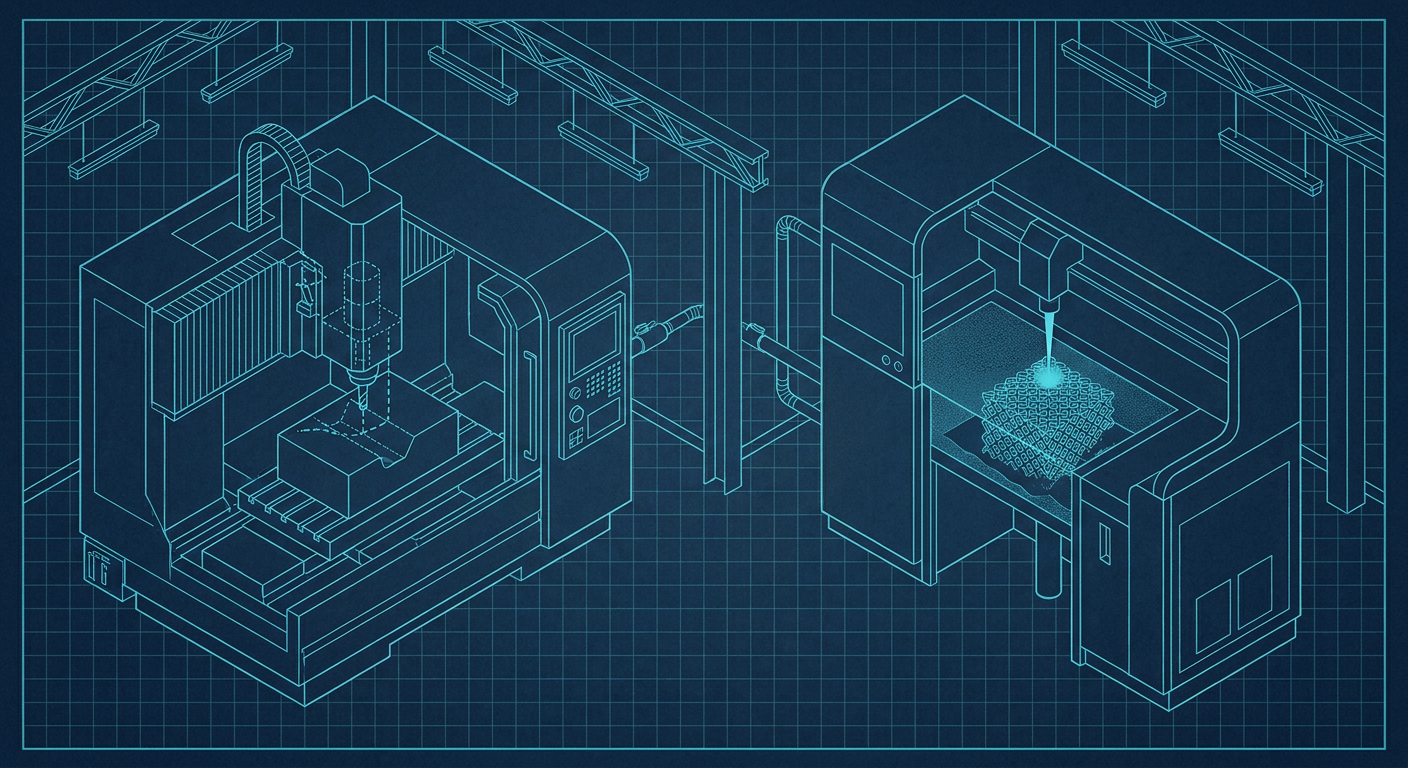
Nikon took an impairment charge of roughly 83 billion yen (around $575 million) on its acquisition of SLM Solutions. The Japanese optics and industrial giant bought the German metal printer manufacturer in late 2022 for 622 million euros, betting that laser powder bed fusion (LPBF) would rapidly replace conventional multi-axis subtractive milling for high-end production parts.
That bet hit a wall. It did not fail because the lasers do not work or because SLM's quad-laser and 12-laser NXG XII 600 systems cannot fuse metal. It failed because the unit economics of metal powder bed fusion do not scale like traditional production processes.
For small and mid-size manufacturing shops, robotics builders, and mechanism designers, this write-down confirms what machinists have known for a decade. Metal 3D printing is not a general replacement for a 5-axis machining center. Beyond prototypes and hyper-specific aerospace consolidation jobs, direct metal laser sintering (DMLS) hits an asymptotic cost curve almost immediately. If you need 50, 200, or 2,000 parts, traditional subtractive billet machining and investment casting win on part cost, lead time, and dimensional reliability.
To understand why Nikon had to write off the bulk of that purchase, you have to look at the shop-floor cost stack that additive marketing brochures routinely leave out.
The Phantom Cost Stack of Laser Powder Bed Fusion
When a sales engineer pitches an LPBF machine, the math looks deceptively simple. You calculate the part volume, multiply by powder bulk density, add the raw material cost per kilogram, and divide the machine hourly rate by the number of parts packed into the build envelope.
That calculation is pure fiction.
In a production environment, the raw build time is often less than half the total cost of delivering a finished, inspectable metal component. The hidden line items eat the margin.
+-------------------------------------------------------------+
|              THE REAL LPBF PRODUCTION COST STACK            |
+-------------------------------------------------------------+
| 1. Machine Amortization ($800k-$1.8M CapEx over 5 years)   |
| 2. Feedstock: Virgin Spherical Powder ($80-$350/kg)         |
| 3. Atmosphere: High-Purity Argon Gas Purge & Continuous Flow |
| 4. Thermal: Vacuum Stress-Relief Cycle (Mandatory Pre-EDM)  |
| 5. Separation: Wire EDM Off Build Plate ($150-$400/plate)   |
| 6. Consolidation: Hot Isostatic Pressing (HIP) for Fatigue   |
| 7. Secondary Machining: 5-Axis Milling of Critical Datums   |
| 8. Support Removal & Manual Bench Grinding                  |
| 9. Metrology: CT Scanning or Coordinate Measuring (CMM)     |
+-------------------------------------------------------------+
1. Powder Metallurgy and Yield Loss
Powder for LPBF is not standard bar stock. It must be gas-atomized into highly spherical particles between 15 and 45 microns to ensure smooth recoater blade spreading.
Titanium Ti-6Al-4V Grade 23 powder runs between $200 and $350 per kilogram. Billet Ti-6Al-4V bar stock costs around $35 to $60 per kilogram. Inconel 718 powder costs $90 to $160 per kilogram, compared to $30 for rod. Aluminum AlSi10Mg powder runs $45 to $80 per kilogram, while standard 6061-T6 plate costs roughly $6 to $10 per kilogram.
Powder cannot be recycled forever. Every build cycle exposes the un-melted powder bed to elevated heat and trace oxygen levels. The powder picks up oxygen and nitrogen, which degrades ductility in titanium and nickel superalloys. After 5 to 10 recycles, you must blend in 30% to 50% virgin powder or scrap the lot. When you sieve and reclaim powder, 2% to 5% is lost as fine particulate. That scrap rate is expensive when the raw powder costs $250 a kilo.
2. Shield Gas and Utility Draw
A medium-to-large frame LPBF system (such as an EOS M290 or SLM 280) draws 8 to 14 kW of continuous electrical power during sintering, plus chillers. Before the build starts, the chamber must be purged with high-purity argon down to oxygen levels below 100 parts per million.
A full chamber purge consumes 1,500 to 3,000 liters of argon. During a 40-hour build, continuous laminar gas flow across the powder bed burns through multiple industrial gas cylinders or requires a dedicated bulk cryogenic liquid tank. At standard gas supplier rates, argon consumption alone adds $120 to $300 per build plate.
3. Build Plate Setup and Wire EDM Cutoff
Parts do not sit freely on the floor of the machine. They are welded by the laser directly onto a thick ground tool steel or titanium baseplate.
When the laser finishes, you have a solid slab of metal anchored to dozens of support structures. You cannot pry them off with a pry bar. The entire assembly must go onto a wire electrical discharge machining (EDM) tank to slice the parts off the baseplate.
Wire EDM is slow. A single plate cutoff run costs $150 to $400 in machine time and wire consumption, depending on the cut area. After cutoff, the baseplate must be skimmed flat on a surface grinder before it can be used in the next build. A build plate only survives 15 to 25 skim cuts before it becomes too thin and must be scrapped.
LPBF Baseplate Cycle:
[New Plate: 30mm] -> [Print] -> [Stress Relief] -> [Wire EDM Cut] -> [Surface Grind -0.8mm] -> [Repeat ~20x] -> [Scrap]
The Secondary Operations Trap: As-Printed vs. Drawing Tolerance
Additive manufacturing does not produce net-shape mechanical parts. It produces near-net-shape blanks with rough surfaces and high internal stress.
+-----------------------+---------------------+----------------------+
| Parameter             | As-Printed LPBF     | Standard 5-Axis CNC  |
+-----------------------+---------------------+----------------------+
| Surface Roughness (Ra)| 8 to 18 µm          | 0.8 to 1.6 µm        |
| Linear Tolerance      | ±0.1 to ±0.2 mm     | ±0.010 to ±0.025 mm  |
| Hole Cylindricity     | Poor (egg-shaped)   | < 0.005 mm           |
| Bearing Bore Fit      | Impossible (loose)  | H7 / G6 achievable   |
| Thread Quality        | Unusable (re-tap)   | Precision single-pt  |
+-----------------------+---------------------+----------------------+
An as-printed DMLS part has a surface roughness (Ra) ranging between 8 and 18 microns. Downskin surfaces (overhangs supported by powder) are often worse than 20 microns Ra.
If you have a bearing bore requiring an H7 tolerance (+0.015 / -0.000 mm), you cannot print it. If you need a flat face for an O-ring seal with an Ra of 0.8 microns, you cannot print it. If you need an M4 tapped hole, printing the threads directly results in clogged, out-of-spec pitch diameters that snap taps when you try to chase them.
You must print the part with 1.0 to 1.5 mm of extra stock on all critical faces, take it off the EDM machine, clamp it in a CNC mill, and machine those features.
This creates a fixturing nightmare.
When a generative design tool produces an organic, bone-like geometry, how do you hold that part in a standard 3-jaw chuck or Kurt vise to mill the bearing bores? You cannot locate off an organic surface with 15-micron surface ripple and expect repeatable zero-point datums.
The machine shop is forced to design and CNC-mill custom soft jaws or sacrificial clamping tabs into the additive part. The labor required to fixture, probe, and machine an organic additive blank frequently exceeds the cost of milling the entire component from solid billet in the first place.
FIXTURING BOTTLENECK:
[Organic Generative Mesh]
       |
       v
[Rough, non-planar datums (Ra ~15µm)]
       |
       v
[Requires custom 5-axis soft jaws + probing cycles]
       |
       v
[Machining time matches 70% of a full billet run]
Stress Relief and Hot Isostatic Pressing
Laser powder bed fusion is micro-welding. A 400-watt to 1,000-watt laser beam melts a tiny puddle of metal that cools at rates exceeding 10,000 degrees Celsius per second. This rapid thermal cycle freezes massive residual tensile stresses into the crystalline lattice.
If you cut a titanium or Inconel part off the build plate without stress-relieving it, the release of tension will bow, twist, or crack the part instantly.
Every build must go into a vacuum or argon-shielded furnace for stress relief before the parts are cut off the plate. For Ti-6Al-4V, that means 2 to 4 hours at 650 to 700 degrees Celsius. For nickel alloys, it requires solution annealing cycles running up to 1,100 degrees Celsius.
For aerospace or critical dynamic robotics components, thermal stress relief is not enough. You must also eliminate the internal gas porosity (typically 0.1% to 0.5%) inherent to powder bed fusion.
This requires Hot Isostatic Pressing (HIP). The parts are placed in a pressure vessel, heated to 900–1200 degrees Celsius, and subjected to inert gas pressure of 100 to 150 MPa (15,000 to 22,000 psi). The pressure collapses sub-surface voids and diffusion-bonds the pore walls.
HIP is not cheap. Outside service bureaus charge a batch minimum of $600 to $1,500 per run, or $15 to $35 per kilogram. If your fatigue life requirements demand HIP, you must add that line item and an extra week of supply chain lead time to every production batch.
The Real Break-Even Calculus
Let us look at a real-world component: an aerospace actuator bracket measuring roughly 120 mm x 80 mm x 60 mm, originally designed in Ti-6Al-4V.
We will compare three manufacturing routes:
- 5-Axis CNC Milling from a solid billet block.
- Laser Powder Bed Fusion (LPBF), followed by wire EDM cutoff, stress relief, and 5-axis finish machining of bearing bores and mounting pads.
- Investment Casting using a 3D-printed wax pattern (quick-tooling) for low volumes, moving to hard tooling for production.
UNIT COST BREAKDOWN ACROSS VOLUMES (Ti-6Al-4V Actuator Bracket)

Quantity       5-Axis CNC Billet      LPBF + Finish CNC      Investment Casting
-------------------------------------------------------------------------------
1 unit         $1,850                 $1,420                 $6,500 (tooling setup)
10 units       $480                   $560                   $850
50 units       $290                   $490                   $280
200 units      $210                   $460                   $145
1,000 units    $175                   $440                   $85
5,000 units    $150                   $430                   $62
Look at how the unit costs behave across these volumes:
Cost ($)
 ^
 |   LPBF Flat Curve (Stays ~$430-$490)
 |   ========================================
 |      \
 |       \   5-Axis CNC (Drops quickly to ~$175)
 |        \----------------------------------
 |         \
 |          \   Investment Casting (Drops to ~$62)
 |           \-------------------------------
 +--------------------------------------------> Batch Size
     1     10      50      200     1000    5000
At 1 to 5 units, LPBF is competitive. You avoid the CAM programming setup time, specialized tooling purchases, and heavy raw material waste of hogging out 88% of a titanium block. The single-piece cost is lower than machining from billet because machine setup overhead dominates unit 1.
By unit 50, the math flips decisively.
Once a 5-axis CNC program is dialed in on a machine like a Hermle C42 or a DMG Mori DMU 50, cycle time drops to 22 minutes. Modern dynamic milling toolpaths running solid carbide endmills clear titanium material quickly without burning cutters. The billet costs $45. Machining time costs $55. Setup is amortized across the batch. The unit cost lands at $290.
LPBF cannot drop its cost curve this way. The laser takes the exact same number of hours to fuse the cross-sections of part #200 as it did for part #1. The argon purge cost per part stays constant. The wire EDM cutoff fee is flat. The stress relief furnace cycle costs the same. The secondary CNC machining step to finish the bearing bores still takes 12 minutes of machine time.
At 200 units, the LPBF part costs $460, while the billet machined part costs $210. At 1,000 units, investment casting crushes both at $85 per unit.
Additive manufacturing does not scale down in cost per unit because it is a physics-limited serial scanning process. A laser spot measuring 70 to 100 microns must physically trace every square millimeter of solid geometry across thousands of 30-micron powder layers.
Adding more lasers helps, but an SLM 12-laser machine costs well over $1.5 million. The amortization on that capital expense wipes out the savings gained from the faster build speed.
Where Powder Bed Fusion Actually Works
This economic reality does not mean metal additive is dead. It means the market has corrected from widespread marketing hype to realistic engineering applications.
Metal LPBF is the correct production tool when geometry provides systemic value that no subtractive tool or mold can replicate:
1. Conformal Cooling Channels in Tooling
In plastic injection molds and high-pressure die-casting dies, cycle time is determined by cooling rate. Standard CNC gun-drilling can only create straight cooling passages. LPBF allows fluid channels to curve smoothly around core pins and cavity contours, maintaining an exact 2 mm offset from the molding surface.
If a $15,000 3D-printed H13 tool steel insert reduces the cycle time of an automotive injection molding line from 32 seconds to 22 seconds, that mold saves hundreds of thousands of dollars over a 500,000-part run. The high additive print cost is irrelevant compared to the operational savings.
Standard Tooling:            Conformal Additive Tooling:
+-------------------+        +-------------------+
|   [ Straight ]    |        |   ( Curved to )   |
|   [ Channel  ]    |        |   (  Contour  )   |
+-------------------+        +-------------------+
Cooling time: 32s            Cooling time: 22s
2. Radical Assembly Consolidation
In liquid-propellant rocket engines and high-performance turbomachinery, assemblies like fuel injectors or heat exchangers often consist of dozens of brazed tubes, CNC flanges, and stamped sheet metal baffles. Every braze joint is a potential leak path, requiring manual assembly, x-ray inspection, and hydrostatic pressure testing.
Printing an entire injector head as a single Inconel 718 component replaces 40 distinct parts, eliminates 30 weld seams, removes inspection steps, and drops overall assembly weight by 25%. Even if the printed part costs $8,000 to produce and post-process, it replaces $14,000 worth of manual brazing, tracking, and qualification scrap.
3. Extreme Buy-to-Fly Ratios with Exotic Alloys
If an aerospace structural component requires machining an intricate titanium or refractory metal shape where 95% of an expensive forging ends up as chips in the recycling bin (a 20:1 buy-to-fly ratio), LPBF makes sense. You deposit near-net material and machine only the mating interfaces, saving raw high-grade material.
Outside of those three conditions, designing a standard bracket, robotic arm link, manifold, or gear housing for metal 3D printing is usually an engineering mistake.
Generative Design Must Respect the Shop Floor
Much of the push toward metal additive over the last five years came from generative design software. Algorithms optimized parts purely for structural stiffness-to-weight ratios using finite element analysis (FEA). The results looked organic, beautiful, and alien.
They were also nearly impossible to machine or measure.
Generative algorithms generated free-form surfaces that had no planar clamping datums, zero consideration for wire EDM cutoff clearances, and internal cavities that trapped un-melted powder. Mechanical designers were told to simply print them.
When we look at generative engineering at Mexaio AI, we see the workflow moving in the opposite direction. Generative design tools must evaluate manufacturing constraints before they generate geometry. If a part can be milled on a 3-axis or 5-axis CNC mill from standard 6061-T6 plate in under 30 minutes, software should never recommend an LPBF additive workflow.
A viable generative design system must understand tool reach, endmill diameter constraints, fixture setups, and raw material stock dimensions. Organic geometry that cannot be verified on a CMM or held in a standard vise is not advanced engineering. It is unmanufacturable CAD data.
Practical Rules for the Shop and the CAD Station
If you are designing mechanical parts or setting up manufacturing lines, use these practical rules of thumb before committing to metal additive:
- Check the production volume first. If the production run exceeds 50 parts, assume 5-axis CNC milling or casting will beat LPBF on cost, unless the part has internal fluid channels that cannot be drilled.
- Design datums for post-machining before you design the part. If you must print a part, include flat datum pads, tooling ball locations, or clamping lugs directly in the print geometry. Ensure your machinist has a solid surface to probe before you commit the file to the build chamber.
- Keep critical features aligned to the build plane. Overhangs shallower than 45 degrees require heavy support structures. Supports leave witness marks that must be manually ground or milled away. Orient precision holes perpendicular to the recoater blade to prevent out-of-round distortion.
- Account for the total thermal cycle in the drawing tolerances. Additive parts shrink and move during stress relief. Never specify final hole tolerances on the additive CAD model. Model the holes undersized by 2 to 3 mm or leave them solid, then bore them out after thermal processing.
- Don't print standard metals. If your part is made from standard 6061-T6 aluminum, 304 stainless steel, or 4140 alloy steel, machine it from bar stock. Metal 3D printing only begins to make economic sense when dealing with difficult-to-machine alloys like Inconel 718, Hastelloy X, Titanium Grade 5, or specialized tool steels.
Nikon's multi-hundred-million-dollar write-down is not an indictment of advanced manufacturing. It is an economic correction. Metal additive manufacturing has found its permanent home as an elite, high-specialization fabrication process for complex geometry and extreme thermal environments. For everything else, the 5-axis milling machine on your shop floor remains the most efficient, cost-effective, and precise manufacturing tool ever built.
Sources
- https://www.metal-am.com/introduction-to-metal-additive-manufacturing-and-3d-printing/
- https://www.sciencedirect.com/science/article/pii/S1526612522007459
- https://markforged.com/resources/learn/design-for-additive-manufacturing-metals
- https://www.nist.gov/additive-manufacturing
- https://www.desktopmetal.com/resources/design-for-additive-manufacturing-generative-design