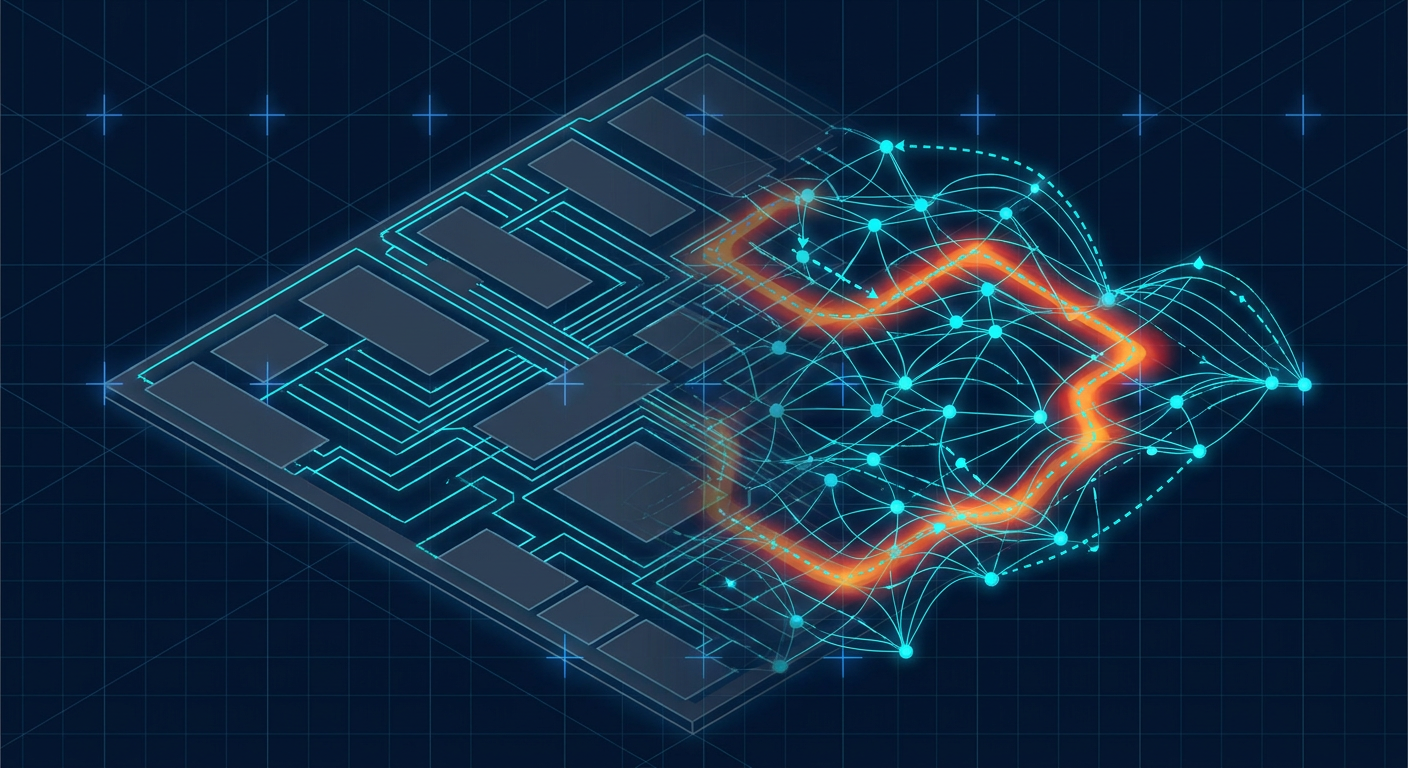
Ricursive Intelligence closed a $300 million Series A at a $4 billion valuation this quarter, bringing its total funding to $335 million in four months. The round, backed by Sequoia, Lightspeed, DST, and NVentures, is an eye-watering sum for an EDA startup. Founders Anna Goldie and Azalia Mirhoseini built AlphaChip at Google, the system that placed macros on multiple generations of Google Tensor Processing Units (TPUs) in hours instead of months.
The size of the check tells you something important about where semiconductor venture capital is going. Venture investors have finally realized that LLM wrappers generating synthesizable Verilog do not solve the actual problem in chip design. RTL syntax generation is a solved, low-value novelty. The real wall in modern silicon development is physical design, timing closure, parasitic extraction, and floorplanning on sub-5nm nodes.
Ricursive is not building another chat interface for writing state machines. They are building neural surrogate solvers and reinforcement learning agents designed to replace analytical placers, simulated annealing engines, and iterative signoff loops.
The Failure Mode of RTL Autocomplete
Over the last three years, the market saw dozens of startups attempt to build the software equivalent of a GitHub Copilot for Verilog. Almost all of them hit the exact same engineering brick wall.
Writing RTL is rarely the critical path of an ASIC project. On a typical 50-person chip design team, maybe eight engineers write front-end logic. The rest work on verification, static timing analysis (STA), DFT insertion, clock tree synthesis, power grid design, and physical implementation.
Large language models trained on open-source code repositories excel at outputting textbook FIFOs, SPI controllers, and AXI4-Lite crossbars. But their utility drops to zero when faced with practical chip design constraints:
- LLMs have no intrinsic concept of physical distance, standard cell area, routing track congestion, or RC parasitic delays.
- A piece of Verilog can be syntactically valid, pass linting, and compile cleanly in Verilator, yet create an unrouteable nightmare during placement or fail setup time by 400 picoseconds at 2.0 GHz.
- LLMs struggle with multi-clock domain crossings (CDC) and structural floorplan awareness. They will happily instantiate 64-bit wide multiplexers that create massive routing congestion hotspots in the middle of a dense execution core.
When front-end engineers write RTL, they write it with a mental model of the physical implementation. They know where data must flow, how wide buses will route across macro boundaries, and where pipeline stages are mandatory to break critical paths. LLMs possess zero spatial or physical intuition. Handing an unconstrained LLM-generated netlist to an ASIC physical design team just produces broken timing runs and unroutable DRC violations.
Silicon teams do not need help typing always @(posedge clk). They need to compress the three-month physical layout loop between netlist signoff and tapeout.
The Mathematics of the Physical Implementation Wall
To understand why Ricursive commanded a $4 billion valuation, you have to look at the mathematics behind traditional place-and-route (P&R) tools like Synopsys IC Compiler II or Cadence Innovus.
Physical design is a collection of NP-hard combinatorial optimization problems governed by strict physical and electromagnetic equations. Macro placement, standard cell placement, and global routing must simultaneously optimize for Total Negative Slack (TNS), Worst Negative Slack (WNS), dynamic power density, IR drop, and Design Rule Checking (DRC) clean routing.
+-------------------------------------------------------------------------+
|                        TRADITIONAL EDA INNER LOOP                       |
|                                                                         |
|  +------------+     +----------------+     +-------------------------+  |
|  | Post-Synth | --> | ePlace/WA LSE  | --> | Trial Global Route      |  |
|  | Netlist    |     | Analytical     |     | (Congestion Estimation) |  |
|  +------------+     +----------------+     +-------------------------+  |
|                            ^                            |               |
|                            |                            v               |
|                     Slow Iteration         +-------------------------+  |
|                     (Hours to Days)        | StarRC / Quantus 3D     |  |
|                            |               | Parasitic Extraction    |  |
|                            |                            |               |
|                            |                            v               |
|                     +---------------+      +-------------------------+  |
|                     | PrimeTime/STA | <--- | Detailed Routing        |  |
|                     | Timing Closure|      | & Legalization          |  |
|                     +---------------+      +-------------------------+  |
+-------------------------------------------------------------------------+

+-------------------------------------------------------------------------+
|                   PHYSICS-INFORMED NEURAL AGENT LOOP                    |
|                                                                         |
|  +------------+     +----------------+     +-------------------------+  |
|  | Post-Synth | --> | Graph Neural   | --> | Neural Surrogate P&R    |  |
|  | Netlist    |     | Netlist Embed  |     | (Zero-Shot Congestion   |  |
|  +------------+     +----------------+     |  & Parasitic Predict)   |  |
|                            ^                            |               |
|                            |                            v               |
|                     Fast Policy Update     +-------------------------+  |
|                     (Seconds)              | RL Optimization Agent   |  |
|                            |               | (Joint Macro, Power Grid|  |
|                            +-------------- |  & Clock Synthesis)     |  |
|                                            +-------------------------+  |
+-------------------------------------------------------------------------+
Analytical Placement and Electrostatic Analogies
Modern placers like ePlace or NTUplace formulate standard cell placement as an electrostatics simulation. Standard cells are treated as charged particles enclosed in a placement region. The wirelength objective is modeled as an attractive force (often using smooth approximations like Log-Sum-Exp or Weighted-Average wirelength models), while cell overlapping is penalized using repulsive electrostatic potential fields governed by Poisson's equation:
$$\nabla^2 \phi(x, y) = -\rho(x, y)$$
Solving this non-linear optimization problem over 50 million instances takes massive compute clusters running for 12 to 36 hours.
The Macro Placement Bottleneck
Analytical placers work reasonably well on uniform standard cells, but they break down on mixed-size layouts containing hundreds of large memory macros (SRAMs, register files, ROMs). Large macros block standard cell placement rows and create routing obstacles across lower metal layers (M1 through M4).
Traditionally, macro placement has relied on simulated annealing or manual human floorplanning. A physical design engineer manually places SRAM blocks around the periphery of a die, sets up power rings, places halo keep-out zones, and runs trial routing. If global routing reveals severe horizontal congestion or a long setup violation across the bus interface, the engineer shifts the macros, recalculates channel spacing, and reruns placement from scratch.
This manual trial-and-error cycle consumes months of engineering time on modern 3nm designs.
The Extraction and STA Bottleneck
Even after placement, you cannot know if your chip meets timing without calculating interconnect parasitics. Wire resistance and capacitance dominate gate delay at advanced nodes.
Getting accurate parasitics requires detailed routing, layer assignment, via insertion, and extracting 3D capacitances (SPEF generation). Full-chip 3D field solvers (like Synopsys StarRC or Cadence Quantus) take hours to run. Static timing analysis engines (PrimeTime or Tempus) then calculate delay over hundreds of process, voltage, and temperature (PVT) corners.
If your placer makes a decision based on an inaccurate wirelength proxy, you find out twelve hours later when signoff STA flags a negative slack violation.
Inside Physics-Informed EDA: AlphaChip, RL-CCD, and C3PO
The founders of Ricursive pioneered the approach that bypasses this iterative bottleneck. Instead of running slow deterministic algorithms or heuristic searches, they formulate chip layout as a reinforcement learning problem over graph-embedded netlists.
Their published pedigree outlines the architectural roadmap Ricursive is now industrializing:
- AlphaChip (Nature 2021): Framed macro placement as a sequential Markov Decision Process. A Graph Neural Network (GNN) encodes the netlist hypergraph, mapping cells, macros, and interconnections into continuous vector embeddings. An RL agent places macros on a coarse grid one by one. The reward function combines wirelength proxies, routing congestion estimators, and density penalties.
- RL-CCD (DAC 2023 Best Paper): Applied reinforcement learning to Concurrent Clock and Data optimization. Rather than treating clock tree synthesis (CTS) as a separate step after placement, the agent modifies clock skews and data path logic simultaneously to expand timing margins.
- Insta (DAC 2025 Best Paper): Introduced instant layout estimation models that predict congestion and wirelength without running global routing.
- C3PO (ASP-DAC 2026 Best Paper): Advanced custom physical layout optimization routines directly targeting fin-pitch and poly-pitch alignment constraints.
How Neural Surrogate Solvers Work
Instead of calling a numerical field solver or running full global routing at every step, a physics-informed EDA system uses neural surrogate models trained on tens of thousands of past placement and routing runs.
Netlist Hypergraph (V, E)
       |
       v
+--------------------------------------------------------+
| Edge-Contracted Graph Neural Network (GNN)             |
| - Node Features: Cell area, pin count, driving strength|
| - Edge Features: Net weight, timing criticality, bus ID|
+--------------------------------------------------------+
       |
       v
Latent Spatial Representation Matrix (Z)
       |
       +------------------------+------------------------+
       |                                                 |
       v                                                 v
+------------------------------+ +------------------------------+
| Parasitic RC Surrogate Model | | Congestion Surrogate Model   |
| Predicts SPEF values         | | Predicts GCell track overflow|
| (Inference: 50 ms)           | | (Inference: 20 ms)           |
+------------------------------+ +------------------------------+
       |                                                 |
       +------------------------+------------------------+
                                |
                                v
                 RL Policy Gradients / Rewards
- Graph Representation: The structural gate-level netlist is represented as a directed hypergraph where gates are nodes and nets are edges. Node features include cell drive strength, capacitance, and logical hierarchy. Edge features include timing constraints and bus membership.
- Surrogate RC Extraction: A convolutional graph network predicts interconnect capacitance and resistance directly from the relative spatial coordinates of the placed instances. Instead of running a 3D field solver for four hours, the surrogate infers parasitics with 95% correlation in 50 milliseconds.
- Congestion Prediction: The system uses 2D fully convolutional networks to predict horizontal and vertical routing track demand per GCell (global routing bin), spotting pin density violations before detailed routing even begins.
- Policy-Driven Optimization: Because the surrogate models are differentiable and fast, the RL agent can explore millions of floorplan variants in hours, learning non-intuitive macro arrangements that human engineers would never attempt (such as clustering SRAMs in the center of the core surrounded by standard logic cells).
On Google TPU v5e and TPU v6, AlphaChip dropped floorplanning timelines from months to single-shift automated runs, cutting total wirelength and improving power consumption over human-tuned layouts.
Why Wrapper AI Fails Against Native Neural Solvers
To understand Ricursive's edge over incumbent solutions, you have to look at how Synopsys DSO.ai and Cadence Cerebrus operate.
DSO.ai and Cerebrus are optimization layers wrapped around legacy C++ engines. They treat the underlying EDA tools as black boxes. They launch hundreds of standard tool runs in parallel on AWS or on-prem clusters, tuning command-line switches, tool options, clock uncertainty margins, and target densities using genetic algorithms or Bayesian optimization.
This approach works, but it is brutally compute-inefficient. If a single P&R run through Cadence Innovus or Synopsys ICC2 takes 14 hours, a Bayesian optimization sweep testing 50 configurations needs massive cluster capacity and days of wall-clock time. The underlying engines are still calculating classical Poisson equations, simulated annealing steps, and standard multi-pass global routes.
Ricursive is replacing the inner loop itself.
By executing placement and congestion estimation inside the latent space of trained neural networks, their platform can evaluate millions of floorplan iterations in the time it takes an incumbent tool to complete a single trial routing pass. Once the neural agent finds an optimal layout state, it feeds the coordinates back into standard signoff tools for final DRC legalization and timing signoff.
This hybrid architecture preserves signoff guarantees while cutting the exploration phase by two orders of magnitude.
Advanced Node Realities: Sub-3nm and Nanosheet Complexity
Developing neural physical design tools for mature nodes (like 28nm or 16nm) is relatively straightforward. The design rules are planar and mostly linear. But Ricursive's real test lies in advanced packaging, Gate-All-Around (GAA) nanosheets, and backside power delivery networks (BSPDN) on TSMC N3, N2, and Intel 18A nodes.
At these dimensions, physical design encounters non-linear physical effects that break naive ML models:
- Pin Accessibility Constraints: On N2 nanosheets, standard cell pin access is heavily constrained. A router cannot drop a via on a pin without violating complex spacing rules with adjacent metal tracks. Placers that optimize purely for wirelength produce layouts that detail routers cannot wire without hundreds of thousands of DRC violations.
- Backside Power Delivery (BSPDN): Separating the power distribution network (PDN) to the back of the wafer and signal routing to the front changes thermal dissipation profiles and IR drop behavior. Floorplanning algorithms must co-optimize power delivery via through-silicon vias (TSVs) alongside standard logic placement.
- Thermal Hotspots: Dense compute clusters on advanced FinFET and GAA nodes experience localized self-heating. If a neural placer clusters high-activity switching logic together to minimize wirelength, it risks creating a thermal runaway hotspot that drops transistor reliability and causes local electromigration failure.
For Ricursive to justify its valuation, its neural surrogate models must encode these thermal, voltage drop, and pin-access constraints directly into the loss function of its placement models. If their system produces floorplans that fail detailed DRC on TSMC N2, teams will be forced back to traditional, slow, deterministic P&R engines.
What This Means for Engineering Teams
The implications for small silicon startups and custom ASIC teams are massive.
Today, the economics of building a custom chip are dictated by engineering headcount. A complex 3nm datacenter SoC requires a physical design team of 30 to 60 specialized engineers working for 18 months, running hundreds of thousands of dollars in EDA license seats per engineer. Tool licenses and physical design salaries routinely consume over 60% of a startup's pre-tapeout capital.
+-------------------------------------------------------------------------+
|                        ESTIMATED ASIC TEAM SIZING                       |
|                                                                         |
| Traditional 3nm Tapeout Workflow (50 Engineers):                        |
| [RTL Logic]        ######## (8)                                         |
| [Verification]     ################ (16)                                |
| [Physical Design]  ######################## (24)                        |
| [Custom Analog]    ## (2)                                               |
|                                                                         |
| Neural-Surrogate Accelerated Workflow (20 Engineers):                   |
| [RTL/Arch Design]  ######## (8)                                         |
| [Verification]     ########## (10)                                      |
| [Physical Design]  ## (2)  <-- Physical implementation compressed       |
+-------------------------------------------------------------------------+
If Ricursive delivers an autonomous physical design pipeline that reliably takes a synthesized netlist and produces a DRC-clean, timing-closed floorplan at signoff quality, the required physical design headcount shrinks drastically. Two engineers managing an autonomous agent could handle the implementation work of an entire physical design department.
This shift also changes how architectural exploration is done. Currently, front-end architects evaluate architectural trade-offs using crude area and timing estimations. By the time a design reaches physical layout, it is too late to make fundamental structural changes without slipping the tapeout schedule by half a year.
With physics-informed neural EDA tools, an RTL designer can run a complete physical placement and parasitic evaluation on every pull request. We built Silicode on the premise that architectural generation must eventually hook directly into accurate physical feedback rather than throwing dead netlists over the wall to an isolated physical design team. True design speed only happens when front-end logic changes are instantly checked against physical wirelength, congestion, and timing reality.
What to Track
If you are running an engineering team or evaluating AI-driven physical design tools over the next twelve months, do not get distracted by vendor benchmark slides showing gross wirelength reductions on trivial ISCAS-89 open-source test circuits. Look at how these models behave under real production stress:
- Detailed Route DRC Violations: Demand to see the raw DRC error count coming out of detailed routing. A placer that reduces HPWL (Half-Perimeter Wirelength) by 15% but leaves 50,000 short-circuit violations is useless.
- Correlation to Signoff STA: Check the correlation curve ($R^2$ value) between the neural model's parasitic predictions and actual signoff SPEF extraction from StarRC or Quantus across multiple PVT corners.
- Generalization Across Foundries: Verify whether the surrogate models require retraining from scratch when moving from a TSMC N5 process to an Intel 18A or Samsung SF2 process with completely different design rule manuals (DRMs).
The era of venture capital pouring millions into shallow LLM wrappers writing trivial Verilog is over. The silicon industry is entering an era of deep, physics-grounded surrogate modeling where machine learning replaces brute-force numerical optimization on actual silicon geometries.
Sources
- https://semiengineering.com/startup-funding-q1-2026/
- https://www.prnewswire.com/news-releases/ricursive-intelligence-raises-300-million-series-a-at-4-billion-valuation-to-accelerate-ai-driven-semiconductor-design-302670061.html
- https://news.crunchbase.com/venture/startup-ai-lab-ricursive-seriesa-unicorn/
- https://www.ricursive.com/
- https://techcrunch.com/2026/02/16/how-ricursive-intelligence-raised-335m-at-a-4b-valuation-in-4-months/
- https://lsvp.com/stories/investing-in-ricursive-intelligence-ai-for-chip-design-and-chip-design-for-ai/