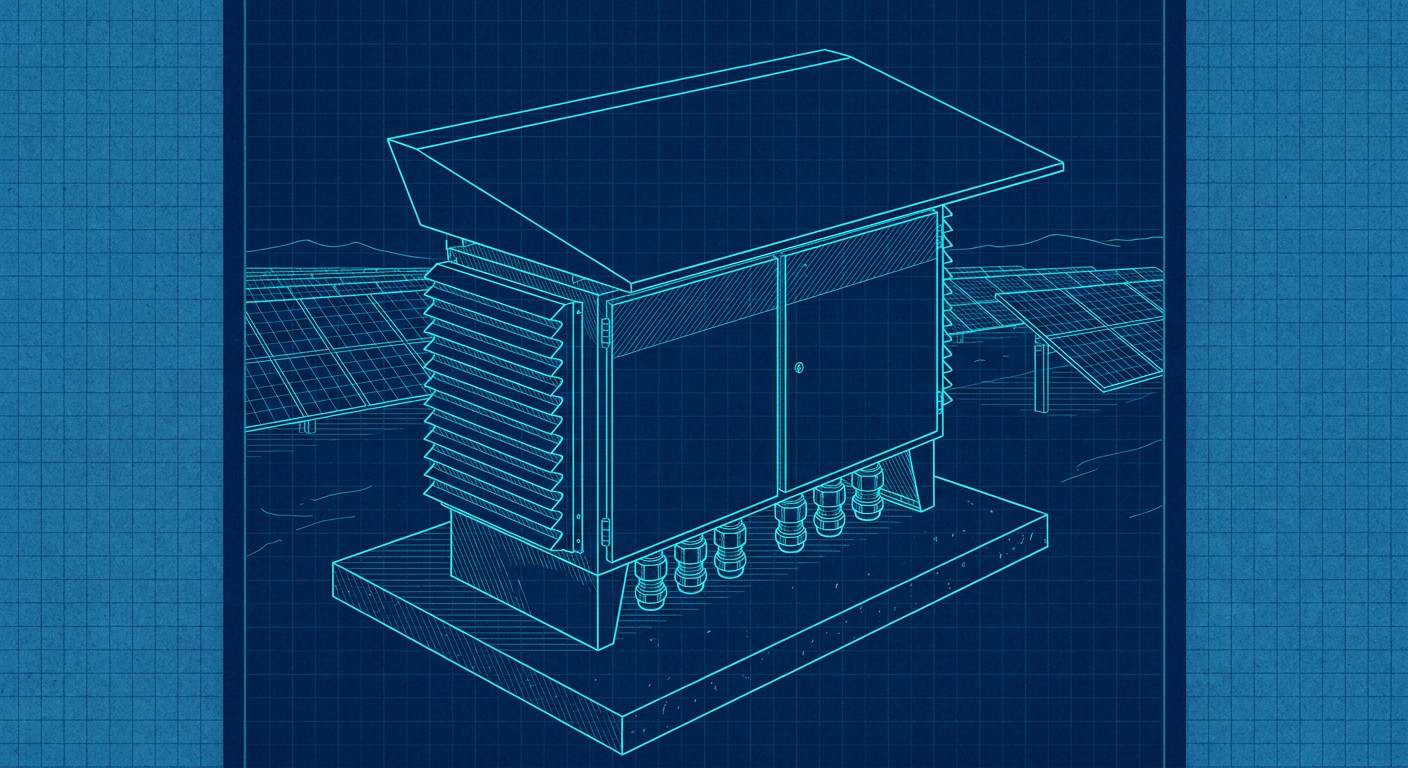
If you drop a standard off-the-shelf control panel into the desert outside Riyadh, Tabuk, or Sweihan, it will usually die within its first summer.
Not because the PLC or Remote Terminal Unit (RTU) processor was cheap, but because the mechanical packaging around it was designed for a factory floor in Central Europe. The mild steel enclosure with standard polyester powder coat chips during transport, gets drilled for an antenna on site, and starts rusting around the cutout within six months. The IP54 louver vents pull in airborne silica that has the consistency of talcum powder. That dust coats the power supply heatsinks, the internal cabinet temperature hits 72°C in July, and the sealed lead-acid backup battery boils dry before the site even reaches commercial operation.
Across the GCC, utility distribution automation programmes and gigawatt-scale solar installations are putting tens of thousands of these outdoor boxes in remote desert fields. These boxes automate pole-top reclosers, collect string-combiner telemetry, run solar tracker motors, and feed SCADA data back to regional control centres.
If you are a robotics engineer, an embedded systems developer, or a plant operations generalist who suddenly owns the bill of materials for these control boxes, you do not need to memorize every line of IEC 61439 or IEEE 1613. You just need to understand the physics of solar loading, fine particulate ingress, and battery thermal decay so your hardware survives unattended for ten years.
The Real Operating Environment: Sun, Silt, and Thermal Stacking
When a site specification says maximum ambient temperature is 50°C, that number only describes the air in the shade. It does not describe what happens when direct solar radiation hits a metal box.
Peak solar irradiance in the Gulf routinely exceeds 1,000 W/m². When direct sunlight strikes an unshielded dark or unfinished metal enclosure, the enclosure skin absorbs that energy and acts like a radiator directed into the cabinet interior. The internal air temperature inside an unventilated outdoor box will easily rise 20°C to 25°C above the ambient air temperature. On a 48°C day with zero wind, the inside of your box can hit 75°C.
Most industrial RTUs, managed Ethernet switches, and DC-DC converters are rated for operation up to 70°C or 85°C. But power supplies and battery chargers derate sharply above 50°C. A 240W DIN-rail power supply rated for 50°C might only deliver 120W at 70°C before tripping on thermal overload.
Then there is the dust. Desert sand is not just coarse grains that fall to the ground when the wind stops. A significant fraction of desert dust consists of fine quartz particulates with grain sizes under 10 micrometres (PM10) and even under 2.5 micrometres (PM2.5). This dust behaves like a fluid. It penetrates conventional mesh filters, coats circuit boards, attracts moisture during high-humidity coastal nights (such as in Dhahran or Dubai), and forms a conductive, corrosive sludge across printed circuit board traces.
Because of this combination, open-loop ventilation using intake fans and exhaust louvers is almost always a failure mode in desert field installations. The filters clog in two weeks, airflow drops to zero, the fan motor burns out, and the cabinet turns into an oven.
Enclosure Materials: Painted Steel vs 304 vs 316L vs GRP
Selecting the right enclosure material is the first and most critical choice on your bill of materials.
Material Comparison for Outdoor Desert Utility RTUs

Material          Corrosion Resistance   Solar Reflection   Impact/Rigidity   Best Application
------------------------------------------------------------------------------------------------------
Painted Steel     Poor (edges rust)      Moderate (light)   High              Indoor substations only
304 Stainless     Moderate (pits fast)   High               High              Inland, non-saline sites
316L Stainless    Exceptional            High               High              Coastal, high-humidity, marine
GRP / Polyester   Exceptional            Moderate           Medium            Small junction boxes, remote RF
Painted Mild Steel
Mild carbon steel with an outdoor polyester powder coating is cheap and easy to source. But it is fundamentally fragile in the desert. The high-velocity wind during sandstorms acts as a continuous sandblaster. It erodes the paint layer on leading edges. Furthermore, field technicians invariably drill extra cable gland holes, puncture the chassis for antenna bulkheads, or scratch the paint during installation. The moment bare steel is exposed to coastal humidity or morning condensation, galvanic corrosion takes hold and creeps under the paint.
304 vs 316L Stainless Steel
Grade 304 stainless steel sounds like a safe default, but it frequently fails in the Gulf region. Much of the renewable and utility infrastructure in the GCC sits within 50 kilometres of the coast, where the air carries high concentrations of airborne chlorides from the sea, or near sabkha plains (salt flats) with corrosive soil chemistry. Chloride ions attack 304 stainless steel, causing localized pitting corrosion and tea-staining that can penetrate thin sheet metal in a couple of seasons.
Grade 316L stainless steel contains 2% to 3% molybdenum and has a lower carbon content than standard 316. This chemical addition dramatically boosts its resistance to chloride pitting and crevice corrosion. If you are building outdoor RTU boxes for utility clients like SEC, DEWA, or Kahramaa, 316L with an electro-polished or brushed finish (typically 240 grit) is the industry standard baseline for metal enclosures.
Glass Reinforced Polyester (GRP)
Glass Reinforced Polyester (also called fiberglass reinforced plastic) is a non-metallic alternative. It does not rust, is immune to salt spray, and does not block radio frequency signals. This makes GRP useful for small pole-top RTUs where you want internal 4G/5G cellular or LoRaWAN antennas without external bulkhead punch-outs.
However, GRP has distinct tradeoffs. It is an insulator, meaning heat generated by internal electronics cannot conduct through the enclosure walls to escape. It also suffers from long-term UV degradation under extreme solar radiation unless specified with heavy UV stabilizers or protective gel coats. For larger power distribution panels or boxes with high internal heat loads, 316L stainless steel remains the superior engineering choice.
Solar Radiation Shields: Solving the Thermal Problem Passively
The most reliable cooling system is one with zero moving parts. Air conditioners and thermoelectric Peltier coolers add maintenance overhead, draw parasitic DC power, and fail when their external heatsinks get choked with sand.
Instead of active refrigeration, desert RTUs rely on passive thermal design, starting with solar radiation shields (often called sunshades or double-skin roofs).
    Direct Solar Radiation (1000+ W/m²)
             ↓↓↓↓↓↓↓↓↓↓↓↓
    ==============================  <- Top Sunshade (2mm 316L)
      ↑ Air Gap (25mm to 50mm) ↑   <- Natural Convection Flow
    ------------------------------  <- Inner Enclosure Roof
    |                            |
    |      Enclosure Body        |
    |                            |
A solar shield is an external sacrificial metal skin mounted on standoffs 25mm to 50mm away from the main enclosure roof, sides, and door.
When direct solar radiation hits the top sunshade, the sunshade absorbs the heat and gets extremely hot. However, because it is separated from the main cabinet by an open air gap, that heat does not conduct into the box. Instead, the air in the gap heats up, expands, and rises, drawing cooler ambient air in from the bottom through natural chimney-effect convection.
Field measurements show that a properly designed three-sided solar shield (top, east-facing door, and west-facing side) reduces the peak internal air temperature of an enclosure by 10°C to 15°C compared to an unshielded bare metal box under the same direct sunlight. That 15°C reduction is often the exact margin that keeps your industrial switch or RTU CPU operating within its standard datasheet limits without needing forced air.
Sealing and Gaskets: Moving to IP66 and Dual Doors
If you cannot run an intake fan with a filter, your enclosure must be completely sealed. In the IEC world, this means IP66 (dust-tight and protected against powerful water jets from heavy washdowns or driving rain). In North American NEMA ratings, this corresponds to NEMA 4X.
Achieving and maintaining an IP66 seal in high-heat desert environments requires close attention to gasket materials and door mechanics.
Gasket Chemistry: EPDM vs Foamed Silicone
Most standard industrial enclosures use continuous polyurethane (PUR) foam-in-place gaskets. Polyurethane gaskets work well in temperate climates, but continuous exposure to temperatures above 60°C combined with high UV levels causes polyurethane to suffer from compression set. Over two or three years, the gasket loses its elasticity, becomes brittle, stays permanently flat, and allows fine silt to blow past the seal.
For desert utility panels, specify foamed silicone gaskets or extruded EPDM (ethylene propylene diene monomer). Foamed silicone maintains its mechanical memory and sealing capability from -40°C all the way to 150°C and does not degrade under intense UV radiation.
The Dual-Door Architecture
For critical distribution automation RTUs and solar substation marshalling kiosks, utilities often specify a dual-door design:
- Outer Door: A heavy mechanical door with a three-point latching mechanism and solar shield. It takes the mechanical abuse, stops wind-blown sand, and provides the first layer of thermal shading.
- Inner Door / Dead-Front: A secondary hinged door behind the outer door. It contains the HMI, status LEDs, display screens, and test points.
This setup allows maintenance crews to open the outer door to check visual status indicators or plug in a field laptop without exposing the core RTU processor, power terminal blocks, and sensitive DC bus wiring to a raging sandstorm.
Cable Penetration and Bottom Entry
Never bring conduits or cables into the top or sides of an outdoor enclosure. Every penetration on a horizontal or vertical face creates a ledge where standing water and dust can collect, eventually compromising the gland seal.
All cable penetrations must enter through a removable gland plate on the bottom face of the enclosure. Use nickel-plated brass or 316L stainless steel cable glands with integrated neoprene or silicone sealing rings. When using plastic glands, specify UV-stabilized polyamide 6 with an IP68 rating.
Good vs Bad Cable Entry Practice

BAD: Top / Side Penetrations        GOOD: Bottom-Only Penetration

     [=== Enclosure ===]                 [=== Enclosure ===]
     |                 |                 |                 |
->-- Gland on side     |                 |                 |
     |                 |                 |                 |
     -------------------                 --------[=]--------
                                                  ↑
                                           Glands on bottom
                                           with drip loops
Every cable entering from the trench should have a drip loop below the gland plate. This ensures that water condensing on the cable jacket runs down away from the box rather than tracking directly into the gland threads.
The Battery Problem: Keeping Telemetry Alive Without Boiling Cells
Utility RTUs must stay powered during grid outages. An RTU controlling an automated medium-voltage recloser or a motorized switch disconnector needs to communicate fault conditions back to SCADA even when the local 11°kV or 33°kV feeder is completely dead.
Most utility specifications demand between 8 and 24 hours of autonomous battery backup. How you store those amp-hours in a hot cabinet determines whether your site operates reliably or generates endless maintenance tickets.
The Failure of Standard VRLA / Lead-Acid
Standard Valve Regulated Lead-Acid (VRLA) or AGM batteries are chemical devices optimized for 20°C to 25°C. Their chemical aging rate follows the Arrhenius equation: for every 10°C permanent rise in operating temperature above 25°C, battery service life is cut in half.
VRLA Battery Lifetime vs Operating Temperature

Operating Temperature    Expected Life (10-Year Design)
--------------------------------------------------------
25°C                     10 years
35°C                     5 years
45°C                     2.5 years
55°C                     1.25 years
Inside a desert control box where temperatures hover at 45°C to 55°C for five months of the year, a premium 10-year VRLA battery will swell, vent acid vapour, and fail in under 18 months. When the battery vents, the released acid vapours corrode the copper busbars, terminal screws, and nearby electronics inside the sealed enclosure.
Modern Alternatives: LiFePO4 and High-Temp NiCd
Two main chemistries solve this problem for outdoor desert RTUs:
- Lithium Iron Phosphate (LiFePO4): LiFePO4 chemistry handles elevated temperatures much better than standard lead-acid or nickel-manganese-cobalt (NMC) lithium cells. They tolerate continuous operating temperatures up to 55°C or 60°C without runaway risks, offer 3,000 to 5,000 charge cycles, and occupy a third of the physical footprint of an equivalent lead-acid pack.
- High-Temperature Sintered/Pocket-Plate NiCd: Nickel-Cadmium remains popular with traditional power utilities across the Gulf because of its indestructible mechanical and electrochemical nature. NiCd cells can sit at 50°C for years without catastrophic capacity loss and do not suffer sudden thermal runaway. However, they are heavy, bulky, and expensive.
Remote Battery Telemetry
Whichever chemistry you choose, blind battery backup is a major operational risk. If a battery fails silently, you only find out when a grid fault happens and the RTU drops offline instead of reporting the trip.
Modern desert RTU designs pair the DC backup system with an intelligent power supply or smart Battery Management System (BMS) communicating over Modbus RTU or Modbus TCP. The RTU continuously reads back:
- Real-time cell temperatures
- Individual string voltages
- Charge/discharge current
- Internal cell resistance / impedance trends
- State of Charge (SoC) and State of Health (SoH)
If the internal battery temperature crosses 50°C, the BMS can automatically throttle back the float charge voltage or notify the SCADA master to dispatch a service inspection before the pack degrades irreversibly.
Internal Layout and Wiring Rules for Non-Specialists
When arranging components on the interior DIN rails and backplate, thermal physics and mechanical stability dictate component placement.
Recommended Interior Panel Layout

+-------------------------------------------------------------+
|  [ Passive Heat Exchanger / Roof Vent Plate ]               |
|                                                             |
|  TOP LEVEL (Heat Sources):                                  |
|  [ 24V DC Power Supply ]   [ Solar Charger / BMS ]          |
|                                                             |
|  MIDDLE LEVEL (Core Electronics):                           |
|  [ Utility RTU / CPU ]     [ Managed Switch ]  [ DI/DO ]    |
|                                                             |
|  LOWER LEVEL (Sensitive Components & Isolation):            |
|  [ LiFePO4 Battery Pack ]  [ Surge Protection Devices (SPD)]|
|                                                             |
|  BOTTOM (Field Termination):                                |
|  [ Spring-Cage Terminal Blocks - Clean Separation ]         |
+-------------------------------------------------------------+
1. Thermal Stacking Rules
Heat rises. Never place sensitive RTU processing units, cellular modems, or analog measurement modules directly above heat generators like AC/DC power supplies, interposing relays, or solar charge controllers.
Mount power supplies and chargers near the top of the enclosure (or in a thermally partitioned side compartment) so their dissipated heat rises directly into the top roof plate and escapes through the air gap under the solar shield without washing over the rest of the control gear. Keep the RTU processor and I/O modules in the middle or lower third of the cabinet where internal air temperatures are lowest.
2. Ditch Screw Terminals for Spring-Cage Connections
In the desert, diurnal temperature swings can be extreme. A clear desert sky can see ground temperatures swing from 50°C at 2:00 PM down to 18°C at 4:00 AM.
This 30°C+ daily thermal cycling causes continuous expansion and contraction of copper wire and metal terminal clamps. Traditional screw-clamp terminal blocks inevitably loosen over time under thermal cycling and wind vibration, leading to high-resistance joints, localized arcing, and intermittent field faults.
Use push-in or tension-clamp spring-cage terminal blocks (such as those from Phoenix Contact, WAGO, or Weidmüller). The constant spring force dynamically compensates for the thermal expansion and contraction of the copper conductor, maintaining a gas-tight electrical connection over decades.
3. Dedicated Surge Protection (SPD)
Desert utility sites are prime targets for lightning strikes and switching surges because distribution lines run for tens of kilometres across wide open terrain.
Every line crossing the enclosure boundary must pass through dedicated Type 1 and Type 2 Surge Protective Devices (SPDs):
- AC supply feeds need high-energy varistor/spark-gap SPDs.
- 24V or 48V DC power buses need discrete DC surge suppressors.
- Outdoor RS-485 serial lines, current transformer (CT) inputs, and Ethernet runs coming from outdoor trackers or weather sensors must pass through DIN-rail data-line surge suppressors grounded directly to a low-impedance copper earth busbar.
When laying out wiring inside the box, tools like LabCD can help synthesize panel schematics, calculate total heat dissipation from selected components, and verify that wire gauges and fuse ratings match expected utility fault limits before sheet metal is cut.
Practical Checklist for Your Next Panel Build
When you review your next engineering package or factory acceptance test (FAT) documentation for desert-bound RTU enclosures, verify these specific details:
- Enclosure metal: Is it explicitly 316L stainless steel with continuous seam welds, rather than painted carbon steel or 304?
- Solar shading: Are top and door solar radiation shields included on the mechanical drawings with a minimum 25mm standoff?
- Gasket material: Is the door seal foamed silicone or UV-stable EPDM, with test data for continuous operation above 70°C?
- Sealing integrity: Is the cabinet rated IP66/NEMA 4X without open ventilation slots or louvers?
- Penetration plane: Are all cable entries restricted to the bottom gland plate, using rated stainless or nickel-plated glands with drip loops?
- Battery chemistry: Have you eliminated standard lead-acid in favour of high-temp LiFePO4 or NiCd, paired with an intelligent BMS reporting health over Modbus?
- Termination style: Are all field and internal control wiring terminated using spring-clamp or push-in DIN rail terminals?
- Thermal zoning: Is the RTU processor mounted below the heat-producing power supplies rather than above them?
Catching these design choices on paper during the submittal phase costs nothing. Fixing a corroded box with boiled batteries in the middle of a 500-megawatt desert solar array in the middle of August costs a small fortune.
Sources
- MarketsandMarkets: GCC Countries Distribution Automation Market (2025-2030) https://www.marketsandmarkets.com/Market-Reports/geography/distribution-automation-market/GCC-Countries
- Baker Institute: Gulf Energy Transition Through Renewable Energy Development https://www.bakerinstitute.org/research/gulf-energy-transition-through-renewable-energy-development
- EPRI: Distribution Automation Assets Project Overview https://distribution.epri.com/automation/public/overview/
- Eaton: Distribution Automation Fundamentals https://www.eaton.com/us/en-us/products/utility-grid-solutions/grid-automation-system-solutions/distribution-automation-fundamentals.html
- RatedPower: Utility-Scale Solar Plants in Desert Climates https://ratedpower.com/blog/solar-plants-desert/