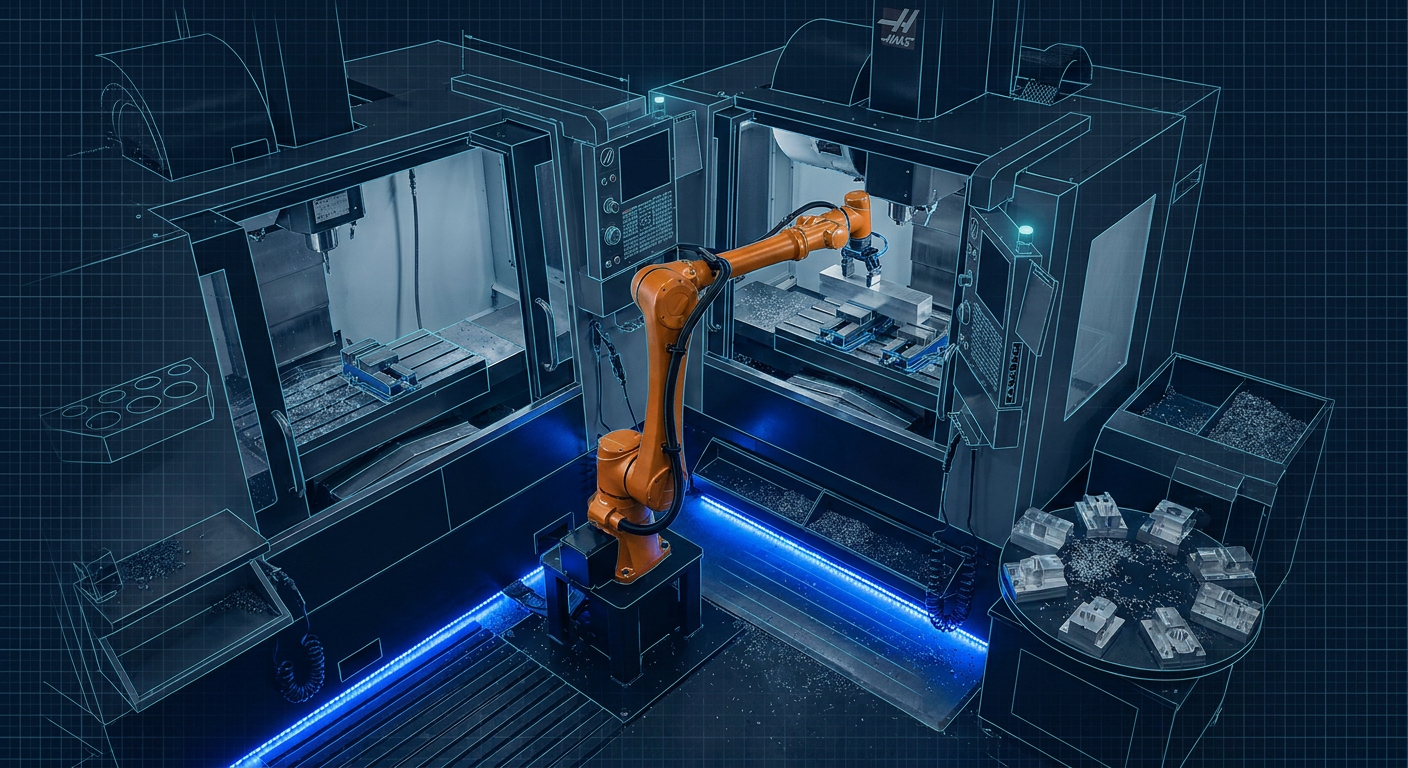
A three-axis vertical machining center sitting in an industrial estate in Dammam, Dubai Industrial City, or south Riyadh costs roughly the same to purchase as it does anywhere else in the world. A standard Haas VF-2 or a Mazak VC-500 will run between $75,000 and $130,000 depending on spindle speed, through-spindle coolant options, and tool capacity.
Where the economics diverge sharply is in how that spindle gets fed.
For the past two decades, machine shops across the Gulf Cooperation Council (GCC) solved spindle utilization through inexpensive, multi-shift imported labor. A shop owner running oilfield flanges, pump impellers, or structural bracketry could keep a spindle turning 16 hours a day by staffing two shifts of machine operators at monthly base wages between 2,500 and 4,500 AED or SAR.
That calculation is breaking down. Visa quotas, rising regulatory fees, mandatory insurance increases, Saudization and Emiratization targets, and the cost of skilled machinists who can actually set up a job rather than just hit green buttons have changed the balance sheet.
At the same time, local manufacturing mandates under Saudi Vision 2030 and the UAE Operation 300bn require higher dimensional consistency, tighter quality audits, and verifiable lot traceability. That pushes shops away from casual part-swappers toward repeatable automation.
When a machine shop decides to automate an existing spindle rather than buy a dedicated turn-key automation cell from an OEM, what does the bill of materials actually look like, and when does it turn cash-positive?
The Real CapEx Bill of Materials for a CNC Tending Retrofit
Many machine shop owners see a $35,000 price tag on a 10 kg collaborative robot arm and assume they can automate a mill for under $45,000. In practice, the arm represents less than half of the total hardware, software, and mechanical integration cost.
A reliable retrofit on a three-axis or five-axis vertical machining center requires five distinct physical subsystems: the robotic manipulator, end-of-arm tooling, automated door actuation, workholding with pneumatic or hydraulic clamping, and the electrical handshake interface to the CNC controller.
+-----------------------------------------------------------------------+
| Component / Subsystem               | Realistic Hardware Cost (USD)   |
+-------------------------------------+---------------------------------+
| 10kg-12kg 6-Axis Cobot Arm          | $34,000 - $42,000               |
| Dual Pneumatic Parallel Gripper Kit | $4,500 - $7,200                 |
| Machine Auto-Door Pneumatic Actuator| $2,800 - $4,500                 |
| Pneumatic Zero-Point Vise & Chuck   | $6,500 - $9,500                 |
| Solenoid Manifolds, Air Prep & Regs | $1,200 - $1,800                 |
| Relay Board / CNC M-Code I/O Module | $1,500 - $3,000                 |
| Rotary Part Carousel / Grid Tray    | $3,000 - $6,500                 |
| Custom Base Pedestal & Anchoring    | $1,500 - $2,500                 |
| Floor Scanners / Safety Interlocks  | $2,200 - $3,800                 |
| On-Site Integration & Local Wiring  | $6,000 - $10,000                |
+-------------------------------------+---------------------------------+
| TOTAL RETROFIT CAPEX                | $63,200 - $90,800               |
+-------------------------------------+---------------------------------+
If you cut corners on this list, the cell fails in production. Skipping the dual-gripper setup forces the robot to make two full trips per cycle, one to remove the finished part and place it in the tray, and a second to pick up raw stock and load it. That doubles the door-open dead time from 14 seconds to 28 seconds. On a four-minute cycle run across 120 parts a day, that dead time eats nearly half an hour of cut time.
Mechanical and Pneumatic Integration Bottlenecks
Connecting a robot arm to a machine tool is mostly mechanical and pneumatic problem-solving, not software programming. Writing the motion script for a cobot to move between three waypoints takes an afternoon. Getting the vise to clear chips reliably without human intervention takes three weeks.
1. Workholding and Chip Evacuation
A manual Kurt vise with a lead screw cannot be automated reliably with an external torque wrench on a robot wrist. You must install a pneumatic or hydraulic power vise, or ideally, a zero-point base plate (such as a Lang Quick-Point, Schunk Vero-S, or 5th Axis pneumatic chuck) mounted directly to the T-slot table.
The real failure point here is chip accumulation on the locating surfaces. When an operator runs a cycle, they use a hand-held compressed air nozzle to blast chips off the vise jaws and locating pins before loading the next billet. A robot cannot feel a 0.5 mm aluminum chip sitting on the datum face. If the billet sits on top of that chip, the part gets machined out of parallel, failing inspection.
To automate this, your retrofit needs two dedicated pneumatic blow-off circuits:
- A high-volume air nozzle mounted to the end-of-arm tooling, programmed to sweep the vise jaws at 6 bar pressure while the door is open.
- A pneumatic seat-check sensor built into the vise base. This uses a low-pressure back-pressure circuit. When the raw billet sits completely flat against the ground datum faces, it seals small air orifices. The resulting pressure spike trips an input signal confirming the part is seated within 0.02 mm. If the pressure switch does not trip, the CNC halts the cycle before the tool plunges into a crooked part.
2. Door Actuation
Opening and closing heavy CNC sheet metal doors destroys cobot joints if the robot arm pulls the door manually. You need an automated door cylinder.
A rodless pneumatic cylinder or a belt-driven electric actuator mounted to the top of the machine frame handles the stroke. The actuator requires independent end-of-travel reed switches wired back to the machine PLC to ensure the robot never enters the envelope while the door is mid-stroke, and to ensure the spindle never starts while the door is open.
3. The Controller Handshake
Older CNC controls (like a Haas Coldfire machine or a Fanuc 18i-MB) do not have native fieldbus support for Ethernet/IP or Profinet communication with modern robot controllers.
You cannot simply plug in an RJ45 cable and start trading register data. You must hardwire 24V DC discrete signals through an auxiliary I/O board or spare M-code relays.
The minimum signal handshake requires six discrete lines:
- CNC to Robot: Cycle Complete (Spindle stopped, coolant off, table at load position).
- CNC to Robot: Door Fully Open.
- CNC to Robot: Machine Alarm / Emergency Stop Active.
- Robot to CNC: Robot Clear of Machine Envelope.
- Robot to CNC: Part Clamped / Door Close Command.
- Robot to CNC: Cycle Start (External Start).
If your machine control does not have spare user-configurable M-codes (such as M21/M22 for external device trigger), you have to install an expansion I/O card. On older Fanuc controls, this means locating spare relays on the I/O module and editing the ladder logic, which requires a specialist technician and adds $2,500 to $4,000 in programming fees.
The Labor Economics: Gulf Shop Floor Numbers
To calculate real payback, we have to look at actual labor costs across the GCC rather than western European or North American baseline numbers.
In Riyadh or Dubai, an entry-level machine operator's monthly take-home salary might be 3,500 SAR ($933 USD). But the fully burdened employer cost is significantly higher. Once you account for the Iqama/visa fees, annual municipal levies, mandatory health insurance, flight allowances, shared accommodation, transport, and end-of-service accruals, the true cost of an operator to the company ranges between 5,800 and 7,500 SAR per month ($1,546 to $2,000 USD).
+-----------------------------------------------------------------------+
| Fully Burdened Monthly Cost per Operator (GCC) | Amount (USD)         |
+------------------------------------------------+----------------------+
| Base Salary                                    | $950                 |
| Iqama / Visa & Government Levies (amortized)   | $320                 |
| Mandatory Health Insurance                     | $110                 |
| Housing & Transport Allowance                  | $350                 |
| Annual Flight Ticket & End of Service Accrual  | $130                 |
+------------------------------------------------+----------------------+
| TOTAL BURDENED MONTHLY COST                    | $1,860 per operator  |
+------------------------------------------------+----------------------+
If you run two shifts per day, that single CNC machine costs $3,720 per month ($44,640 per year) just in loading labor.
However, the labor cost reduction is only half the equation. The bigger financial lever is machine utilization.
In a standard manual-load job shop in Al Quoz or Dammam Industrial Area 2, an operator running a 5-minute cycle rarely achieves more than 60% spindle uptime across an 8-hour shift. Operators take breaks, wait for quality sign-offs, step away to deburr parts, or get distracted. The spindle sits idle for an average of 18 to 22 minutes every two hours.
With a stable tending cell and a 20-slot rotary carousel, the machine runs continuously through shift handovers, lunch breaks, and for two to three hours of unattended dark time after the evening shift leaves.
Spindle utilization routinely jumps from 58% to 84%.
Manual Operation (2 Shifts, 16 Total Hours Available):
- Active cutting time: 16 hours x 58% utilization = 9.28 spindle hours/day
- Output on 6-minute cycle part: 92 parts/day

Automated Retrofit (1 Supervised Shift + 6 Hours Unattended = 14 Hours Total):
- Active cutting time: 14 hours x 84% utilization = 11.76 spindle hours/day
- Output on 6-minute cycle part: 117 parts/day
You get 27% more finished parts per day out of the exact same machine tool while cutting direct operator headcount on that machine from two operators to a single technician who sets up tooling and inspects parts.
The Payback Schedule
Let us run the numbers on a real-world scenario: a 40-person production shop in Dammam machining 4140 steel hydraulic valve bodies on a Mazak vertical mill.
- Total Retrofit Capital Expenditure: $74,000 (Cobot, Schunk dual gripper, pneumatic vise, auto-door kit, discrete I/O integration, safety scanner, custom part carousel).
- Direct Labor Savings: 1 operator eliminated across two shifts (the remaining operator manages tooling, programming, and quality for four automated cells). Monthly savings: $1,860.
- Revenue Gain from Extra Spindle Hours: 2.48 additional cutting hours per day x $45/hour machine shop rate x 25 working days per month = $2,790 per month.
- Scrap Reduction: Dimensional reject rate drops from 3.2% to 0.4% due to consistent pneumatic clamping torque and clean locating faces. Estimated savings on material and wasted cycle time: $650 per month.
- Additional Operating Costs: Pneumatic air consumption, electricity, gripper seal maintenance, consumable robot fingers: -$250 per month.
Net Monthly Financial Improvement:
$1,860 (Labor) + $2,790 (Capacity) + $650 (Scrap) - $250 (Opex) = $5,050 / month

Payback Period:
$74,000 Total CapEx / $5,050 Net Monthly Gain = 14.65 Months
Under 15 months to break even on an existing asset is an attractive internal rate of return. After month 15, that machine generates an additional $60,000 in net cash flow every year of its operating life.
Cumulative Cash Flow on a $74,000 CNC Tending Retrofit (USD)

 Month | Net Outlay / Cash Position
-------+---------------------------
   0   | -$74,000  [Initial Hardware + Integration]
   3   | -$58,850  [Ramping up cycle stability]
   6   | -$43,700
   9   | -$28,550
  12   | -$13,400
  15   |  +$1,750  [Payback achieved]
  18   | +$16,900
  24   | +$47,200
  36   | +$107,800
High-Mix, Low-Volume Realities
The math above assumes you are running batches of at least 300 to 1,000 parts. What happens if your shop is purely high-mix, low-volume, with batch sizes between 20 and 80 parts?
This is where many Gulf retrofits stall. If a mechanical engineer or shop programmer spends three hours teaching robot waypoints and machining custom gripper fingers for a run of 30 parts, the programming overhead destroys the labor savings.
To make automation viable on low batch sizes, you have to standardize your tooling envelope:
Standardize Raw Stock Footprints: Instead of cutting aluminum bar stock to 30 different dimensions, standardize on three outer profile sizes (e.g., 50mm, 75mm, 100mm round or square). Machine the internal features and profile, and hold the parts using stepped, modular gripper fingers that fit all three profiles without mechanical changeover.
Parametric Robot Programs: Do not hand-teach waypoints for every new part. Use a parametric palletizing script where the operator enters only three numbers on the teach pendant: part diameter, part height, and tray pitch. The robot calculates its pick-and-place trajectories mathematically.
Kinematic and Fixture Validation: Before cutting soft jaws, shops use tools like Mexaio AI to verify kinematic clearances inside tight machine enclosures, checking gripper reach against tool changers and sheet metal brackets before committing metal to the table.
Zero-Point Quick-Change Jaws: Use master jaw sets with snap-in inserts. Changing the vise from holding 25mm rod to 80mm plate should take two minutes with an Allen key, not half an hour of dial-indicator alignment.
What to Inspect Before Signing a Purchase Order
If you are auditing your shop floor in Riyadh, Abu Dhabi, or Sharjah to pick candidate machines for a tending retrofit, do not start with your newest, most complex multi-axis mill. Start with a reliable three-axis workhorse running consistent batch work.
Walk out to the machine and check these four physical requirements before talking to an automation integrator:
Clean, Dry Air Supply: A pneumatic tending cell running continuous blow-off and rapid jaw clamping requires dry air at 6.5 bar minimum. Gulf summers push ambient temperatures above 45°C with high coastal humidity. If your compressor setup does not have a properly sized refrigerated air dryer and coalescing oil filters, moisture will enter the solenoid manifolds and freeze up the robot's gripper valves within three months.
Spindle Tool Clearance at Part Load: Measure the clearance between the spindle nose (at its maximum Z-axis home position) and the top of the pneumatic vise. Ensure your cobot wrist and dual gripper can swing a raw billet into the vise without coming within 50 mm of the longest tool in the carousel.
Programmable Coolant or Air Blast: If your machine only has manual flexible coolant nozzles aimed by hand, the robot will load parts into a puddle of stagnant chips. You need programmable coolant nozzles or a dedicated through-spindle air blow feature to clear the table before the robot approaches.
Machine Safety Circuit Compatibility: Ensure your CNC electrical cabinet has dual-channel emergency stop inputs that can interface directly with the robot safety controller (Category 3, PLd compliance). If hitting an E-stop on the robot does not instantly halt the machine spindle and axis drives, the installation will fail local civil defense and industrial safety audits.
Spindle automation is no longer a luxury reserved for European automotive plants. For machine shops across the Gulf building out domestic manufacturing capabilities, retrofitting existing CNC mills with standard 6-axis cobots and pneumatic workholding is the fastest, lowest-risk capital investment to double shop-floor capacity without doubling headcount.
Sources
- https://www.weforum.org/stories/all/how-industry-4-0-is-transforming-the-gulf-s-manufacturing-sector/
- https://tuliptechs.com/how-robotics-is-transforming-manufacturing-in-the-gcc-region/
- https://www.kenresearch.com/gcc-ai-powered-smart-manufacturing-robotics-market
- https://www.automationwithinreach.com/blog/cnc-machine-tending-small-vs-large-shops
- https://atanrobotics.com/blog-posts/how-much-does-a-cnc-machine-tending-robot-cost-pricing-guide
- https://trener.ai/blog/business-case-for-automation-in-cnc-machine-shops
- https://www.linkedin.com/posts/bernardmartin_retrofitting-cnc-automation-without-replacing-activity-7490497926318866432-bz3i
- https://www.linkedin.com/posts/sohail-tariq-phd_estimated-number-of-manufacturing-companies-activity-7376980204017156096-79A2