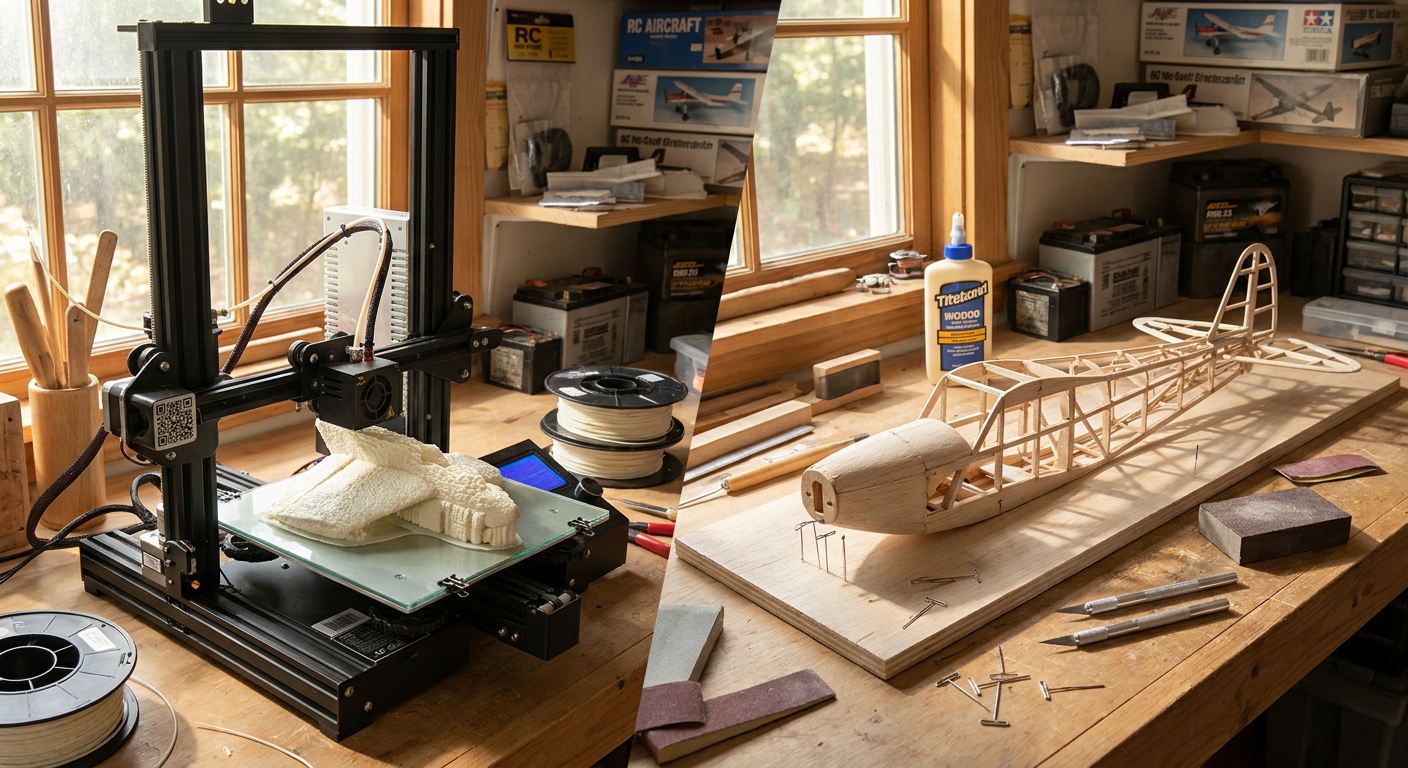
A mate at our field left his brand-new 3D printed flying wing on the back parcel shelf of his estate car for two hours while we stopped for breakfast last July. The car windows were up. The outside air was barely 28 degrees Celsius, but inside the glass it felt like a pizza oven. When we opened the boot, the trailing edge had drooped by twenty degrees and the battery bay had turned into an oval. The airframe had never even seen its maiden flight.
That same morning, three guys pulled forty-year-old balsa trainers out of their boots. The covering film had a few wrinkles you could fix in ten seconds with a travel iron, but the wing spars were dead straight.
Every flying club in the country is having this exact argument right now. On one side, you have the guys running Bambu Lab and Prusa machines around the clock, printing slick scale warbirds and sleek flying wings out of active-foaming LW-PLA. On the other side are the balsa purists who insist that nothing beats laser-cut contest balsa, spruce stringers, and a roll of iron-on film. Both sides claim their way is lighter, cheaper, and faster to get into the air.
Having built and crashed plenty of both over the last four seasons, the reality is a lot messier than what you see on social media.
The Magic and Misery of Foaming Filament
Standard PLA is useless for serious RC aircraft. If you print a standard 1.2-metre wingspan model using regular PLA filament with a 0.4mm nozzle, the finished airframe ends up weighing between 1.2 and 1.6 kilograms before you even install a motor, servos, or a flight pack. The wing loading climbs so high that the plane flies like a flying brick, requiring high-speed landing runs and snapping into a stall the moment you pull back hard on the elevator.
Active foaming LW-PLA, which started gaining traction with ColorFabb and later PolyLite and eSun, changed the equation completely. These filaments contain a chemical blowing agent that activates inside the hotend once the nozzle temperature passes roughly 215 degrees Celsius. As the filament pushes through the nozzle at 230 to 250 degrees, it expands inside the melt zone to roughly twice its original volume.
To compensate, you drop your slicer extrusion multiplier (flow rate) down to somewhere between 45% and 55%. The resulting plastic is full of microscopic gas bubbles, cutting the printed part mass by nearly half while maintaining the same outer wall thickness. A single-wall perimeter print suddenly drops from standard PLA density down to around 0.55 or 0.6 grams per cubic centimetre.
That puts printed plastic right into the ballpark of a traditional wood build. You can slice a four-foot wing into four sections, click print, and walk away. When you come back twenty hours later, you have hollow, stiff, perfectly curved aerofoil sections with built-in internal ribs and servo lead channels already formed.
However, getting consistent foaming requires continuous tuning. If your room temperature shifts or your filament absorbs a tiny bit of ambient moisture, the foaming ratio wanders. Too cold, and the plastic does not expand enough, leaving pinholes and weak layer bonding. Too hot, and the plastic oozes endlessly during travel moves, leaving hairy cobwebs inside every hollow wing cavity that add dead weight and catch on your servo linkages.
What the Scale Actually Says
There is a stubborn myth on the forums that LW-PLA makes planes lighter than balsa. It does not.
Contest-grade balsa wood typically sits at a density between 0.10 and 0.16 grams per cubic centimetre. Even medium-density balsa from your local hobby shop rarely exceeds 0.20 grams per cubic centimetre. Even with active foaming running at full expansion, LW-PLA sits around 0.50 to 0.60 grams per cubic centimetre. Wood is fundamentally three to four times lighter than the foamed plastic.
Why do printed planes manage to stay competitive at all? Because a 3D printer can lay down an unbroken skin that is exactly 0.4mm thick with hollow geometric internal webbing, whereas a balsa plane needs ribs, spars, sheer webs, leading-edge sheeting, trailing-edge stock, and plastic covering film.
When you total up an entire 1000mm wingspan park flyer airframe, the numbers usually shake out like this:
- Classic laser-cut balsa kit (built-up, covered in iron-on film): 280 to 360 grams empty airframe weight.
- Active foaming LW-PLA print (single wall, 0.4mm nozzle, carbon joiner spars): 380 to 490 grams empty airframe weight.
- Moulded EPO foamie (standard commercial foam airframe): 320 to 420 grams empty airframe weight.
The balsa build wins on mass almost every time, especially at the wingtips where weight matters most for roll response and tip-stall recovery. A printed wing carries more mass distributed across its outer shell. In steady cruising flight, you might not feel it. But when you pull a tight turn at the bottom of a loop or try to float through a three-point deadstick landing, the printed plane drops its wing noticeably faster than the balsa equivalent.
Active Bench Time vs Passive Machine Time
Where 3D printing destroys wood construction is active labour.
Building a traditional 40-inch laser-cut balsa kit (like an old Sig Kadet, an alien aircraft kit, or a modern Stevens Aero pack) is a genuine craft project. You clear your building board, lay down wax paper over the rolled-out paper plans, stick in your T-pins, mix five-minute epoxy for the dihedral braces, sand the leading edges to shape with an aluminium sanding bar, and spend four hours ironing on film covering without shrinking holes through the open bays. If you are experienced, you might finish an airframe in twenty to thirty hours of hands-on bench time over three weeks.
With a printed plane from designers like Eclipson, 3DLabPrint, or PlanePrint, your hands-on time is maybe two hours total.
You spend twenty minutes loading the STL files into your slicer, confirming your bed levelling, and setting your temperature and flow multipliers. The printer runs for forty to sixty hours unattended. Once the parts are pulled off the magnetic PEI sheet, assembly consists of sliding a 6mm carbon tube through the pre-printed spar pockets, applying a thin bead of medium cyanoacrylate (CA glue) along the interlocking tongue-and-groove joints, hitting it with an aerosol kicker spray, and clicking your micro servos into pre-sized pockets.
For a lot of club members with full-time jobs and young kids, that difference is the entire game. If you only have forty-five minutes of free time on a Tuesday evening, you cannot realistically set up a balsa glueing jig, mix resin, and sand a fuselage. But you can easily clear finished wing panels off a print bed, glue three sections together, and start the slicer on the tail group.
The Heat Trap
If you fly anywhere that gets warm during the summer, the material physics of polylactic acid will catch up with you sooner or later.
Standard PLA begins to soften at its glass transition temperature, which sits around 55 to 60 degrees Celsius. LW-PLA tends to deform even earlier because the internal foam structure provides less structural mass to resist mechanical tension. When a thin 0.4mm single-wall print sits under sun exposure, the dark pigments (or even unpainted natural beige filament) absorb thermal energy rapidly.
A model sitting on green grass in 32-degree ambient heat under direct sunlight can reach a skin temperature of 60 degrees Celsius within twenty minutes. The first thing that happens is the control surfaces warp. Ailerons develop a twist because the hinge lines are held under slight tension by the servo pushrods. Next, thin wing skins between the internal structural ribs develop hollow sags, permanently ruining your aerofoil profile.
Balsa does not care about heat. Wood can sit in a closed car boot in the middle of an August heatwave in Arizona or Dubai and emerge mechanically unchanged. The iron-on film might wrinkle if the wood beneath it breathes out some trapped moisture, but five minutes with a heat gun or a hobby iron shrinks it back to drum-tight perfection.
Some makers attempt to print planes in PETG or ASA to beat the heat. PETG is too dense and flexes excessively for thin-wall aerofoils, making wings flutter violently at high throttle. High-temperature foaming filaments like LW-ASA exist and handle temperatures past 95 degrees Celsius without blinking, but they are expensive, require heated enclosures to avoid massive layer splitting, and smell awful while printing. For standard everyday printing at home, LW-PLA remains the primary lightweight option, along with its summer heat risks.
What Happens When You Plant the Nose
No matter how good a pilot you are, you will eventually stall on final approach, clip a fence post, or lose orientation during an overcast afternoon. How the airframe reacts to sudden ground contact determines whether you go home with a repairable plane or a plastic carrier bag full of confetti.
Balsa Crash Dynamics
Wood has long grain fibres that flex, crush, and absorb impact energy progressively. When a balsa plane noses into turf, the front plywood firewall usually breaks along its glue joints, the motor pushes backward into the tank compartment, and a few balsa stringers crack.
You take the wreck back to the pits, get out a sharp hobby blade, cut away a neat square of covering film, scarf-joint a fresh two-inch piece of 1/8th-inch square balsa into the broken stringer, wick thin CA glue into the wood joints, patch the hole with a strip of spare covering film, and you can often fly again in the next round. Wood transfers repair loads naturally through glue joints that are often stronger than the parent grain.
LW-PLA Crash Dynamics
Foamed plastic behaves very differently. Under sharp compressive shock, thin-wall 3D prints do not crush gently; they shatter along layer lines and shatter across thin perimeter walls like an eggshell.
Because the structural integrity relies on the continuous printed shell, a hard nose-in typically splinters the front fuselage section into dozens of tiny curved shards. Trying to align and glue thirty jagged shards of 0.4mm foamed plastic back together at the flying field is an exercise in pure frustration. CA glue melts or foams inconsistently into the porous print edges, adding heavy glue weight while leaving the repaired nose structurally weak.
At the same time, if a printed wing cleanly snaps along a single layer joint, you can spray accelerator, press the two halves together for ten seconds, and have a structural bond ready for flight immediately. If the break is clean, the field repair is faster than wood. But if the crash involves high-energy shattering, you are not fixing it with CA. You are going home, opening your slicer, and spending fourteen hours reprinting Nose_Section_01 and Wing_Panel_Left.
Firewalls, Vibration, and Control Linkages
One area where balsa still easily outperforms printed plastic is at the business end of the aeroplane: the motor mount.
Brushless outrunner motors generate high-frequency vibration along with continuous rotational torque and gyroscopic precession forces during sharp aerobatic manoeuvres. A piece of 3mm or 5mm birch aircraft plywood bolted into balsa fuselage doublers dampens this vibration cleanly. Screws bite into the wood grain firmly and stay tight throughout a season of flying.
When you mount a powerful brushless motor directly onto a printed LW-PLA firewall, problems show up quickly:
- Motor Heat Transfer: A hard-working brushless motor often runs at 50 to 70 degrees Celsius. That heat conducts straight through the steel motor mount into the plastic firewall. Within minutes, the plastic softens under the motor mounting screws, the motor tilts by two degrees, and your thrust angle is ruined.
- Vibration Resonance: Thin plastic fuselage sections act like acoustic soundboards. A motor with a slightly out-of-balance propeller that runs quietly on a wooden airframe will produce a loud, droning buzz inside a printed fuselage, which can eventually cause mechanical fatigue along layer lines near the nose.
- Screw Creep: Fasteners driven directly into plastic or self-tapping into printed pilot holes lose tension over time as the plastic slowly yields under mechanical pressure.
Smart 3D designers solve this by designing their models to accept a laser-cut plywood or carbon firewall bonded into the printed nose shell. If you are printing a model, never screw an electric motor directly to a single-wall printed plastic face. Always glue in a proper 3mm plywood backer plate to spread the mechanical loads and insulate the plastic from motor heat.
Head-to-Head Comparison
To make sense of where each build method earns its place on your bench, here is how the materials and practical factors stack up across typical 1000mm to 1400mm sport models:
| Feature / Metric | Active-Foaming LW-PLA | Classic Laser-Cut Balsa | Built-up Foam (EPO / EPP) |