Prompting a generative model to write an AXI4-Stream crossbar or a pipelined fixed-point filter takes ten seconds. The generated Verilog compiles cleanly in Icarus, runs through Verilator with zero syntax errors, and passes a basic unit test in Cocotb. To an engineering manager looking at sprint velocity metrics, the feature appears complete.
The friction begins when that code hits real FPGA implementation tools. When you feed AI-generated RTL into AMD Vivado 2024.1 targeting a Zynq UltraScale+ or Intel Quartus Prime Pro targeting an Agilex 7 device, the synthesis log tells a very different story. Logic that should occupy 400 Look-Up Tables (LUTs) inflates to 1,800. Dedicated DSP slices go completely unmapped because the model missed a pipeline register on an accumulator feedback path. Instead of chaining through dedicated high-speed carry logic (CARRY8 in UltraScale+ or the dedicated carry chains in Agilex Adaptive Logic Modules), arithmetic expansions splinter across general-purpose routing tracks.
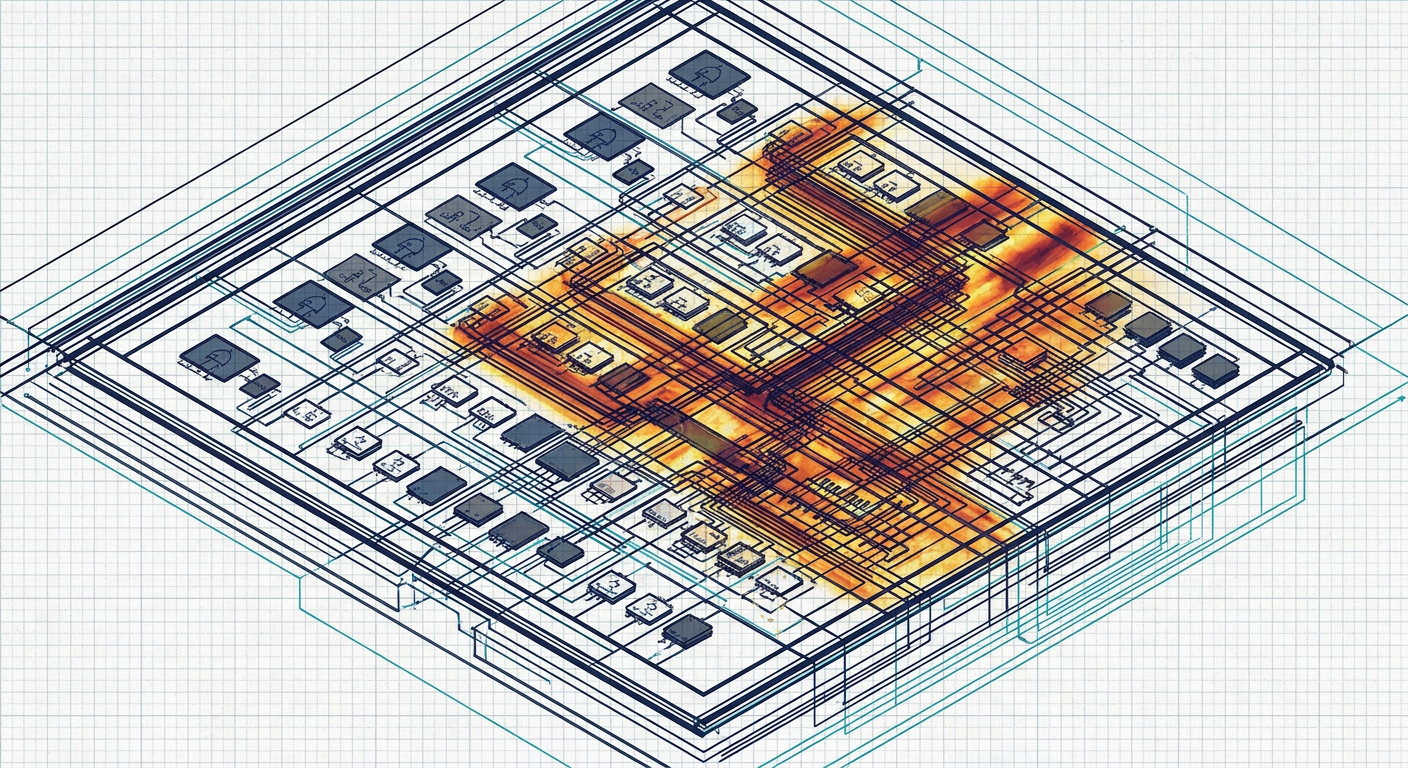
The net result is predictable: routing congestion levels jump to category 5 or higher, slice pin density spikes, and your achievable clock frequency ($F_{\text{max}}$) collapses by 35 to 50 percent. For RTL and FPGA engineers working against hard timing budgets, fixing this unoptimized logic by hand often takes longer than writing the module from scratch.
The Illusion of Clean Syntax
Large language models are trained heavily on public repositories containing open-source Verilog, C-to-RTL high-level synthesis outputs, and academic toy examples. These models learn structural token relationships, not silicon physics. They understand that a multi-channel arbiter requires request signals, grant outputs, and a round-robin pointer. They do not understand the routing architecture of a Xilinx Configurable Logic Block (CLB) or an Intel Adaptive Logic Module (ALM).
When a human RTL engineer writes a high-throughput datapath, they mentally map every construct to the target primitive. They structure conditional logic into balanced ternary trees or one-hot multiplexers to fit neatly into 6-input LUTs (LUT6). They align registers to allow Vivado to infer a full DSP48E2 block, packing pre-adders, multipliers, and accumulators inside a single hard macro running at 750 MHz.
Generative models write RTL sequentially, treating Verilog almost like software. When an LLM generates a wide priority encoder or a multi-client AXI crossbar, it frequently writes nested if-else trees or massive unpipelined case statements. While logically correct, this style produces catastrophic logic topologies for physical synthesis engines.
LUT6 Inflation and the Anatomy of Carry-Chain Splitting
To understand why AI-written Verilog triggers routing congestion, examine how modern FPGA logic cells operate.
In AMD UltraScale+ devices (such as the ZU9EG or Artix UltraScale+ AU25P), each slice contains eight 6-input LUTs and one 8-bit carry chain (CARRY8). An ALM in an Intel Agilex device features an 8-input fracturable LUT capable of splitting into two independent functions, feeding dedicated carry-chain logic. These structures excel when logic functions share inputs or when arithmetic operations follow clean bit-parallel paths.
When an LLM writes wide conditional expressions with deep nesting, synthesis tools struggle to map the logic into individual LUT6 primitives without adding extra logic levels. Consider a generated priority arbiter with 16 input channels:
// Typical LLM-generated priority selection
always @(*) begin
    grant = 16'b0;
    if (req[0])      grant[0] = 1'b1;
    else if (req[1]) grant[1] = 1'b1;
    else if (req[2]) grant[2] = 1'b1;
    // ... 13 intermediate else-if branches ...
    else if (req[15]) grant[15] = 1'b1;
end
This linear priority chain creates an asymmetric logic cone. In UltraScale+, mapping this construct directly forces the synthesis engine to cascade multiple LUTs across several CLB columns. As the logic depth increases from 2 to 5 or 6 levels of unpipelined logic, the router must allocate long horizontal and vertical routing tracks to connect the intermediate terms.
Even worse is how AI code handles arithmetic datapaths. When instructed to generate a signed multiplier with saturation and rounding, LLMs frequently break the addition and clamping logic into disjoint assign statements:
// AI-generated arithmetic with unaligned clamping
wire signed [31:0] raw_mult = a_reg * b_reg;
wire signed [31:0] scaled_val = raw_mult >>> 12;
wire [15:0] clamped_val = (scaled_val > 32'sd32767)  ? 16'sh7FFF :
                          (scaled_val < -32'sd32768) ? 16'sh8000 :
                          scaled_val[15:0];
In this pattern, the comparison operations (> 32'sd32767 and < -32'sd32768) evaluate independently of the lower-bit arithmetic. Instead of inferring a single structured arithmetic comparator using the dedicated carry chain, Vivado or Quartus synthesizes separate wide magnitude comparators across dozens of general-purpose LUTs. The dedicated CARRY8 or ALM carry chain is split into fragments. The synthesis engine must route intermediate carry bits out of dedicated hard tracks and onto general interconnect wires, instantly spiking local routing demand.
DSP Slice Mapping Failures
Modern FPGA DSP blocks (like the DSP48E2 in UltraScale+ or the Variable Precision DSP in Agilex) are sophisticated math co-processors. They can execute a $27 \times 18$ bit multiplication, a 48-bit accumulation, and dynamic pattern detection at maximum silicon speeds, but only if the RTL strictly matches their architectural register rules.
To absorb operations into hard DSP slices, the input data, pipeline stages, and feedback loops must all feature specific, synchronous reset and clock-enable structures. If an LLM introduces an asynchronous reset on an internal datapath register, or if it places a combinatorial multiplexer between the multiplier output and the accumulator register, the synthesis tool abandons DSP inference entirely.
When DSP inference fails, the tool falls back to soft-logic implementation. A single 32-bit fixed-point multiply-accumulate unit that should have consumed exactly one or two DSP slices is suddenly constructed out of 450 to 800 soft LUTs and hundreds of flip-flops.
Multiply this by an 8-channel processing pipeline, and your design suddenly requests 5,000 extra LUTs. These soft multipliers sit directly in the middle of your core logic array, consuming local routing tracks and boxing in surrounding blocks.
Place-and-Route Benchmark Comparisons
To quantify this impact, we evaluate two common RTL designs synthesized across both AMD UltraScale+ and Intel Agilex architectures: a 4-channel AXI4-Stream crossbar with packet routing, and an 8-channel fixed-point finite impulse response (FIR) filtering datapath with saturation.
The table below details an illustrative composite benchmark comparing baseline code generated by frontier general-purpose LLMs against hand-optimized, hardware-aware RTL written by senior engineers.
| Design Under Test | Target Device | Metric | Hand-Optimized RTL | Raw AI-Generated RTL | Degradation Factor |
|---|---|---|---|---|---|
| 4-Channel AXI Crossbar | AMD ZU9EG (Vivado 2024.1) | LUT6 Utilization | 412 | 1,380 | 3.35x bloat |
| Logic Levels | 3 | 7 | 2.33x depth | ||
| Routing Congestion | Level 1 (Normal) | Level 5 (Shortage) | Severe | ||
| Achieved $F_{\text{max}}$ | 450 MHz | 245 MHz | -45.5% | ||
| 4-Channel AXI Crossbar | Intel Agilex 7 (Quartus 23.4) | ALM Count | 280 | 890 | 3.17x bloat |
| Logic Levels | 3 | 6 | 2.00x depth | ||
| Achieved $F_{\text{max}}$ | 520 MHz | 290 MHz | -44.2% | ||
| 8-Channel FIR Datapath | AMD AU25P (Vivado 2024.1) | DSP48E2 Inferred | 8 (100%) | 0 (0%) | Complete fallback |
| Soft LUT6 Count | 310 | 3,840 | 12.38x bloat | ||
| Routing Congestion | Level 1 (Normal) | Level 6 (Critical) | Routing failure risk | ||
| Achieved $F_{\text{max}}$ | 400 MHz | 185 MHz | -53.7% | ||
| 8-Channel FIR Datapath | Intel Agilex 7 (Quartus 23.4) | DSP Blocks Inferred | 8 (100%) | 0 (0%) | Complete fallback |
| Soft ALM Count | 215 | 2,450 | 11.39x bloat | ||
| Achieved $F_{\text{max}}$ | 480 MHz | 210 MHz | -56.2% |
Note: Metrics represent an illustrative composite derived from standard benchmark synthesis runs using default vendor optimization profiles (-directive Default in Vivado, balanced optimization in Quartus Pro).
The numbers reveal why frontend synthesis success is deceptive. The raw AI Verilog passed all functional testbenches, yet the implemented results created massive logic bloat, crippled operating frequencies, and caused critical routing congestion.
Why Routing Congestion Destroys Timing Closure
When LUT utilization bloats by 3x and soft logic replaces hard macros, place-and-route tools face a geometric problem. Modern FPGAs have fixed routing interconnects arranged in structured grids. Each switch box has a limited number of pass transistors and directional multiplexers.
AMD's UltraScale+ architecture guidelines (such as UG949) explicitly warn that when local LUT combining exceeds 40 percent in a single congested area, or when slice pin demand exceeds the routing capacity of the switch box, routing congestion reaches Level 5 or higher. At this point, the router cannot use direct, low-latency wires. It must detonate its timing budget by detouring signals through distant switch boxes just to complete the physical connections.
This creates a destructive feedback loop:
- High Pin Density: AI-generated sprawling multiplexer trees connect dozens of unrelated signals into the same CLB tile, demanding more routing inputs than the tile switch matrix provides.
- Long Routing Detours: The router routes nets out of the local tile, around congested areas, and back in, introducing nanoseconds of routing delay on paths that have only two or three logic levels.
- Clock Skew and Hold Violations: To fix setup violations caused by these massive detours, the tool inserts routing delay buffers on neighboring paths, which in turn introduces hold timing violations across clock domain crossings.
- Placement Thrashing: During physical optimization iterations, the tool attempts to tear up and replace logic cells. Because the unpipelined logic cones are fundamentally wide, shifting one cell to improve timing breaks three adjacent nets.
Your compile times stretch from twenty minutes to six hours, only for the run to terminate with negative slack and unrouted nets.
+------------------------------------------------------------------------------------+
| Vivado Routing Congestion Report (Illustrative Snapshot - Raw AI Crossbar)         |
+-----------------------+------------------+--------------------+--------------------+
| Congestion Direction  | Congestion Level | Tile Name          | Max Cell Pin Usage |
+-----------------------+------------------+--------------------+--------------------+
| North                 | Level 5 (32x32)  | CLEM_X42Y120       | 94.2%              |
| South                 | Level 5 (32x32)  | CLEL_R_X42Y119     | 91.8%              |
| East                  | Level 6 (64x64)  | INT_X42Y120        | 98.1%              |
| West                  | Level 4 (16x16)  | INT_X41Y120        | 86.4%              |
+-----------------------+------------------+--------------------+--------------------+
* Congestion level >= 5 indicates high probability of timing closure failure or unroutable nets.
Engineering Rules: How to Constrain and Structure AI Output
If your team uses generative models to accelerate initial RTL drafting, you cannot treat the output as production-ready Verilog. You must enforce strict architectural rules during generation and run automated post-processing validation before handing code to synthesis.
Here is a practical checklist for constraining and refactoring generated code:
1. Eliminate Multi-Stage Priority Trees
Never let a model output deep if-else chains for arbiters or multiplexers wider than 4 inputs. Force the model to structure wide muxes into two-stage balanced trees or one-hot multiplexers.
// Refactored balanced multiplexer structure
wire [31:0] mux_stage1_0 = sel[0] ? in1 : in0;
wire [31:0] mux_stage1_1 = sel[1] ? in3 : in2;
wire [31:0] final_out    = sel_stage2 ? mux_stage1_1 : mux_stage1_0;
This guarantees mapping into parallel LUT6 primitives with minimal logic depth and eliminates localized switch-box pin congestion.
2. Mandate Synchronous Resets and Retiming Registers on DSP Candidates
To guarantee that Vivado and Quartus infer DSP slices instead of soft LUT cascades, explicitly prompt and lint for standard DSP template structures:
- Use synchronous resets only (
if (posedge clk)without an asynchronous reset term in the sensitivity list). - Place dedicated pipeline registers directly on multiplier inputs and product outputs.
- Avoid any intermediate combinatorial logic between the multiplication product and subsequent addition registers.
3. Audit Carry-Chain Alignment
Check all wide addition, subtraction, and comparison operations. If an AI module performs a magnitude comparison followed by an arithmetic shift, verify that the operation uses standard bit-slicing that synthesizers can pack into a single CARRY8 or ALM carry chain. If the synthesis log flags high soft-LUT usage for basic arithmetic, inspect the netlist schematic to find where the carry chain broke.
4. Configure Vendor Synthesis Strategies
When synthesizing RTL that contains AI-generated blocks, adjust your default synthesis settings to actively defend against LUT bloat:
- In Vivado, test the
Flow_AlternateRoutabilityorCongestion_SpreadLogic_highsynthesis strategies, and consider settingLUT_COMBININGtooffif congested tiles exhibit high pin density. - In Quartus Prime Pro, set the optimization mode to
High Performance EffortwithAggressive Congestion Reductionenabled.
What this means for Silicode
Silicode addresses this exact breakdown between textual plausibility and physical silicon realities.
Standard code-generation models produce Verilog that looks elegant in a text editor but fails inside the physical constraints of an FPGA fabric or ASIC standard-cell library. Silicode evaluates RTL generation directly against synthesis metrics, lint rules, and physical constraints. By coupling LLM reasoning engines with immediate headless synthesis loops and formal property checking, it prevents LUT6 bloat, forces proper DSP mapping, and ensures that the generated RTL closes timing on modern devices without requiring days of manual refactoring.
The Path Forward for Silicon Engineers
Generative AI will become a permanent part of the digital design workflow, but its utility will not be measured by how many lines of Verilog it can spit into an editor in three seconds. In hardware engineering, lines of code are a liability, not an asset.
What matters is physical efficiency: Look-Up Table utilization, dedicated macro inference, logic depth, and worst-case negative slack. The engineers who gain real leverage from AI tools will not be the ones who paste raw outputs directly into their repositories. They will be the ones who understand FPGA silicon architecture deeply enough to constrain the model, detect physical netlist degradation early, and verify timing closure with rigorous, automated evidence.
Sources
- FPGA Design Automation: A Survey - Deming Chen
- AMD UG949: Vivado Design Suite User Guide - Disable LUT Combining
- Machine Learning Based Routing Congestion Prediction in FPGA - arXiv
- AMD Zynq UltraScale+ MPSoC Architecture Overview
- AMD Artix UltraScale+ FPGA Portfolio
- Altera FPGA AI Suite and Architecture Documentation