Saudi Arabia and the United Arab Emirates have restructured the operating environment for industrial employers over the past two quarters. The enforcement of revised localization quotas under Saudi Vision 2030, paired with Saudi Arabia's skill-based work permit verification system and the UAE's industrial workforce targets under Operation 300bn, has changed the basic math of engineering recruitment.
For Heads of HR, Chief Technology Officers, and Corporate Learning and Development (L&D) directors at Gulf manufacturing, energy, and logistics firms, the old playbook is broken. For two decades, regional operators managed talent shortfalls in industrial automation and process control by hiring mid-career expatriates from Western Europe, South Asia, and North America. That approach now creates two immediate problems: mounting compliance penalties under nationalization quotas, and an unsustainable talent acquisition cycle where specialized controls talent takes four to six months to recruit, demands steep relocation packages, and leaves within two years.
At the same time, regional universities are graduating thousands of capable national electrical, mechanical, and computer science engineers each year. The operational friction is that university curricula teach fundamental physics, circuit analysis, and high-level software development, but rarely train graduates on industrial automation standards, programmable logic controller (PLC) architecture, industrial communication protocols, or functional safety.
Rather than spending 120,000 to 180,000 USD per senior hire on headhunter retainers and visa processing, forward-looking industrial operators are shifting 40 percent of their annual talent acquisition budgets into dedicated 90-day internal conversion programs. By designing structured learning paths that convert entry-level electrical and mechanical graduates into billable, site-ready controls engineers, industrial teams are securing regulatory compliance while cutting project delivery lead times.
The Real Cost of External Recruitment Pipelines
To understand why L&D budgets are pivoting, consider the total cost of ownership for traditional industrial talent acquisition in the Gulf.
When a manufacturing facility or utilities operator needs a controls engineer, the recruitment cycle typically looks like this:
- A regional search begins, finding that domestic senior controls engineers are already retained by national oil companies or major utilities at premium salary bands.
- The company contracts an international recruitment agency with a 20 to 25 percent placement fee based on first-year base salary.
- The candidate undergoes a three-month interview, vetting, and visa credential verification cycle.
- The company covers flight allowances, temporary housing, family benefits, and onboarding overhead.
- The new hire requires two to three months on-site to adapt to regional vendor configurations, plant-specific legacy architectures, and local safety regulations.
If the engineer leaves after eighteen months, the process repeats. Meanwhile, the employer pays localization non-compliance fees or risks losing access to government procurement contracts.
By contrast, hiring local engineering graduates fulfills nationalization mandates immediately. However, putting an untrained graduate directly into an active plant environment creates downtime risk. Industrial controls require precision: an unhandled exception in ladder logic or an incorrectly configured variable frequency drive (VFD) can trip a production line, costing tens of thousands of dollars per hour.
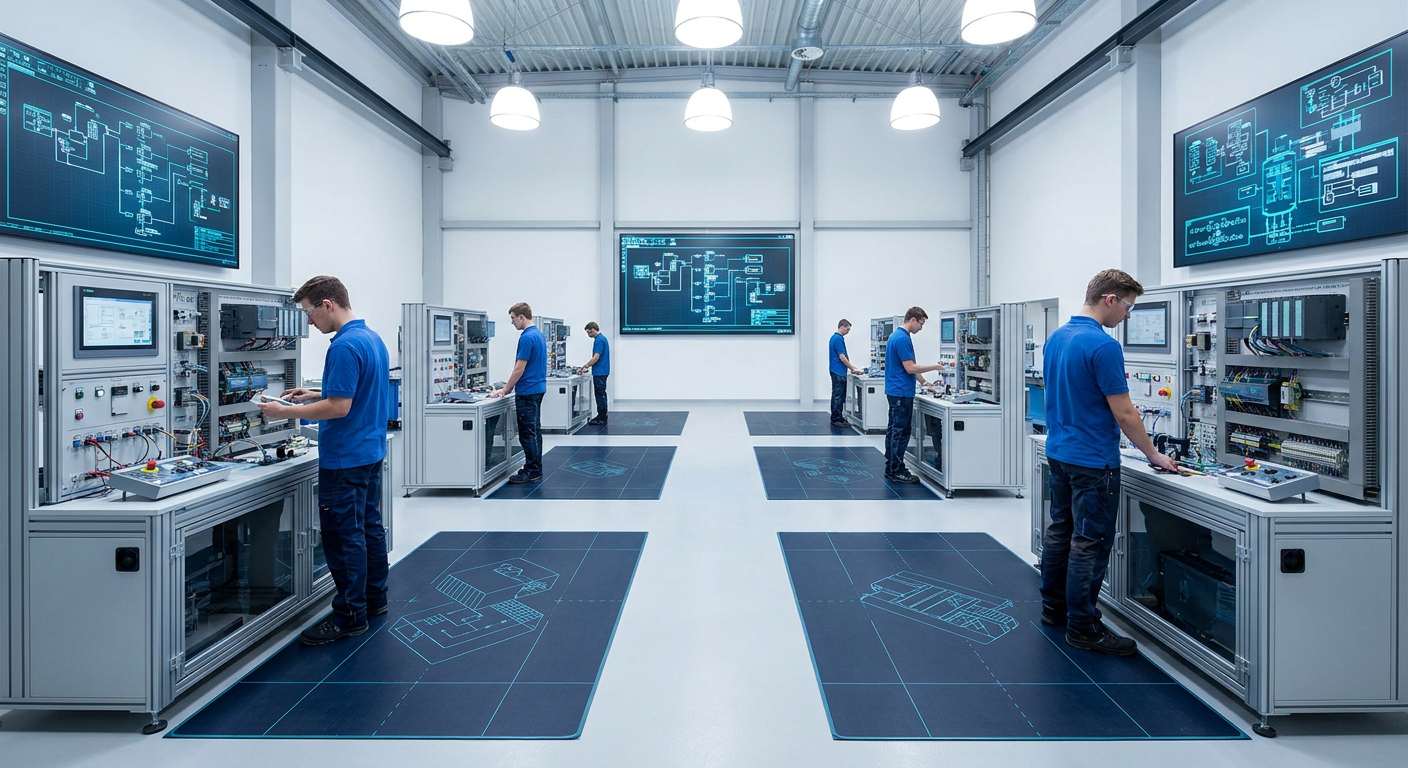
The answer is not a two-year traditional graduate rotation program where new hires spend months shadowing senior engineers without touching production systems. The solution is an intensive, task-verified 90-day conversion program that builds competency through structured simulation and direct physical system validation.
The Skills Disconnect: What Universities Do Not Teach
Regional universities provide solid foundations in differential equations, thermodynamics, digital signal processing, and basic microcontrollers. But modern industrial plants run on distinct frameworks that are rarely covered in four-year academic programs.
A junior electrical engineer knows Ohm's Law and transistor physics, but they usually cannot:
- Read or debug a multi-page industrial wiring schematic formatted to IEC 61082 standards.
- Write structured, maintainable code in IEC 61131-3 languages such as Structured Text (ST), Function Block Diagram (FBD), or Ladder Diagram (LD).
- Configure industrial fieldbus networks like Profinet, Modbus TCP/IP, or EtherNet/IP, including addressing, subnetting, and switch topology.
- Diagnose ground faults, signal noise, and 4-20 mA current loop calibration errors in industrial input/output (I/O) modules.
- Implement machine safety interlocks compliant with ISO 13849-1 and IEC 62061 functional safety standards.
When L&D teams treat this gap as a personal development goal for the employee, it takes two years of unstructured trial and error on the plant floor for the engineer to become useful. When L&D teams treat this gap as a deterministic, modular training objective, the transition can be executed in twelve weeks.
The 90-Day Controls Conversion Architecture
A production-ready conversion framework breaks the discipline of industrial automation into three distinct 30-day blocks. Each block moves the candidate from isolated component understanding to integrated system execution.
Phase 1 (Days 1 to 30): Electrical Fundamentals, Safety, and Field I/O
The first month eliminates the gap between theoretical electrical diagrams and actual control cabinets. Candidates spend 60 percent of their time analyzing physical components and building basic circuits.
- Reading and redlining industrial control panel schematics (P&IDs, loop sheets, single-line diagrams).
- Power distribution inside control cabinets: 24V DC power supplies, circuit breakers, terminal blocks, fusing, and relay logic.
- Sensor integration: discrete proximity switches, photoelectric sensors, analog transmitters (0-10V, 4-20mA), RTDs, and thermocouples.
- Lockout/Tagout (LOTO) protocols, arc flash awareness, and personal protective equipment (PPE) compliance.
- Verification milestone: The engineer is given a wiring diagram with deliberate faults and must wire, power, and verify a complete 16-channel digital and analog I/O rack without error.
Phase 2 (Days 31 to 60): PLC Programming and Deterministic Logic
The second month focuses on core industrial logic using standard platforms such as Siemens TIA Portal or Rockwell Studio 5000.
- Memory management, scan cycles, timer functions, counters, and edge detection.
- Structuring programs using state machines (PackML or ISA-88 standards) rather than messy, unmaintainable monolithic logic.
- Writing Structured Text for mathematical routines, data manipulation, and recipes; utilizing Function Blocks for reusable motor and valve control.
- Simulation-driven verification: Running PLC code against a simulated physics model of a conveyor, tank filling station, or robotic cell to catch edge-case logic faults before touching hardware.
- Verification milestone: The candidate programs an automated material sorting station from a blank project file, handling error states, emergency stops, and manual override modes.
Phase 3 (Days 61 to 90): Industrial Networks, SCADA, and Fault Diagnostics
The final month covers system-level integration, operator interfaces, and systematic troubleshooting under time pressure.
- Configuring HMI (Human-Machine Interface) and SCADA screens with alarm handling, trend logging, and role-based access control.
- Industrial networking: IP addressing, subnet masks, managed switches, Profinet name assignment, and packet diagnostics using network analyzers.
- Motor control: Wiring, parameterizing, and commissioning Variable Frequency Drives (VFDs) over fieldbus protocols.
- Root-cause diagnostics: Injecting hardware, network, and logic faults into a running system. Candidates are evaluated on their time-to-recovery using systematic diagnostic trees rather than random guessing.
- Verification milestone: A timed, scenario-based plant-floor commissioning exercise where the engineer must bring a multi-drive, networked control station from unconfigured hardware to continuous cycling within four hours.
Economic Comparison: Conversion Cohorts vs. International Search
The table below presents an illustrative composite based on talent acquisition and training data across mid-sized industrial operators in the GCC region handling 10-person annual controls engineering intakes.
| Cost and Operational Parameter | Traditional Expat Recruitment Model | Internal 90-Day Conversion Cohort (10 Engineers) |
|---|---|---|
| Agency / Sourcing Fees | 22,000 USD per hire (220,000 USD total) | 3,000 USD per campus hire (30,000 USD total) |
| Relocation and Visa Overhead | 8,500 USD per hire (85,000 USD total) | 1,200 USD standard local onboarding (12,000 USD total) |
| Training Infrastructure & Software | Negligible / Informal on-the-job shadowing | 45,000 USD (simulators, test benches, modular curricula) |
| Time to First Billable Site Task | 120 to 180 days (search + visa + plant orientation) | 90 days from cohort start date |
| Localization Quota Compliance | Negative impact (requires offsetting local hires) | Direct positive impact on nationalization ratios |
| Estimated 24-Month Retention | 45% to 60% (regional turnover rate) | 75% to 85% (career-path loyalty and domestic stability) |
| Total Cost for 10 Deployed Engineers | 305,000 USD (excluding base salaries) | 87,000 USD (excluding base salaries) |
Note: Figures represent an illustrative operational model based on standard regional market recruiting fees, relocation costs, and simulation lab capital expenditures.
The internal conversion model cuts immediate talent acquisition overhead by over 70 percent. More importantly, it creates a repeatable internal capability. The training benches, simulation models, and task assessments built for the first cohort remain available for subsequent intakes, driving down the marginal cost per trained engineer with every iteration.
How L&D Leads Can Secure Buy-in from Plant Managers
The single largest barrier to internal conversion programs is not budget. It is skepticism from Plant Directors and Maintenance Managers. Senior engineering managers often argue that a graduate with 90 days of training cannot replace an engineer with eight years of field experience.
That argument is correct if you expect the junior engineer to design a greenfield refinery control architecture on day 91. But it misses how plant work is actually distributed.
In most operating facilities, 70 percent of controls engineering tasks involve routine modifications, loop tuning, I/O verification, sensor replacements, HMI tag adjustments, and standard diagnostic calls during shift rotations. Senior controls engineers spend hours performing work that does not require an advanced specialist.
When L&D teams deploy a 90-day conversion program, they free senior engineers from repetitive maintenance tasks so they can focus on system architecture, capital expansion, and advanced safety audits.
To build credibility with plant leadership, L&D heads should implement a three-part validation process:
- Co-Design the Final Verification Exam with Operations: Do not let external trainers set the graduation criteria in isolation. Have the lead plant maintenance engineer write the 20 most frequent fault scenarios they encounter on site. Include those exact scenarios in the Day 85 practical exam.
- Replace Attendance Logs with Task Performance Metrics: Plant managers do not care that a candidate attended 40 hours of PLC lectures. They care if the candidate can find an open-circuit fault in a control loop within fifteen minutes. Track time-to-diagnostic, coding syntax error rates, and compliance with IEC naming standards.
- Implement a 60-Day Paired Shadowing Period: After the 90-day conversion, graduate engineers are assigned to senior engineers as junior partners, handling specific field tickets under direct review before signing off independently.
What this means for n1Edtech.ai
The pivot toward internal capability building reinforces the core thesis behind n1Edtech.ai: technical education must move away from generic video courses and toward adaptive, task-verified learning paths tied directly to engineering job outcomes.
By combining high-fidelity digital twins of industrial automation hardware with continuous performance assessment, technical training platforms can simulate complex plant environments safely. This allows corporate L&D teams in industrial, energy, and manufacturing sectors to rapidly upskill domestic engineering talent, verify their diagnostic competencies before they set foot on the factory floor, and meet nationalization targets without sacrificing operational reliability.
How Industrial L&D Heads Should Rebalance Their Budgets
If you are managing technical talent budgets for an industrial enterprise in the Gulf, take these concrete steps before the next fiscal planning cycle:
- Audit Your Open Job Requisitions: Identify every mid-level engineering role that has been vacant for more than 90 days. Categorize the essential tasks into core fundamentals versus niche domain knowledge.
- Calculate Your True Localization Penalty and Recruitment Spend: Combine agency fees, visa costs, expatriate housing stipends, and regulatory non-compliance penalties to establish your baseline acquisition cost per seat.
- Shift 30% of External Hiring Budget to Conversion Tooling: Invest in modular hardware training benches, PLC simulation licenses, and structured digital curriculum frameworks.
- Partner with Regional Universities for Direct Intake: Establish relationships with university engineering departments to recruit the top 15 percent of mechanical and electrical graduates three months before graduation, enrolling them directly into your cohort on day one of employment.
Building local industrial capability is no longer an optional corporate social responsibility initiative. In the modern Gulf industrial economy, it is the only sustainable strategy for operational scaling.
Direct Takeaway Q&A
How can industrial companies in the GCC meet aggressive localization quotas without lowering technical standards? By replacing long, uncertain overseas recruiting cycles with structured 90-day internal conversion programs. Converting local mechanical and electrical graduates into entry-level controls engineers via hands-on simulation, standardized IEC programming, and objective diagnostic testing fills plant floor vacancies rapidly while preserving operational uptime.
Sources
- https://www.vision2030.gov.sa
- https://www.moei.gov.ae
- https://www.vbeyond.com/blog/strategic-horizon-2026-the-gcc-labor-market-transformation-report/
- https://www.alvarezandmarsal.com/insights/industrial-manufacturing-localization-strategies
- https://www.weforum.org/stories/emerging-technologies/3-ways-gcc-economies-tackling-the-global-talent-shortage/