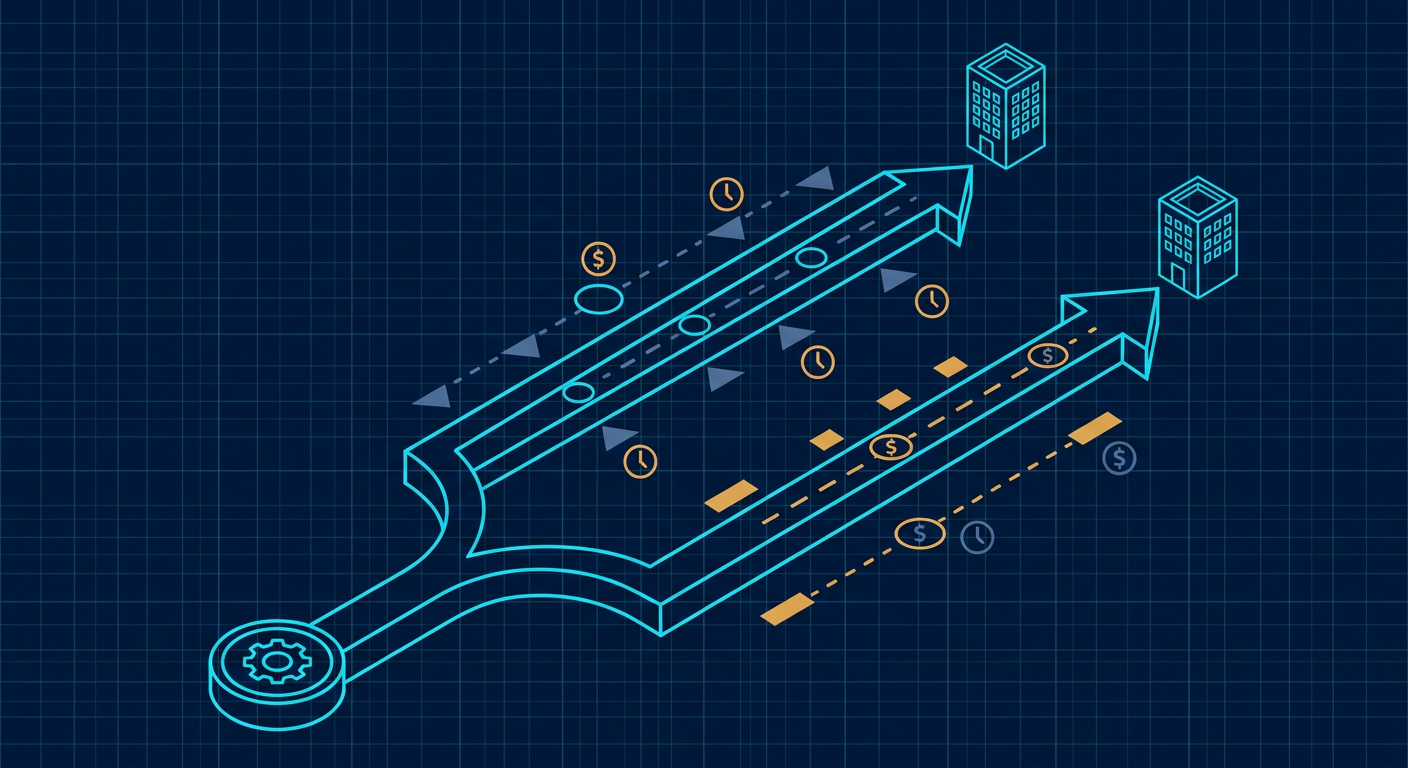
Recent analysis from Ernst & Young highlights an uncomfortable reality across capital projects and industrial engineering: funding is flowing at record levels, but talent deficits are choking project delivery across the board. At the same time, regional workforce audits and technical placement data show that up to 85 percent of university engineering graduates lack the applied operational skills required to step directly into production workflows.
For corporate talent directors, heads of technical learning, and engineering vice presidents, this creates a severe operational squeeze. The traditional playbook assumes that when a team lacks specialized domain skills, such as mixed-signal verification, industrial telemetry, or advanced kinematic modeling, the recruiting team simply opens an external requisition.
That playbook is broken. When talent leads attempt to buy ready-made senior capability off the shelf, they face four-to-six-month requisition cycles, headhunter premiums averaging 20 to 25 percent of first-year base salary, and a lengthy onboarding curve before the new hire writes production-grade work.
The math behind external talent acquisition no longer closes. Solving technical delivery constraints requires corporate learning and development (L&D) teams to stop acting as passive catalog administrators and start functioning as capability supply chains. To do that, L&D buyers need an honest accounting of what buying talent actually costs compared to structured, diagnostic upskilling.
The True Friction of the Open Talent Market
External technical recruitment carries massive hidden friction that rarely appears on a standard HR line-item report. When an engineering director requests an experienced senior specialist, the recruiting apparatus triggers a chain of direct and indirect expenses.
First is the direct search cost. For an engineering specialist commanding a $140,000 to $160,000 base salary, a standard contingency search fee of 20 percent costs roughly $28,000 to $32,000 on day one. Retained executive or niche technical searches frequently reach 30 percent.
Second is the search latency. Data across industrial and electronics sectors shows specialized technical roles sit open for an average of 90 to 140 days. During those three to four months, the existing team absorbs the missing headcount's workload, generating fatigue, delaying project milestones, or forcing the organization to engage expensive outside engineering contractors at $180 to $250 per hour.
Third is the evaluation tax. Screening twenty candidates, interviewing eight, and running technical assessments for three consumes dozens of senior engineering hours. That is time pulled directly away from architecture reviews, testbench creation, and production delivery.
Finally, there is the integration lag. A newly hired senior engineer does not ship mission-critical work in week two. They spend their first 90 to 180 days learning internal toolchains, proprietary codebase conventions, hardware errata, and vendor relationships.
If the hire leaves within the first year, which occurs in roughly 15 to 20 percent of competitive engineering placements, the entire expense cycle resets to zero.
The Fallacy of the Plug-and-Play Engineer
The fundamental assumption behind paying high recruiter fees is that an external hire brings plug-and-play productivity. Yet modern engineering systems are rarely standardized enough for instant execution.
An embedded systems engineer who spent six years working on automotive AUTOSAR stacks still faces a steep ramp when dropped into a team designing low-power telemetry nodes for industrial energy grids. The foundational physics and logic carry over, but the domain constraints, safety standards, component selection rules, and debugging toolsets differ completely.
Organizations end up paying top-of-market rates for domain knowledge that still requires three to six months of internal adaptation. Meanwhile, existing mid-level engineers inside the building already understand your product architecture, your deployment pipelines, and your team culture. What they lack is not organizational context, but specific, targeted technical capability.
A mid-level digital design engineer already knows how your repository runs, how your documentation is structured, and how your hardware test fixtures operate. If that engineer lacks specific competencies in clock domain crossing analysis or UVM testbench assembly, closing that precise gap requires weeks of targeted practice, not an entire replacement search.
Why Raw Credentials Fail: The 85 Percent Gap
Turning to the entry-level hiring pipeline to backfill capacity exposes a different failure mode. Academic institutions and general technical universities continue to produce millions of engineering degree holders globally. However, industrial reports and placement trackers consistently reveal that the vast majority, often up to 85 percent in major technical graduate pools, are not deployable without extensive remedial training.
Undergraduate curricula are structurally designed around broad conceptual theory rather than production rigor. A mechanical engineering graduate understands basic finite element theory but has never run a design-for-manufacturing review on an injection-molded housing with tight draft-angle constraints. A computer engineering graduate understands basic logic gates and simple Verilog syntax but has never written an automated regression testbench or negotiated timing closure against a physical foundry design rule file.
When companies hire entry-level graduates expecting immediate contribution, senior staff end up acting as ad-hoc university professors. This informal, unstructured apprenticeship drains senior engineering throughput while leaving junior staff frustrated by ambiguous expectations and prolonged ramp times.
Buying talent at the top is prohibitively expensive, and hiring raw graduates at the bottom requires months of unbudgeted remedial coaching. The only scalable solution is a structured middle path: taking proven, mid-level staff and methodically bridging their skill gaps through applied, milestone-driven technical curricula.
The Financial Framework: Build Versus Buy
To justify training investments to a Chief Financial Officer or VP of Engineering, L&D leads must present a transparent financial comparison. The table below outlines an illustrative composite model comparing the fully loaded cost of acquiring an external senior engineering specialist against the cost of bridging a capable mid-level internal engineer into that same role.
Financial Comparison: External Acquisition vs. Structured Internal Upskilling
(Illustrative composite model based on average market search fees, engineering salaries, and diagnostic training delivery metrics)
| Cost & Operational Metric | External Senior Specialist Hire | Internal Mid-Level Capability Bridge |
|---|---|---|
| Direct Recruiting / Program Cost | $30,000 (20% recruiter fee on $150k base) | $4,500 (Platform seat, labs, and assessments) |
| Time to Requisition / Program Start | 110 days average search cycle | 10 days to diagnose and enroll |
| Senior Engineering Interview / Mentoring Hours | 45 hours ($4,500 opportunity cost) | 12 hours milestone review ($1,200 cost) |
| Ramp Time to Autonomous Production | 120 days post-start date | 60 days during active training |
| Total Direct & Indirect Cost per Seat | $34,500+ | $5,700 |
| Total Calendar Days to Full Productivity | 230 days | 70 days |
| First-Year Flight / Failure Risk | 18% average turnover | Under 5% (strong retention signal) |
The variance is decisive. The external hire costs roughly six times more in cash outlays and consumes more than three times the calendar schedule before reaching autonomous productivity.
By keeping the mid-level engineer engaged and investing directly in their professional advancement, the company also eliminates the morale penalty that occurs when existing staff see external specialists brought in over their heads at inflated compensation bands.
What Breaks in Standard Corporate L&D
If the math favors building internal capability so heavily, why do technical organizations continue to spend millions on external recruiting agencies? The answer lies in the failure of legacy corporate training methods.
For over a decade, enterprise L&D departments addressed technical upskilling by purchasing enterprise subscriptions to massive video libraries. They distributed logins to thousands of software, hardware, and systems engineers, checked a compliance box, and waited for skills to emerge.
The results have been dismal. Passive video platforms suffer from completion rates below 10 percent among practicing engineers. Senior and mid-level technical staff do not have forty hours to sit through generic, high-level lecture recordings that fail to touch their actual development environments.
Traditional e-learning fails technical teams for three specific reasons:
- Lack of Granular Diagnostics: Standard platforms treat all learners identically. A controls engineer who is already an expert in classical PID tuning but needs to learn state-space modeling is forced to sit through hours of introductory calculus before reaching relevant material.
- Absence of Production Realism: Watching a video of someone configuring a logic analyzer does not build muscle memory. Real capability transfer requires active problem-solving, debugging broken code, calculating thermal tolerances, and resolving realistic constraint violations in sandboxed environments.
- No Verifiable Outcome Metrics: When an engineer completes a video track, L&D receives a completion badge. That badge tells the engineering manager nothing about whether the engineer can accurately size a motor drive, design a low-noise analog front end, or optimize a critical timing path under production pressure.
When L&D delivers vanity metrics instead of verified capabilities, engineering managers lose confidence in corporate training programs and default back to hiring headhunters.
Designing an Applied Engineering Capability Bridge
Building an effective internal upskilling pipeline requires treating technical education like an engineering system. It must be diagnostic, targeted, and rigorously measured against real work outputs.
Step 1: Baseline Skills with Adaptive Diagnostic Audits
Do not ask engineers what they want to learn. Assess what they can currently execute. An adaptive diagnostic presents practicing engineers with concrete technical challenges: identifying a race condition in a state machine, selecting the correct bypass capacitor topology for a power rail, or calculating structural deflection limits under dynamic load.
An accurate diagnostic isolates the exact boundary where an engineer's operational competence ends. If an engineer demonstrates mastery of basic microcontroller peripheral configuration in the first ten minutes, the platform immediately skips those modules and advances to direct memory access (DMA) buffer management and interrupt latency optimization.
Step 2: Construct Modular, Problem-Centric Paths
Once individual and cohort skill gaps are mapped, learning must occur through dense, focused modules centered on applied engineering tasks. Instead of a forty-hour course on general signal processing, provide a six-hour targeted lab on designing digital finite impulse response (FIR) filters for noisy sensor acquisition pipelines.
Engineers should spend 20 percent of their time absorbing core theory and 80 percent of their time designing, simulating, and verifying solutions against explicit technical specifications.
Step 3: Implement Objective Work Verification
Replace multiple-choice quizzes with functional design reviews and automated verification testbenches. When an engineer submits an exercise, it should be evaluated against realistic criteria: Did the circuit meet noise floor specifications? Did the kinematic linkage clear geometric interference boundaries? Did the control loop remain stable across operating temperature extremes?
When an engineer passes these milestones, the engineering manager receives verifiable evidence that the employee can execute that specific task in production.
Step 4: Protect Learning Time Through Operational Sprints
Upskilling fails when engineers are expected to learn entirely during their off-hours after working fifty-hour design weeks. High-performing engineering organizations structure upskilling like development sprints.
Allocating four protected hours per week for focused, diagnostic learning yields measurable skill progression within six to eight weeks. Because the training is targeted directly at active project requirements, the organization recovers that time almost immediately through reduced rework, faster peer reviews, and fewer design respins.
What This Means for n1Edtech.ai
At n1Edtech.ai, this operational framework defines our approach to workforce education. We do not build open-ended video catalogs or generic introductory tutorials. Our platforms focus on adaptive technical learning paths tied directly to identified skill gaps and measurable engineering work outcomes.
By combining precise diagnostic assessments with production-grade problem sets, n1Edtech.ai enables industrial and technology enterprises to bridge mid-level engineers into specialized roles in weeks rather than quarters. We provide talent buyers and engineering managers with transparent data on capability acquisition, ensuring every training dollar directly reduces reliance on volatile external hiring markets.
The Strategic Imperative for Talent Leads
The global engineering talent deficit is structural. Retiring senior specialists, accelerating technology cycles, and an academic pipeline misaligned with modern production needs mean that waiting for the market to supply perfect, ready-made candidates is a losing strategy.
L&D and HR leaders who align their budgets with structured, diagnostic upskilling gain a lasting competitive advantage. They slash recruiting overhead, reduce time-to-productivity across major capital initiatives, and build an engineering culture where mid-level talent systematically evolves into senior capability.
The math is clear. Buying talent off the street is an expensive gamble with diminishing returns. Building talent from within is a predictable, repeatable, and cost-effective discipline.
Direct Summary Q&A
Why does buying ready-made engineering talent consistently fail?
External hiring fails because high recruiter fees ($28,000 to $35,000+ per seat) and long requisition cycles (90 to 140 days) do not guarantee immediate productivity. Even senior hires require three to six months to adapt to internal architectures, workflows, and toolchains, while carrying an 18 percent first-year attrition risk.
What does a structured internal upskilling bridge actually cost?
A targeted internal capability bridge typically costs between $4,500 and $6,000 per engineer, including platform diagnostics, labs, and senior review time. It cuts time-to-autonomy down to 60 to 70 total calendar days while retaining institutional knowledge and protecting team morale.
Sources
The US Needs More Engineers. What's the Solution?
https://www.bcg.com/publications/2023/addressing-the-engineering-talent-shortageHow workforce constraints are reshaping engineering and construction
https://www.ey.com/en_us/insights/industrial-products/workforce-shortages-reshape-engineering-deliveryWhen it Comes to Engineers, Demand Exceeds Supply
https://www.asme.org/topics-resources/content/when-it-comes-to-engineers,-demand-exceeds-supplyTackling the engineering shortage
https://www.ccdaily.com/2026/04/tackling-the-engineering-shortage/Workforce strategy for the engineering talent shortage
https://www.manpower.com/ar/insights/blogs/engineering-workforce-strategy