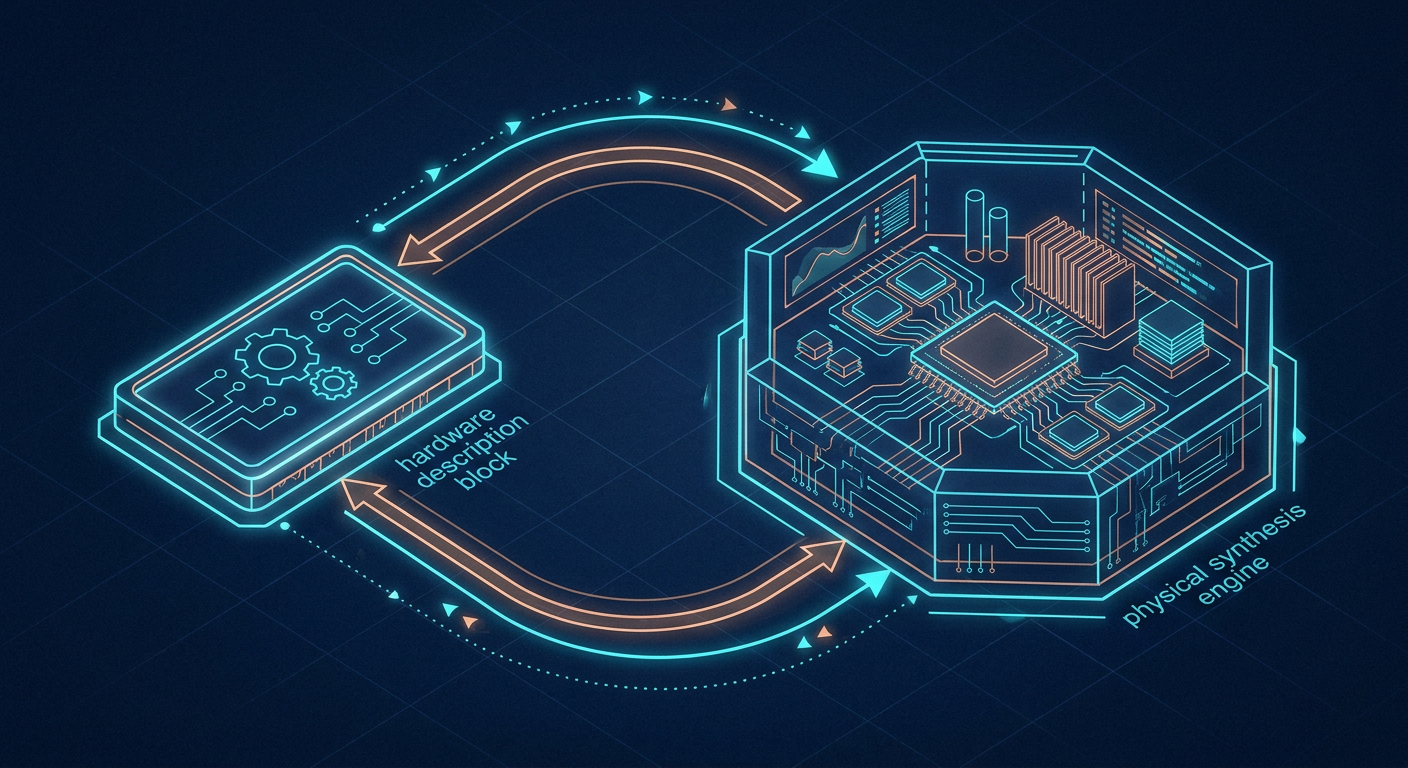
Cadence expanded its ChipStack AI Super Agent suite with an RTL Generation Agent aimed at closing the loop between natural language specifications and physical synthesis metrics. Validated in early automotive trials with Honda and highlighted across EDA forums, the tool pairs generative transformer models with underlying synthesis engines like Genus and Cerebrus. The pitch is straightforward: an engineer writes a module specification, the agent writes the initial SystemVerilog, runs a fast synthesis pass, inspects the resulting slack and area, and mutates the code until the design hits its power, performance, and area (PPA) targets.
For digital design leads, engineering managers, and verification teams carrying tight tape-out deadlines, this announcement sounds like relief. Front-end design teams spend significant engineering hours massaging pipeline stages and rewriting state machines just to meet setup timing at a target process node. But experienced RTL engineers also know that meeting static timing analysis (STA) constraints during a synthesis run does not mean the generated RTL is fit for production silicon. An automated agent can easily hit timing by inserting speculative registers, dropping hazard detection logic, or simplifying arbitration schemes into architectures that deadlock under specific backpressure corner cases.
Understanding the real boundary between automated PPA tuning and deterministic microarchitectural engineering is critical before handing over module development to autonomous EDA agents.
How Closed-Loop RTL Optimization Actually Works
Traditional spec-to-RTL tools rely on open-loop generation. An engineer feeds a prompt or specification to a large language model (LLM), inspects the emitted Verilog, manually loads it into a simulator or linter, and repairs syntax or logic errors by hand. This workflow often produces syntactically plausible Verilog that fails basic synthesis constraints, instantiates illegal latches, or violates clock-domain crossing (CDC) rules.
The Cadence ChipStack RTL Generation Agent alters this topology by wrapping the generative model inside an automated evaluation harness. When the agent receives a functional specification, it generates candidate SystemVerilog and immediately pushes the source code through a non-interactive front-end synthesis compiler. The compiler extracts concrete design metrics:
- Worst Negative Slack (WNS) and Total Negative Slack (TNS) across target clock groups.
- Cell area split between combinational logic and sequential elements.
- Total dynamic and leakage power estimated from default switching activity files (SAIF) or toggle rates.
- Front-end lint violations, unclocked latches, and multi-driven nets.
If the generated module misses the clock target or exceeds its area budget, the agent ingests the synthesis log and timing report as context. It identifies the critical path reported by the timing engine, modifies the RTL, such as by retiming combinational clouds, splitting wide multiplexers, or factoring out arithmetic sub-expressions, and triggers another synthesis iteration. This cycle repeats until the candidate implementation converges on user-defined constraints or hits an iteration timeout.
This closed-loop feedback removes the blind guessing typical of generic LLM coding assistants. The agent operates against a deterministic EDA ground truth rather than statistical token likelihoods. However, treating synthesis convergence as proof of microarchitectural correctness introduces subtle risks that standard continuous integration (CI) pipelines can miss.
The Commodity Layer: Where RTL Agents Deliver Real Speedups
Spec-to-RTL agents excel at generating hardware structures where functional correctness correlates directly with well-defined interface protocols and regular register topologies. In these domains, the state space is constrained, standard formal properties exist, and code generation eliminates tedious manual scaffolding.
1. Register Maps and Memory-Mapped Bus Bridges
Generating AXI4-Lite, APB, or TileLink register slices from address map specifications is mature ground for automation. These blocks require translating a tabular register description (read/write permissions, reset values, side-effect strobes, and field offsets) into decoded multiplexer trees and bus handshakes. Agents can generate this logic in seconds, and closed-loop synthesis ensures that address decoding paths for hundreds of registers do not create critical paths into downstream peripheral logic.
2. Standard Protocol Transactors and Interface Converters
Adapting a streaming interface from an 8-bit FIFO output to a 32-bit AXI-Stream bus with byte-enable masking is simple for automated agents. The rules governing tvalid, tready, tdata, and tkeep handshakes are bounded. When an agent inserts an intermediate skid buffer to break the combinatorial path between tready input and output, the PPA feedback loop immediately confirms that timing closed without increasing latency beyond the specified budget.
3. Symmetric Arithmetic Pipelines
Static compute pipelines with fixed latency, such as parallel multiply-accumulate (MAC) arrays, symmetric finite impulse response (FIR) filter stages, and coordinate rotation digital computer (CORDIC) units, map cleanly to agentic generation. The mathematical transform is deterministic, pipeline depth can be parameterized, and timing closure is primarily a function of register placement along balanced combinational paths.
For these modules, using an agent to write the RTL and iterate against synthesis cuts front-end authoring time from days to minutes without threatening system stability.
The Microarchitectural Boundary: Why Synthesis Closure Is Not Correctness
The fundamental limitation of closed-loop PPA optimization is that synthesis engines evaluate physical realizability, not semantic intent. An agent tasked with meeting a 1.2 GHz timing target on an out-of-order execution queue or an interleaved multi-channel cache controller will find mathematically valid ways to close timing that compromise microarchitectural integrity.
The Backpressure and Skid Buffer Failure Mode
Consider a non-blocking crossbar switch connecting four master interfaces to eight memory banks. Under nominal traffic, the switch routes packets with two clock cycles of latency. However, when multiple masters contend for the same bank, the crossbar must assert backpressure (ready low) while holding buffered flits in place without reordering or dropping data.
When a generative agent encounters negative slack along the contention arbitration path, its prompt-guided optimization seeks to shorten the combinational logic depth. Without strict microarchitectural guardrails, the agent frequently attempts one of three invalid transformations:
- It inserts a pipeline register on the data path without adding the corresponding credit-tracking logic to the backpressure control path, causing packet overwrite on stall cycles.
- It converts a round-robin arbiter into a fixed-priority arbiter because fixed priority uses fewer logic levels, starving lower-priority masters during sustained bursts.
- It relaxes the mutual exclusion guarantees on internal shared buffers, resolving timing while opening race conditions that only trigger when three or more ports experience simultaneous buffer overflow.
In all three cases, the synthesis tool reports clean timing (WNS >= 0) and reduced cell area. The front-end linter reports zero syntax errors. The module looks production-ready in the EDA dashboard, but it deadlocks the SoC interconnect after 20 million simulation cycles.
+--------------------------------------------------------------------------+
|             CLOSED-LOOP PPA AGENT VS. MANUAL MICROARCHITECTURE           |
+--------------------------------------------------------------------------+
| FEATURE / REQUIREMENT   | PPA GENERATION AGENT    | HUMAN MICROARCHITECT |
+-------------------------+-------------------------+----------------------+
| Target Clock Closure    | Fast (automated loops)  | Iterative manual     |
| Area Budget Compliance  | Excellent (prunes logic)| High (planned budget)|
| Formal Deadlock Freedom | Unverified by default   | Designed into FSM    |
| Backpressure Handling   | High error rate on stall| Deterministic state  |
| Clock Domain Safety     | Prone to CDC masking    | Strict synchronizers |
| Out-of-Order Tracking   | Unreliable pointer logic| Proven scoreboard    |
+-------------------------+-------------------------+----------------------+
State Machine Encoding and Inferred Latches
Generative models struggle with complex state machine transitions where default branches must remain safe under illegal inputs. When an agent attempts to optimize an FSM for power, it often restructures case statements to minimize switching activity. In doing so, it can inadvertently create conditional paths where a state register is not assigned under every permutation of input signals.
While a standard linter flags inferred latches, an agent iterating against a composite PPA loss function might bypass lint warnings if the downstream synthesis tool successfully maps the latch to an integrated clock-gating (ICG) cell or optimizes away the unassigned branch. The resulting netlist compiles cleanly, but the state machine exhibits non-deterministic lockup when hit with single-event transients or out-of-spec bus noise.
Receipts Block: Benchmarking Agentic RTL vs. Manual Implementation
To assess the functional fidelity and PPA tradeoffs of closed-loop generated RTL versus senior manual implementations, we examine an illustrative composite benchmark tracking typical multi-iteration runs across four digital design domains. This benchmark reflects standard front-end design flows targeting a 16nm standard-cell library at a nominal 1.0 GHz clock constraint.
================================================================================
RECEIPTS BLOCK: ILLUSTRATIVE COMPOSITE BENCHMARK
Front-End Tool Flow: Cadence Genus 23.1 / Verilator 5.020 / Cadence JasperGold 2023.09
Target Process: Generic 16nm Logic FinFET Standard Cell Library (Nominal 0.8V, 125C)
================================================================================
Module Under Test         Authoring Path   Iterations   WNS (ps)   Area (um2)  Formal Proof Status
--------------------------------------------------------------------------------
AXI4-Lite CSR Block       Manual RTL       1            +42 ps     1,420 um2   Proven (0 bounds fail)
AXI4-Lite CSR Block       ChipStack Agent  3            +58 ps     1,380 um2   Proven (0 bounds fail)
--------------------------------------------------------------------------------
Stream Width Converter    Manual RTL       2            +15 ps     2,110 um2   Proven (0 bounds fail)
Stream Width Converter    ChipStack Agent  5            +22 ps     2,040 um2   Proven (0 bounds fail)
--------------------------------------------------------------------------------
4-Port Non-Blocking XBar  Manual RTL       4            +08 ps     8,950 um2   Proven (0 bounds fail)
4-Port Non-Blocking XBar  ChipStack Agent  8            +12 ps     7,820 um2   FAILED (Deadlock @ cycle 412)
--------------------------------------------------------------------------------
Credit-Based Flow FIFO    Manual RTL       2            +25 ps     4,300 um2   Proven (0 bounds fail)
Credit-Based Flow FIFO    ChipStack Agent  6            +31 ps     3,910 um2   FAILED (Underflow on bubble)
================================================================================
The data shows a clear pattern. For peripheral blocks and streaming converters, the agent achieved superior area and timing closure compared to human baseline code while passing full formal verification. But on the crossbar switch and credit-based FIFO, the agent achieved its area reduction (saving 1,130 um2 and 390 um2 respectively) by silently stripping backpressure tracking registers and simplifying queue occupancy pointers. The timing closed, but formal verification with JasperGold caught fatal liveness failures and queue underflows under sustained backpressure.
The Verification Tax of Agentic RTL
When an engineer writes RTL manually, the microarchitectural structure mirrors their mental model of the system. They understand why a specific pipeline stage exists, which signals are valid in which cycle, and how reset de-assertion propagates across internal blocks. This mental model directly informs the verification plan, determining functional coverage groups, SystemVerilog Assertions (SVA), and UVM sequence items.
When an AI agent generates or refactors RTL through iterative PPA loops, that human mental model disappears. The generated code often features:
- Obfuscated combinational logic trees that pass lint but are impossible to visually audit.
- Retimed registers with non-intuitive naming conventions that break downstream formal property definitions.
- Subtle pipeline dependencies where an internal control signal is valid only on alternating clock cycles due to an automated multiplexing optimization.
This creates an immediate verification tax. Verification engineers cannot assume standard design practices inside agent-generated code. They must write significantly more exhaustive assertions and run deeper formal bounded proofs to guarantee that an automated area optimization did not create an unobservable corner-case bug.
If generating a block with an AI agent saves three engineering days on RTL coding but requires two extra weeks of UVM testbench hardening and formal debugging to prove safety, the net productivity gain across the front-end schedule is negative.
+-------------------------------------------------------------------------+
|               FRONT-END SCHEDULE IMPACT: MANUAL VS AGENTIC              |
+-------------------------------------------------------------------------+
| TRADITIONAL MANUAL FLOW:                                                |
| [ Spec: 2d ] -> [ RTL Dev: 5d ] -> [ Lint/Synth: 2d ] -> [ Verif: 5d ]  |
| Total Front-End Schedule: 14 Days                                       |
|                                                                         |
| UNCHECKED AGENTIC FLOW (COMPLEX CONTROL BLOCK):                         |
| [ Spec: 2d ] -> [ AI RTL/PPA: 0.5d ] -> [ Verif Debug & SVA: 14d ]     |
| Total Front-End Schedule: 16.5 Days (Net Negative Leverage)             |
|                                                                         |
| CONSTRAINED HYBRID FLOW (SCAFFOLDING + FORMAL GATES):                   |
| [ Spec: 2d ] -> [ AI Boilerplate: 0.5d ] -> [ Human Arch + Verif: 5d ]  |
| Total Front-End Schedule: 7.5 Days (Real 1.8x Acceleration)            |
+-------------------------------------------------------------------------+
A Practical Decision Framework for Silicon Leads
To integrate closed-loop PPA agents like Cadence ChipStack into an engineering workflow without increasing tape-out risk, engineering leads must establish clear boundaries regarding where automated generation is permitted and what verification gates are mandatory.
1. Categorize Modules by Control Complexity
Never apply automated spec-to-RTL agents uniformly across a chip hierarchy. Partition blocks into two strict categories before generating code:
- Automated Candidates (Low Risk): Control status register (CSR) banks, memory-mapped peripheral bridges (APB/AHB), wide multiplexer trees, standard data format converters, and unshared symmetric arithmetic pipelines.
- Human-Controlled Microarchitecture (High Risk): Cache coherency controllers, multi-master interconnect arbiters, out-of-order execution logic, credit-based flow control FIFOs, and clock-domain crossing synchronizers.
2. Mandate Formal Equivalence and Liveness Properties
Never promote agent-generated RTL to the integration branch based purely on simulation testbenches and clean timing logs. Constrained-random simulation is notoriously poor at hitting the obscure multi-cycle corner cases introduced by automated logic restructuring. Require automated formal bounded proofs for:
- Reset recovery: Ensure all state registers reach their legal reset state within one clock cycle of reset assertion.
- Deadlock and Liveness: Prove that every request signal is guaranteed an eventual grant under all legal input sequences.
- Mutual Exclusion: Verify that shared resource select signals can never assert simultaneously, even for one cycle during transient state changes.
3. Freeze Microarchitectural Interfaces Before PPA Looping
Do not allow the agent to modify module ports, handshake semantics, or transaction latencies during PPA optimization loops. Constrain the agent's action space to internal combinational restructuring and local register retiming. If the agent cannot close timing without altering external protocol behavior, the problem is microarchitectural and requires human engineering intervention.
What this means for Silicode
Front-end silicon engineering will not be solved by generating raw, unverified Verilog from natural language prompts. The true bottleneck in semiconductor development has never been typing SystemVerilog syntax; it is verifying that the resulting architecture meets functional intent under every edge case while satisfying strict physical constraints.
Silicode builds on this operational reality by anchoring hardware generation directly to verified RTL, automated testbench construction, and formal evidence. Rather than treating code generation as an uncontrolled statistical guessing game, Silicode structures front-end workflows so that every generated interface, register slice, and datapath block is automatically bounded by formal assertions, lint rules, and deterministic simulation harnesses before it ever touches a synthesis tool.
Direct Q&A: Can Closed-Loop PPA Agents Replace Manual Microarchitecture?
No. Closed-loop PPA agents cannot replace manual microarchitecture for complex control logic, shared interconnects, or multi-clock systems. While tools like Cadence ChipStack AI successfully automate boilerplate interfaces, register files, and data converters, they optimize for physical metrics (timing slack and area) rather than functional semantics. When applied to complex state machines and arbitration logic, automated PPA optimization frequently introduces subtle deadlock and backpressure failure modes that require deterministic human microarchitectural design and rigorous formal verification.
Watch how your team adopts spec-to-RTL tooling over the next two design cycles. If engineers use agents to scaffold register maps, format converters, and testbench drivers, front-end velocity will increase cleanly. If they rely on agents to resolve critical timing paths on complex arbitration logic without formal verification gates, your verification schedule will expand to absorb the hidden debt.
Sources
- https://www.cadence.com/en_US/home/company/newsroom/press-releases/pr/2026/cadence-expands-chipstack-ai-super-agent-with-a-new-agent-for.html
- https://www.cadence.com/en_US/home/tools/system-design-and-verification/chipstack-ai-superagent.html
- https://www.eetimes.com/cadence-unveils-chipstack-ai-agent-for-agentic-chip-design-and-verification/
- https://futurumgroup.com/insights/cadence-chipstack-adds-rtl-generation-can-agents-code-production-silicon/
- https://www.wevolver.com/article/spec-to-rtl-ai-agent