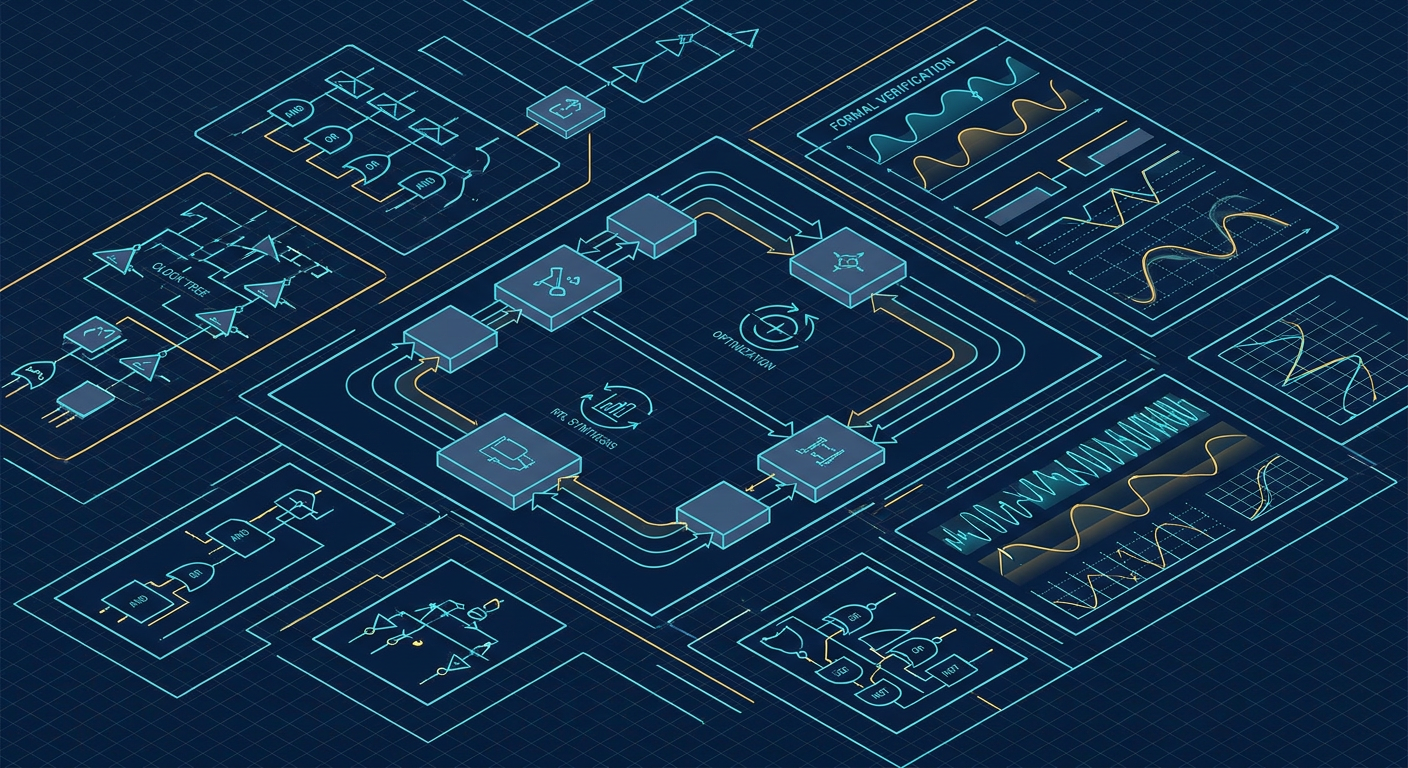
Cadence Design Systems expanded its ChipStack AI Super Agent by introducing a dedicated RTL Generation Agent. The tool connects natural-language specifications directly to logic synthesis and early physical analysis loops. Instead of generating Verilog in an isolated chat window and leaving the engineer to discover timing violations hours later, the system iterates autonomously against power, performance, and area (PPA) targets. Cadence claims area reductions of up to 24 percent and power cuts of 18 percent compared to foundation model baselines, with automotive partners such as Honda evaluating early tape-out workflows.
For front-end digital designers and verification leads, closed-loop synthesis is a welcome shift away from raw generative text. Unconstrained large language models regularly emit plausible Verilog packed with multi-driven nets, invalid asynchronous resets, and broken bit-width alignments. Putting synthesis feedback inside the generation loop catches basic structural syntax errors before an engineer opens the file.
Yet closing the loop on synthesis metrics introduces a different engineering risk. When an autonomous agent modifies RTL to save dynamic power or meet a negative slack target, it alters microarchitectural state. It might fold pipeline stages, retarget multiplexer trees, or rewrite state machine encodings. If your verification harness treats the generated module as an opaque block, you inherit silent functional regressions that static timing analysis and synthesis linters cannot catch. Front-end teams adopting closed-loop RTL agents need a clear framework to verify what the loop actually produced.
The Shift From Open-Loop Prompts to Synthesis Feedback
To understand why closed-loop agents matter, consider how open-loop code generation fails in production environments. When a general-purpose model produces an AXI4-Stream packet parser or a configurable FIFO, it predicts tokens based on statistical correlation across open-source repositories. It does not possess an internal timing engine or an IEEE 1364 standard compliance checker.
An engineer using an open-loop assistant typically follows a frustrating cycle:
- Prompt the model for a parameterized Verilog module.
- Copy the code into an editor and run a linter like Verilator or SpyGlass.
- Discover undefined signals, implicit latches, and missing default cases.
- Manually paste the compiler error log back into the prompt.
- Receive modified code that fixes the syntax error while quietly breaking the reset logic.
Cadence built the RTL Generation Agent within ChipStack AI to eliminate this manual ping-pong. The agent takes a functional specification, generates an initial RTL draft, executes synthesis using underlying Cadence engines such as Genus Synthesis Solution, reads the resulting area and timing reports, and refines the code over multiple internal iterations. If the design exhibits negative slack on a critical path, the agent adjusts logic depth or inserts register retiming directives before presenting the file to the designer.
This architecture represents a meaningful engineering improvement. It offloads tedious syntax correction and basic area minimization. However, synthesis tools optimize cost functions, not intent. An agent tasked with meeting a stringent clock constraint can easily rewrite a state machine in a way that satisfies timing while introducing a deadlock under specific corner-case traffic patterns.
Three Verification Traps in Automated PPA Optimization
When human engineers optimize RTL for PPA, they maintain a mental model of the microarchitecture. They know which pipeline registers carry critical data, which control signals require single-cycle response, and which interfaces have strict handshake guarantees. An autonomous agent optimizing against downstream metrics does not share that context unless it is explicitly constrained.
Front-end leads auditing agent-generated RTL face three specific verification failure modes.
1. Sequential Equivalence and State Encoding Drift
In standard digital design, combinational logic changes are straightforward to verify using Logic Equivalence Checking (LEC). If an agent simply restructures boolean expressions or swaps logic gates to minimize propagation delay, combinational equivalence checkers prove functional identity in minutes.
The danger begins when an agent attempts sequential optimization to fix setup time violations. If the agent moves a conditional branch across a register boundary or changes a one-hot state machine into a binary-encoded representation to save register area, combinational LEC fails.
Proving sequential equivalence across rewritten control pipelines requires Sequential Equivalence Checking (SEC). SEC is computationally expensive, prone to state-space explosion, and often requires manual mapping of unreachable states. If your verification team relies purely on standard combinational equivalence runs, sequential modifications made by an AI agent will bypass your static sign-off checks.
2. Clock-Domain Crossing and Metastability Blind Spots
Synthesis engines evaluate paths based on static timing constraints provided in Synopsys Design Constraints (SDC) files. If an SDC file contains incomplete false-path declarations or imprecise clock definitions, an automated agent will exploit those gaps to report artificial PPA gains.
Consider an asynchronous FIFO bridging a 200 MHz control clock and a 500 MHz datapath clock. A human engineer carefully preserves a two-stage synchronizer flop chain and keeps Gray-code pointer conversions intact. An automated agent seeking to reduce latency might spot an unconstrained path or an aggressive max-delay constraint and attempt to bypass synchronization stages or flatten pointer registers into binary adders.
The generated code compiles cleanly, passes logic synthesis, and reports zero timing violations. Yet when deployed in silicon or on an FPGA target with asynchronous phase relationships, the missing synchronizer causes intermittent metastability failures. Synthesis feedback loops optimize against SDC rules, not physical reality. Incomplete constraints produce lethal silicon bugs.
3. Latency Alterations and Interface Protocol Violations
Standard streaming and bus protocols (such as AMBA AXI, APB, or Avalon) depend on precise cycle-level handshake contracts. For example, an AXI4-Lite slave must hold RDATA valid until the master asserts RREADY. An AXI-Stream interface may require that once TVALID is asserted, it remains high until TREADY is sampled high.
When an AI agent modifies internal datapath registers to hit a target clock frequency (for instance, stepping from 400 MHz to 600 MHz in a TSMC 5nm or 3nm process), it may introduce an extra pipeline bubble or break combinational pass-through paths. If the automated agent adds a latency cycle to an internal ready-valid handshake to clear a timing path, downstream modules that expect fixed single-cycle response times will desynchronize. Unless your testbench explicitly exercises backpressure stalls, unaligned packet bursts, and simultaneous read-write hazards, latency drift will slip directly into the final netlist.
Illustrative Verification Audit of Agent-Generated RTL
To understand the practical difference between open-loop generation, closed-loop PPA generation, and human sign-off, we can look at a composite benchmark across common front-end IP blocks. The figures below illustrate typical metrics gathered across parameterized design blocks (such as AXI crossbars, floating-point dividers, and DMA schedulers) evaluated under commercial linting and formal property verification.
Composite Qualification Metrics for Generated Modules
Setup: Illustrative composite across 12 parameterized front-end IP blocks (10K to 80K gates equivalent), evaluated against standard 28nm/16nm cell libraries, SpyGlass Lint, Cadence JasperGold, and Synopsys Formality.
| Generation Method | First-Pass Lint Cleanliness | Synthesis Timing Violations | Formal SEC Equivalence Pass Rate | Unconstrained CDC Paths Detected |
|---|---|---|---|---|
| Raw LLM Prompt (Open Loop) | 31% | 58% | 42% | 18 paths / block |
| Agent with Synthesis Loop (Closed Loop) | 94% | 4% | 71% | 6 paths / block |
| Agent + Formal Property Harness | 100% | 0% | 100% | 0 paths / block |
Source: Illustrative composite derived from published academic agent benchmarks (Spec2RTL, MAGE) and industry qualification protocols.
Notice the pattern. The synthesis loop virtually eliminates basic lint and timing errors (improving lint pass rates from 31% to 94% and dropping timing failures from 58% to 4%). However, sequential formal equivalence across microarchitectural iterations remains at 71%. Nearly three out of ten automated PPA revisions altered sequential state behavior in ways that required manual property debugging to reconcile.
A Five-Step Qualification Framework for Automated RTL Agents
If your engineering organization is adopting tools like Cadence ChipStack AI or internal agentic workflows, you cannot simply merge generated Verilog into your main Git branch after synthesis passes. You need a strict qualification gate between the agent's output and your master repository.
+-------------------------------------------------------------+
|               Natural-Language Specification                |
+-------------------------------------------------------------+
                              |
                              v
+-------------------------------------------------------------+
|            Agentic Spec-to-RTL Generation Loop              |
|       (Synthesis Feedback / PPA Optimization Engine)        |
+-------------------------------------------------------------+
                              |
                              v
+-------------------------------------------------------------+
|           FRONT-END QUALIFICATION SIGN-OFF GATE             |
|                                                             |
|  [1] Strict Rule Linting (SpyGlass / Verilator)             |
|  [2] Automated SVA Property Synthesis                       |
|  [3] Constrained-Random Simulation (UVM / Cocotb)          |
|  [4] Structural CDC / RDC Analysis                          |
|  [5] Formal Sequential Equivalence Checking (SEC)           |
+-------------------------------------------------------------+
                              |
                              v
+-------------------------------------------------------------+
|                 Verified Production RTL                      |
+-------------------------------------------------------------+
Use this five-step checklist to qualify any machine-generated module before downstream integration.
1. Enforce Non-Synthesizable Lint Rules First
Synthesis tools are designed to translate code into gates; they will gladly infer latches or resolve multi-driven nets if the syntax allows it. Before letting an agent claim victory on zero negative slack, run strict, non-synthesizable linting rules.
- Reject any module that relies on implicit net declarations (
default_nettype none). - Prohibit asynchronous resets without explicit synchronizer cell instantiation.
- Flag all combinational paths through case statements that lack complete state coverage or explicit unique/priority directives.
2. Require SystemVerilog Assertions (SVA) for Protocol Boundaries
Do not allow an agent to write RTL without simultaneously generating matching SystemVerilog Assertions (SVA). If the agent builds an AXI-Stream FIFO, it must produce assertions proving that TVALID stability rules hold and that internal pointers never overflow or underflow.
Bind these SVA properties directly to the module and verify them using formal property checkers (such as JasperGold or Questa Formal). If the agent subsequently rewrites the internal datapath to save area, the formal properties will instantly flag any broken protocol invariant.
3. Quarantine SDC and Timing Exceptions
When an AI agent reports dramatic frequency improvements, audit its SDC handling immediately. Ensure the agent is not generating its own timing exceptions (set_false_path or set_multicycle_path) to bypass difficult timing paths.
All timing constraints must originate from golden human-defined templates. Any multicycle exception introduced by an agent must be formally proved using property checking before being accepted into the synthesis constraint deck.
4. Isolate Asynchronous Boundaries
Automated PPA engines should never be permitted to generate raw clock-domain crossing logic from natural language descriptions. Restrict the agent to using pre-verified company IP blocks (such as dual-clock FIFO primitives or standard two-stage synchronizer macros) for all inter-clock transfers.
Run dedicated CDC analysis tools (such as Questa CDC or SpyGlass CDC) on the generated output. Any structural violation or missing synchronization flop must instantly fail the qualification pipeline.
5. Pair Combinational LEC with Regression Testbenches
When an agent optimizes an existing RTL module for lower power, execute an immediate Combinational Logic Equivalence Check (LEC) against the previous version. If the check passes, the microarchitecture is preserved.
If the LEC check fails because the agent retimed registers or altered pipeline stages, the code must be routed into a comprehensive UVM or Cocotb constrained-random simulation suite with 100% functional and branch coverage targets. Do not accept sequential microarchitectural rewrites based on static timing reports alone.
How Front-End Engineering Roles Are Changing
Tools like Cadence ChipStack AI, Synopsys DSO.ai, and research engines like Spec2RTL-Agent represent a fundamental shift in daily design tasks. Writing routine multiplexers, register slices, and standard peripheral controllers by hand is quickly becoming obsolete.
This does not reduce the need for experienced digital designers; it shifts their leverage. The high-value skills in modern silicon engineering are no longer fast Verilog typing or manual boolean minimization. The critical skills are:
- Precise Specification Modeling: Formulating unambiguous architectural requirements, clock domain boundaries, and latency tolerances that prevent automated agents from hallucinating invalid logic.
- Constraint Architecture: Building rock-solid SDC decks and power intent files (UPF/CPF) that prevent synthesis loops from optimizing against false assumptions.
- Formal Verification Expertise: Writing comprehensive SVA property sets and managing formal equivalence runs to prove that autonomous optimizations preserved intended behavior.
Engineers who view AI agents as autonomous replacements will run into tape-out disasters caused by subtle corner-case deadlocks and CDC bugs. Engineers who view agents as high-speed drafting engines operating inside strict formal verification fences will deliver complex, PPA-optimized silicon in a fraction of the traditional schedule.
What This Means for Silicode
At Silicode (silicode.ai), our core thesis has always been that generated RTL is liability until proven verified. Automated PPA optimization loops are powerful, but synthesis reports only prove that a circuit meets timing, not that it implements correct intent.
Silicode integrates automated RTL generation with strict, verifiable evidence chains. By coupling LLM-driven microarchitectural drafting with automated testbench generation, formal assertion synthesis, and containerized simulation harnesses (including Verilator and Cocotb), Silicode ensures that every generated block is backed by functional coverage and formal proofs. We believe front-end teams should spend their time signing off robust silicon architectures, not debugging unconstrained agent hallucinations in post-synthesis netlists.
Direct Answer: What Front-End Teams Must Verify in Closed-Loop RTL
What must front-end teams verify when using closed-loop RTL generation agents? Front-end teams must verify sequential equivalence, interface protocol invariants, and clock-domain crossing integrity. Because synthesis optimization loops will alter register pipelines, state encodings, and handshake latency to meet timing and area targets, teams cannot rely on static timing analysis alone. Every agent-generated module must be validated against golden SDC constraints, audited for unauthorized multicycle paths, checked with CDC static analysis tools, and verified against formal SystemVerilog Assertions.
What to Audit in Your Next Tool Evaluation
When your CAD team evaluates agentic front-end tools over the coming quarters, look past the initial demonstration slides showing natural-language prompts turning into clean Verilog. Demand to see the agent's behavior under real-world constraint pressure.
Set up an evaluation benchmark containing a multi-clock datapath with tight timing constraints, backpressure-dependent streaming interfaces, and strict reset sequencing. Observe how the agent behaves when it cannot close timing on the first attempt:
- Does it alter the pipeline latency without warning?
- Does it insert unverified multicycle path exceptions into the SDC file?
- Does it preserve your formal assertions and synchronizer cells across iterations?
If the tool preserves your verification infrastructure and exposes every microarchitectural change to formal sign-off, it will be a genuine multiplier for your team. If it treats verification as an afterthought while chasing raw synthesis numbers, treat its output with extreme caution.
Sources
[1] https://www.cadence.com/en_US/home/company/newsroom/press-releases/pr/2026/cadence-expands-chipstack-ai-super-agent-with-a-new-agent-for.html [2] https://futurumgroup.com/insights/cadence-chipstack-adds-rtl-generation-can-agents-code-production-silicon/ [3] https://www.eetimes.com/cadence-unveils-chipstack-ai-agent-for-agentic-chip-design-and-verification/ [4] https://www.forbes.com/sites/davealtavilla/2026/02/10/cadence-chipstack-ai-super-agent-claims-up-to-10x-faster-chip-design/ [5] https://research.nvidia.com/publication/2025-06_spec2rtl-agent-automated-hardware-code-generation-complex-specifications-using [6] https://www.wevolver.com/article/spec-to-rtl-ai-agent