You add two standard 3S 2200mAh flight packs to your online cart for forty dollars, click through to shipping, and watch the total double. Carrier hazardous materials fees and dangerous goods surcharges can easily add thirty to fifty dollars to a single parcel of loose batteries.
This is not a temporary pricing glitch. The 67th edition of the International Air Transport Association Dangerous Goods Regulations, which took full effect in 2026, locked in mandatory 30 percent state-of-charge limits for lithium-ion and lithium-polymer packs shipped under packing instructions 965 and 966. For major express carriers like FedEx and UPS, handling stand-alone lithium batteries now triggers full Section I or Section IB dangerous goods processing, specialized cargo aircraft only routing, and hefty paperwork surcharges.
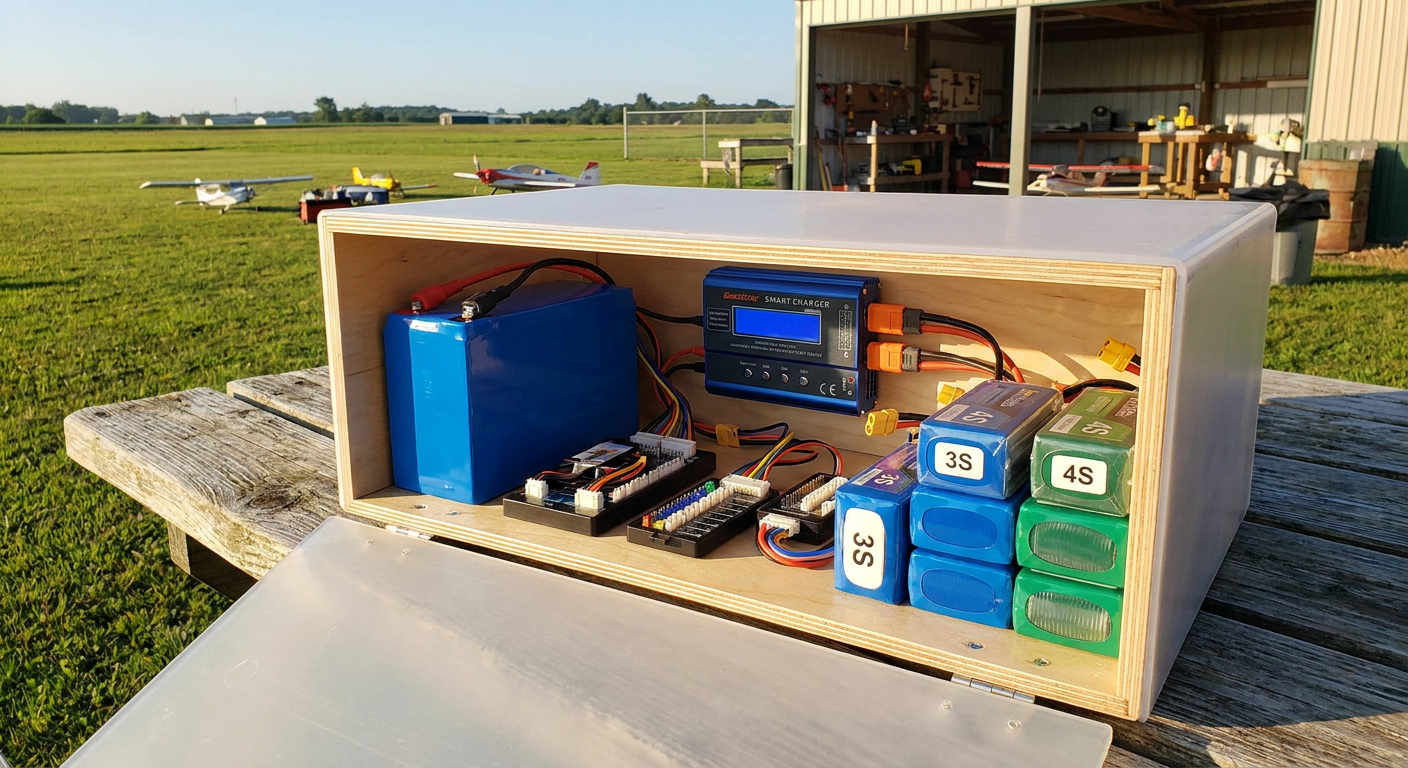
If you fly park flyers, sport planes, or 5-inch quads every weekend, buying eight to ten dedicated packs so you can fly all morning without recharging is no longer the most cost-effective path. The smarter, cheaper approach is buying three high-grade packs and turning a simple plastic toolbox into a self-contained 12V field charging station. With the right field setup, you can fly back-to-back flights until noon, protect your battery investment, and stop paying couriers more in hazmat fees than the cells are worth.
The True Math of Flight Packs vs Field Stations
When shipping was cheap, the default hobbyist strategy was simple: buy ten budget packs from an overseas warehouse, balance-charge them all at home on Friday night, fly them down to 20 percent capacity on Saturday morning, and pack up when the cooler bag was empty.
That strategy falls apart under today's shipping economics. If you factor in the per-order hazmat fees and the natural degradation of packs sitting fully charged or cycling through thermal strain, stockpiling ten packs per plane model is an expensive habit.
Consider what happens over a 200-flight season with standard 3S 2200mAh (24.4 Wh) or 4S 1500mAh (22.2 Wh) packs.
Illustrative Cost-Per-Cycle Comparison
The figures below represent an illustrative composite model based on average 2026 domestic hobby retail prices, international courier hazmat surcharges, and a baseline 200-flight operating season.
| Operational Strategy | Hardware Required | Upfront Gear Cost | Battery & Shipping Cost | Estimated Cost Per Flight | Pack Health at Season End |
|---|---|---|---|---|---|
| 10-Pack Stockpile (Home charge only) | Dual-channel AC home charger | $75 | 10x 3S packs ($220) + 2x Hazmat freight ($70) = $290 | $1.82 | Uneven wear; packs sit at 100% charge for hours, reducing lifespan to ~100 cycles |
| 3-Pack Rolling Field Station (Field charge) | 50Ah LiFePO4 battery ($110) + DC Smart Charger ($45) + Crate/Wiring ($25) = $180 | $180 | 3x 3S packs ($66) + 1x local ground shipping ($12) = $78 | $1.29 | Consistent cycling; packs are charged right before flight and stored at nominal voltage |
By moving the energy reservoir from a dozen small, fragile flight packs into one sturdy deep-cycle field battery, your upfront investment shifts into gear that lasts five to ten years. A quality 12V lithium iron phosphate (LiFePO4) battery easily delivers 2,000 to 3,000 discharge cycles, whereas high-C hobby LiPo packs rarely survive more than 150 to 200 aggressive flight cycles before their internal resistance climbs and flight times drop.
Choosing Your Field Power Reservoir
To build a field charger, you need a stable direct-current power source at the flight line. You have three practical options, each with distinct trade-offs in weight, cost, and maintenance.
1. 12V LiFePO4 Deep-Cycle Battery (The Best Modern Choice)
A 12V 50Ah or 100Ah LiFePO4 battery offers the best balance of safety, weight, and cycle life. A 50Ah unit weighs roughly 11 to 13 pounds (5 to 6 kg), provides about 640 Watt-hours of usable energy, and delivers steady voltage right down to 10 percent capacity. Because LiFePO4 chemistry is chemically stable and resistant to thermal runaway, it is much safer to transport in your car trunk on hot summer mornings than a stack of raw LiPo bricks. A 50Ah pack will recharge a standard 3S 2200mAh pack roughly 20 to 22 times before needing a home recharge.
2. Sealed Lead-Acid (SLA) or Marine Deep-Cycle (The Budget Junkyard Build)
If your budget is tight, a 12V 35Ah lawn tractor battery or deep-cycle marine SLA battery from a local auto supply store gets you on the flight line for under fifty dollars. The catch is weight and usable capacity. Lead-acid batteries degrade rapidly if discharged past 50 percent depth of discharge. That means a heavy 35Ah lead battery realistically yields only about 17Ah of usable power (roughly 200 Watt-hours), enough for 6 to 8 recharges on a 3S setup. It works well if you fly close to your car, but hauling a 25-pound lead brick out to a distant flight line gets old fast.
3. A 6S 5000mAh LiPo Brick (The Ultralight FPV Approach)
FPV pilots often use a single large 6S 5000mAh pack (111 Wh) as a mobile donor battery to charge smaller 4S 650mAh to 850mAh drone packs in a backpack. While light, this approach still leaves you dependent on ordering large LiPo packs subject to shipping surcharges. For fixed-wing flyers and general sport flying, a LiFePO4 reservoir is far more economical per Watt-hour.
Building the Field Charging Crate Step by Step
You do not need complex electrical engineering skills to wire a safe, dependable field charging station. You can build a clean setup inside a standard 50-caliber plastic ammo box or a small tool tote in an evening.
Bill of Materials
- Power Reservoir: 12V 30Ah to 50Ah LiFePO4 battery with screw terminals.
- DC Smart Charger: A compact DC-input balance charger capable of 10A to 15A output (such as an ISDT Q6 Nano, ToolkitRC M6D, or HOTA D6 Pro).
- Primary Circuit Protection: In-line automotive blade fuse holder with a 25A or 30A fuse.
- Main Wiring: 12 AWG or 10 AWG flexible silicone wire (red and black).
- Connectors: Amass XT60 or XT90 female connectors for charger output and input ports.
- Hardware: 8mm ring terminals (crimped and soldered for the battery posts), zip ties, and double-sided foam tape.
- Container: Plastic ammo box or small heavy-duty tool caddy with ventilation holes.
Assembly Instructions
- Prepare the Reservoir Terminals: Crimp and solder heavy-duty 8mm ring terminals onto your 10 AWG wire leads. Splice the in-line fuse holder into the positive (red) lead within three inches of the battery terminal. Never connect an unfused direct line to a high-capacity battery.
- Install the Input Tap: Terminate the fused leads with an XT60 or XT90 male connector. Mount this connector securely through the sidewall of your crate or leave it on a short 6-inch pigtail inside the box.
- Mount the Charger: Use heavy-duty hook-and-loop tape or 3D-printed brackets to secure your DC balance charger to the upper tray or lid of the crate. Ensure the charger's cooling fan and intake vents have at least an inch of clear airflow around them.
- Add Accessory Power: If you want to charge your radio transmitter or phone at the field, tap off the main 12V leads through a secondary 5A fused sub-circuit to a marine dual-USB panel mount jack.
- Label the Connections: Mark your input polarity clearly with permanent marker or heat shrink. While modern DC chargers have reverse-polarity protection, blowing an inline fuse at the flight line is an annoying way to start your morning.
Managing Field Workflow and Pack Longevity
Having a field charger changes how you manage your packs throughout the day. Instead of rushing through ten batteries, you run a disciplined three-pack rotation:
- Pack 1 is in the air (flying for 6 to 8 minutes).
- Pack 2 is resting and cooling down on the bench.
- Pack 3 is on the charger pulling a safe 1.5C to 2C charge.
The Cooling Rule
Never take a warm LiPo straight out of a plane and plug it into a fast charger. Charging a hot cell accelerates internal electrolyte breakdown and increases the risk of cell puffing. Let the pack sit in ambient shade for at least 8 to 10 minutes until the casing feels cool to the touch before starting the charge cycle.
Target Resting Voltages
Set your flight timer so you land with your cells resting at 3.75V to 3.80V per cell. If you land with cells depleted down to 3.2V or 3.4V under load, your charger has to work twice as hard in constant-current mode to recover the pack. Landing at 3.75V resting voltage leaves roughly 20 percent capacity in the pack, allows for a quick 15-to-20-minute field recharge at 1.5C, and extends the operational life of your battery from 100 cycles to well over 250 cycles.
Storage Charge Before You Leave
One of the best benefits of an active field station is end-of-day battery care. When you decide to pack up the car, set your DC charger to "Storage Mode." Because your packs are already at roughly 3.75V to 3.80V per cell from your last flight, bringing them to the ideal long-term storage level of 3.85V per cell takes only two to three minutes on the bench. You head home with every pack safely balanced and chemically stable, ready for storage on your garage shelf without any midweek maintenance.
Smarter Ways to Source Your Packs Locally
While a field charging station cuts down the total number of batteries you need to buy, you will still occasionally need fresh flight packs. You can avoid air freight surcharges by changing how and where you buy:
- Support Your Local Hobby Shop: Local hobby shops buy bulk inventory that arrives via palletized ground or ocean freight, spreading hazardous shipping overhead across hundreds of items. A pack on a local store peg might carry a slightly higher sticker price than a direct-from-factory listing, but when you factor in the thirty-dollar air freight surcharge on direct orders, the local shop is almost always cheaper.
- Organize Club Group Orders: If your local club needs replacement batteries for spring flying, pool your orders together into a single large ground-freight purchase. Ground hazmat shipping fees are charged per consignment box, not per individual battery. Splitting a single $35 ground hazmat charge across eight club members drops the shipping burden to less than five dollars per person.
- Look for Regional Ground Warehouses: When shopping online, filter specifically for regional or domestic ground warehouses that ship via standard parcel post (ground only) rather than international air couriers. You might wait four days for delivery instead of two, but you will avoid international dangerous goods surcharges entirely.
What this means for MyRC
Building dependable airframes and keeping your fleet airborne requires balancing power system weight, motor draw, and field logistics. MyRC (myrc.ai) helps hobbyists and makers model airframe performance, motor-propeller combinations, and battery loadouts before spending money on gear. By focusing on practical setups and real-world flight line realities, MyRC makes it easier to design planes that fly efficiently on standard, widely available pack sizes that do not break your hobby budget.
Questions and Answers
Q: How do I build a budget field charging station to beat battery shipping surcharges? A: Connect a 12V 30Ah to 50Ah LiFePO4 battery through a 25A inline fuse to a compact DC-input balance charger inside a plastic ammo box. A three-pack rotation (one flying, one cooling, one charging at 1.5C) lets you fly all morning while avoiding the cost of buying and shipping ten separate flight packs.
Action Checklist for the Flight Line
- Check your current battery inventory and retire puffed or high-resistance packs safely.
- Pick up a 12V LiFePO4 deep-cycle battery (30Ah to 50Ah) from an automotive or solar supplier.
- Wire a dedicated DC charge crate using 10 AWG wire and a 25A automotive blade fuse.
- Set your plane's flight timer to land at 3.75V resting per cell for faster field turnarounds.
- Use your field station's storage function to balance packs to 3.85V before driving home.
Sources
- IATA 2026 Dangerous Goods Regulations and Battery Guidance
- IATA Battery Shipping Regulations Manual
- Hazmat School Overview of 2026 Lithium Battery Rules
- FAA Interactive Guide to Shipping Lithium Batteries
- FedEx Lithium Battery Shipping Guidelines and Surcharges
- HobbyKing Guide on Safe LiPo Charging Practices
- UAV Model LiFePO4 Portable Field Rig Guide
- Radio Control Info Field Charging Setup Analysis