A clip made the rounds recently from Hyderabad startup UAV.tech showing a micro-turbine drone launching cleanly from the back of a moving pickup truck. Within forty-eight hours, every RC club group chat had someone asking the exact same question: why are we still tearing up our landing gear on rough grass when we could just drop a release rail on a roof rack and drive down the runway at thirty miles per hour?
It sounds brilliant on paper. If your jet needs fifty miles per hour of clean airspeed to get off the deck, and your truck is doing thirty-five, you only need fifteen miles per hour of thrust-driven acceleration to fly away cleanly. No long rollout, no nose gear snapping on molehills, no burning up expensive five-inch wheels on cracked asphalt.
Then you actually try it, or you watch someone at the field try it. Most of the time, the airframe ends up cartwheeling into the ditch, the flight controller freaks out before it leaves the bed, or the turbine ingests a blast of dirty cab air and flames out ten feet off the tailgate. Moving vehicle launches look easy on military test ranges and startup demo reels, but they introduce a specific nest of aerodynamic and mechanical problems that will chew up standard hobby hardware.
The Physics Everyone Forgets in the Bed of a Truck
The math behind a moving launch is simple enough. You want to bypass the high-drag, low-lift regime where heavily loaded jets struggle. An 80mm or 90mm electric ducted fan (EDF) jet, especially a scale bird like a Freewing F-16 or an A-10 loaded with ordnance, has miserable static thrust compared to its flying weight. A jet might produce three kilos of static thrust on the bench, but once it gets moving, the fan unloads and works much more efficiently. If you start the flight with thirty knots of wind already rushing through the intake, the fan does not have to fight the dead weight of the model from a dead stop.
Aircraft carriers have relied on this trick for a century. The ship steams into the wind at twenty-five to thirty knots, adding free airspeed over the deck before the catapult stroke even starts. When the US Navy fires a jet off a C-13 steam catapult or an electromagnetic EMALS track, they are stacking carrier speed on top of catapult acceleration to get a sixty-thousand-pound aircraft flying in three hundred feet.
Here is what the carrier has that your pickup truck does not: clean, laminar air.
A pickup truck is an aerodynamic disaster. Air hits the front bumper, splits around the hood, hits the flat windshield, climbs up over the cab, separates into a massive turbulent wake, and tumbles directly into the truck bed. If you mount a model jet on a rail in the bed or just above the tailgate, it is not sitting in clean headwind. It is sitting in a boiling low-pressure eddy.
For a micro turbine like a KingTech K-30 or a Swiwin SW45B, that turbulent air can cause compressor stalls before you even drop the release pin. Turbines hate dirty intake air. If the airflow across the intake ring is tumbling and detached while the engine is spooling from idle to its 180,000 RPM sweet spot, the combustion chamber temperature spikes instantly. If you get a flameout while sitting on a moving truck bed, you are suddenly carrying a very hot, five-hundred-dollar glider moving at thirty miles per hour straight toward the ground.
For an EDF, the turbulent air simply starves the rotor. You hear the fan scream as it cavitates in dirty air, producing half the expected thrust right when the mechanical latch lets go.
Flight Controllers Hate Moving Platforms
Ten years ago, launch experiments were purely manual. You held the elevator stick slightly back, your buddy stepped on the gas, and you flipped a manual toggle switch to let the plane fly off a cradle. Today, almost everyone flying fast composite wings or expensive EDFs has an autopilot or gyro onboard, whether it is an ArduPilot Matek board, an INAV flight controller, or a basic Spektrum AS3X receiver.
Gyros and accelerometers do not understand moving trucks.
When you power up a flight controller, the inertial measurement unit (IMU) assumes the aircraft is resting on a stationary earth. It measures the gravity vector straight down and zeros out the rate gyros. If you arm the system while parked and then start accelerating down a dirt strip or paved farm road, the accelerometers register forward acceleration as a tilt. The artificial horizon will often lean backward because the sensors cannot immediately separate forward linear acceleration from gravitational pull without solid GPS integration.
If you have an auto-level or launch mode engaged, the flight controller thinks the nose is pointing thirty degrees up into the sky while you are driving. The moment the plane releases from the rail, the flight controller shoves the elevons full down to "correct" the pitch attitude. The jet lawn-darts into the tailgate or the tarmac behind you before your thumbs can react.
GPS locks also get confused if you configure dynamic arming incorrectly. ArduPilot supports moving baseline launches for maritime and vehicle applications, but it requires specific parameter changes to disable pre-arm velocity checks. If you try running a standard fixed-wing setup off a moving platform, the software will throw an EKF variance error or an accelerometer inconsistency warning the second the truck hits twenty miles per hour. If it locks out your control surfaces right as you release the latch, you are done.
The Cab Blocks Your Radio Link
Radio propagation during a moving launch creates another sneaky failure point.
Most pilots trying this stand either in the bed next to the jet or out on the side of the runway while a friend drives the truck. If you stand on the side of the runway, you are dealing with a moving target that changes orientation relative to your transmitter antenna every millisecond.
If you stand behind the truck and the driver moves away from you, the metal cab, the steel frame, the engine block, and the tailgate are directly between your transmitter and the receiver inside the model fuselage. At 2.4 GHz, and especially at 900 MHz or with modern ExpressLRS and Crossfire setups running directional patch antennas, shooting through a steel cab full of electronics causes massive packet loss.
If the plane drops into failsafe for just a quarter of a second at the exact moment of mechanical release, standard failsafe settings will drop the throttle to zero or hold last input. An unpowered, heavily loaded jet coming off a guide rail at thirty miles per hour has about half a second of energy before it runs out of airspeed and drops a wing.
If you stand in the bed of the truck with the radio, you have clear line-of-sight to the jet, but now you have to fly the aircraft from a moving frame of reference. Human depth perception and visual tracking fall apart when you are moving at thirty miles per hour while trying to judge the roll angle of a thirty-inch foam wing flying at fifty miles per hour away from you. You will over-correct on aileron almost every single time.
Structural Loads and the Cradle Hang-Up
Look at how real catapult systems release an aircraft. On a carrier deck, a holdback bar snaps cleanly once the catapult cylinder builds full pressure. The shuttle pulls the nose gear forward, and the airplane is pulled straight down the track.
When hobbyists build moving truck mounts, they usually construct a cradle out of PVC pipe or welded aluminium tubing lined with foam pipe insulation. The plane rests on the cradle, held back by a servo-operated pin, a mechanical tow-line latch, or purely by friction until the motor reaches full throttle.
Here is what actually happens on the track:
+-----------------------+-----------------------------+-----------------------------+
| Launch Method         | Main Structural Risk        | Common Point of Failure     |
+-----------------------+-----------------------------+-----------------------------+
| Truck Roof/Bed Cradle | Asymmetric wing twist       | Ailerons catching cradle    |
| Moving Bungee Tow     | High tension line snap      | Hook tearing out of foam    |
| Static Bungee Rail    | Over-rotation on exit       | Nose-hook friction hang     |
| Hand Launch (EDF)     | Low-speed stall / torque roll| Wing drop before fan spools |
+-----------------------+-----------------------------+-----------------------------+
As the truck drives forward, the jet begins generating lift while still physically sitting in the cradle. But lift is never perfectly balanced across both wings. A slight side gust across the runway makes the left wing generate lift a fraction of a second before the right wing.
The left wing rises, canting the fuselage sideways inside the cradle. Now the guide pins or fuselage supports are binding against the fuselage skin under hundreds of grams of lateral friction. When you flip the release switch, the plane does not pop up into clean air. One side hangs up on the PVC rail, the aircraft yaws violently into the cab or off the side of the truck bed, and the trailing edge of an elevon or flap catches on the launch structure.
Foam airframes suffer the worst here. EPO foam is flexible. When a 90mm jet is pinned against a launch rail by a combination of aerodynamic drag, turbulent buffeting, and partial lift, the fuselage compresses. The wings flex upward, changing the angle of attack of the stabs. When the holdback releases, all that stored elastic energy in the foam snaps back, kicking the tail up and sending the jet nose-down.
Why the Static Bungee Ramp on Grass Still Rules
If moving vehicle launches are full of aerodynamic, electronic, and structural traps, what actually works for high-speed, high-wing-loading jets?
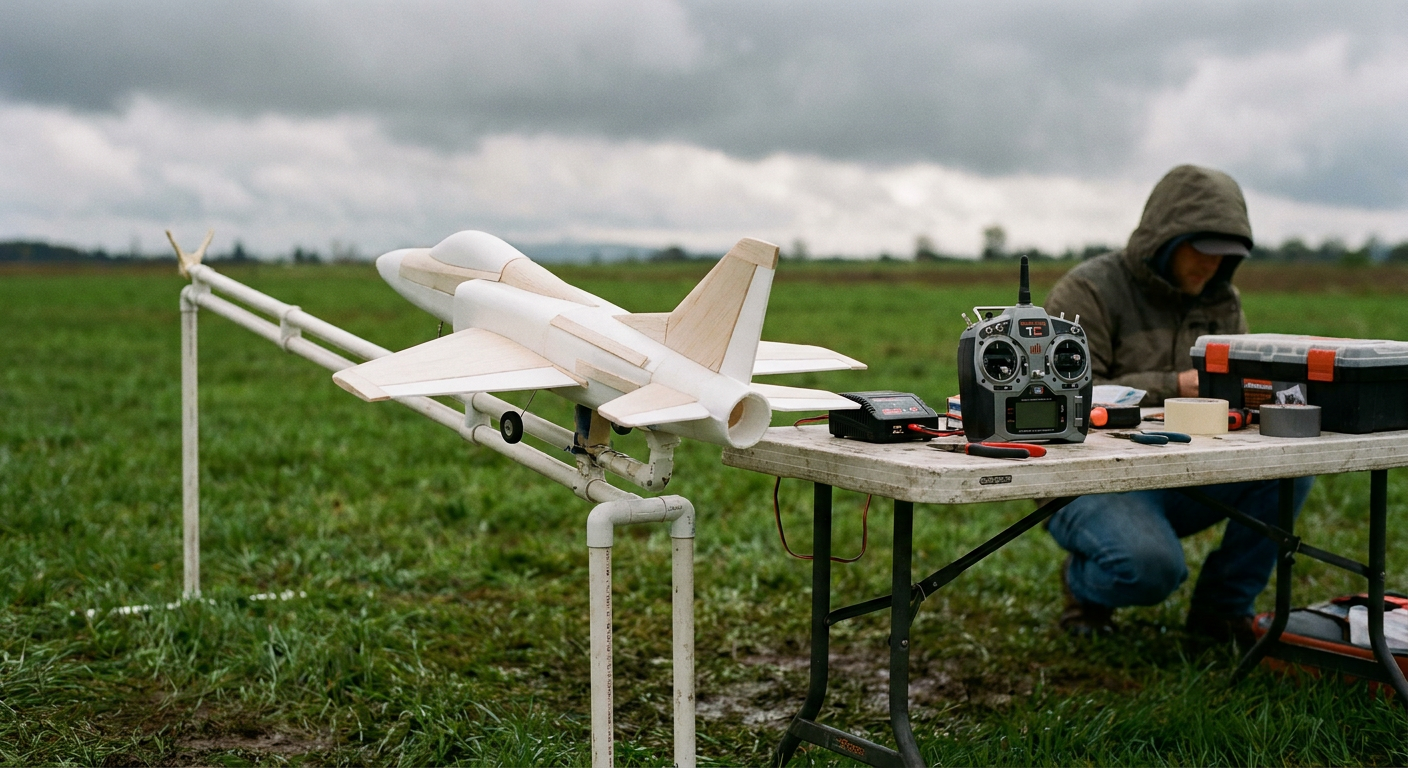
The answer has been sitting in the trunks of seasoned jet flyers for thirty years: a simple ground rail, ten meters of heavy surgical tubing or hobby bungee rubber, and a foot pedal release.
A ground bungee ramp gives you all the advantages of a moving vehicle launch with none of the chaotic failure points:
- The airframe stays completely stationary until the exact millisecond of launch. Your flight controller initialises on flat, unmoving ground. Accelerometers read true level, GPS locks have zero velocity drift, and your control surfaces are exactly where they belong.
- The radio link is rock solid. You are standing five paces behind the launch rail, transmitter in hand, with a direct line of sight to the receiver antennas and no metal car body blocking the signal.
- Acceleration is straight and progressive. When you tap the mechanical foot pedal, the stretched rubber snaps the tow ring forward. A standard eight-millimeter or ten-millimeter silicone bungee cord will pull with three to five times the model's weight in initial force, accelerating a three-kilo jet from zero to forty miles per hour in less than twenty feet.
- Clean air only. The ground rail sits in undisturbed, laminar ground-level wind. Intakes ingest pure, straight air, letting micro turbines spool to full power while anchored to the ground before you drop the foot pedal.
Setting up a proper bungee rail takes thirty dollars in hardware store PVC pipe, some ground stakes, and good-quality UV-resistant rubber tubing.
The Golden Rules of Bungee Hook Geometry
The reason people abandon bungee ramps and look for crazy truck setups is usually because their first bungee launch went wrong. Almost every bungee launch failure comes down to hook placement.
If you put the tow hook right at the Center of Gravity (CG), the rubber will pull the aircraft down the rail, but as soon as the nose leaves the pipe, the upward pull of the line will pitch the nose violently up. The plane stalls, snaps, and piles into the grass five feet past the ramp.
If you put the hook too far forward near the nose cone, the rubber will pull the nose down into the dirt, preventing the aircraft from rotating even after it reaches full flying speed.
The sweet spot for almost every delta wing, swept EDF, and micro turbine jet is between twenty and thirty degrees forward of the CG, measured from the bottom of the fuselage. The hook should angle backward at roughly forty-five degrees so that the steel tow ring falls away under gravity the moment the model overtakes the line or the tension drops to zero.
When checking your hook placement and calculating static wing loading on tools like myrc.ai, make sure you factor in the thrust line of the motor. A high-mounted micro turbine with a downward thrust angle will fight a bungee hook differently than a centerline EDF. If the numbers show a high stall speed, lengthening the bungee pull by five yards is ten times safer than trying to launch from the roof of an SUV.
Turbine Spool Times and the Static Advantage
Electric fans are easy to time: you hit full throttle on the radio, wait one second for the ESC to ramp up, and kick the release pedal. Modern brushless setups on 6S or 8S packs hit maximum thrust almost instantly.
Turbines do not work that way. A micro turbine can take anywhere from three to six seconds to transition from its stable ground idle up to full spool.
If you try to launch a turbine from a moving vehicle, the driver has to coordinate speed, runway distance, vehicle braking room, and the engine spool curve all at once. If the driver runs out of runway while the pilot is waiting for the turbine to hit full thrust, you either have to slam the vehicle brakes (which throws the jet off the cradle prematurely) or abort the run at forty miles per hour.
On a ground-based bungee rail, turbine management is completely relaxed:
- Anchor the tail of the jet to a mechanical release pedal via a steel cable or heavy nylon loop.
- Hook the bungee cord to the belly of the jet and stretch it to the target tension.
- Start the turbine through its ground sequence. Let it stabilise at idle.
- Check your radio telemetry, fuel flow, and exhaust gas temperatures.
- Slowly advance the throttle stick to maximum. Listen for clean, full spool. Verify pump voltage and RPM on your telemetry screen.
- Once the turbine is screaming at full song and the tail latch is holding the combined pull of the bungee and the engine, step firmly on the mechanical foot pedal.
The jet leaves the rail already under maximum power, the bungee gives it an instantaneous 30-knot kick down the rails, the tow ring drops away cleanly, and the model climbs out at a comfortable, scale twenty-degree angle with clean control response from the start.
Practical Things to Build This Weekend
If you are flying heavy foam jets or getting into micro turbines and you are sick of pulling broken retracts out of wing roots, skip the truck bed experiments and build a proper field kit.
- Get the right rubber: Do not use cheap braided cargo bungees from the gas station. They do not have the stretch ratio required for a progressive launch stroke. Buy six-millimeter to ten-millimeter pure latex or silicone tubing designed specifically for glider winches or marine spear-guns. You want a rubber that can stretch to two and a half to three times its resting length without snapping.
- Build a breakdown PVC rail: Use 1.5-inch furniture-grade PVC pipe. Build two parallel guide rails about six feet long, angled upward at roughly fifteen degrees, with a narrow channel down the middle for the belly hook. Stake the rear legs firmly into the ground with steel rebar or heavy tent pegs so the ramp cannot slide forward when the line is loaded.
- Use a mechanical foot pedal: Never rely on holding the model back by hand while an assistant pulls a pin. Build a simple wooden or metal rocker pedal with a steel release pin that captures a ring on the tail of the aircraft. When you step on the back of the pedal, the pin drops down, releasing the plane cleanly while both of your hands stay firmly on the transmitter sticks.
Leave the moving truck launches to defense contractors with closed test tracks, dynamic telemetry links, and airframes they are paid to smash into pieces. A forty-dollar bungee rig on flat grass will save your airframes, keep your flight controllers happy, and get your jets airborne safely every single Saturday.
Sources
- https://www.instagram.com/reel/DXYj0qEAiGA/
- https://migflug.com/afterburner/zero-to-165-mph-in-two-seconds-how-carriers-launch-jets/
- https://en.wikipedia.org/wiki/Aircraft_catapult
- https://thehill.com/policy/defense/6029103-trump-orders-navy-catapult-reversal/
- https://www.youtube.com/watch?v=xM3uvysz420