If you land at Dubai International with a foam wing in a cardboard box or try to order a stack of 4S LiPos to your flat in Al Barsha, you will run into the local rules fast. Airspace in the Emirates is some of the most strictly managed territory on earth. Between massive commercial airline corridors, military zones, and the rapid expansion of commercial Beyond Visual Line of Sight (BVLOS) delivery routes, you cannot simply wander out behind an apartment block with a transmitter and toss a glider into the air.
Yet the UAE still has one of the most active, well-funded RC communities you will find anywhere. You just need to know how the system works, where the tarmac runways are hidden in the dunes, and how to avoid having your flight controllers held in a customs warehouse in Garhoud.
The Squeeze on Open Airspace
The days of informal park flying in city limits are gone. Over the past few years, the General Civil Aviation Authority (GCAA) and the Dubai Civil Aviation Authority (DCAA) have locked down urban airspace. A big reason is security, but another major driver is the Dubai Future Foundation BVLOS Drone Delivery Program. Dubai wants automated commercial corridors for medical supplies and parcel deliveries running between hubs across the city. When commercial delivery routes share low-altitude airspace with regular civil aviation, regulators have zero tolerance for uncoordinated hobby flights.
In practical terms, you cannot fly in public parks, around the Dubai Marina, along the Abu Dhabi Corniche, or in empty neighbourhood construction plots. Flying in these spots without explicit permits is a quick way to lose your gear and pick up a hefty fine. If you want to fly fixed-wing, scale helis, FPV wings, or multirotors, you have to do it at an approved club or a designated, registered zone.
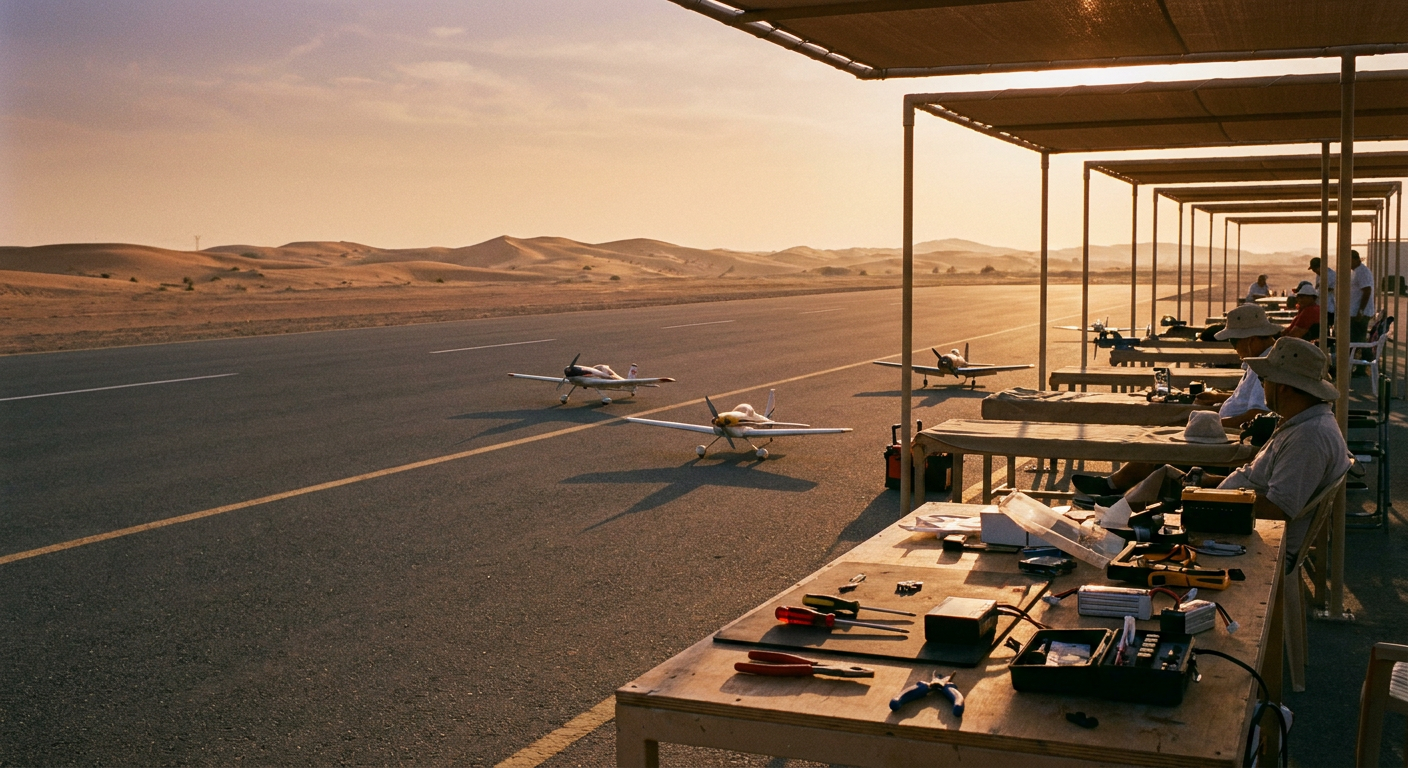
This sounds restrictive if you grew up flying in open farmland in Europe or North America. The flip side is that the sanctioned flying sites in the Emirates are world-class. Instead of a bumpy patch of grass mowed by volunteers once a month, you get full-scale tarmac runways with shaded pits, air-conditioned clubhouses, and charging stations.
Where You Can Actually Fly
SkyHub RC (Al Lisaili)
SkyHub RC is the crown jewel of hobby flying in Dubai. Located out in Al Lisaili along the Dubai-Al Ain Road, about thirty minutes from downtown, it feels like an executive airport scaled down to quarter size.
The main runway is a paved, perfectly flat strip several hundred metres long. It can handle everything from a twin-jet turbine F-16 weighing twenty kilograms to a delicate balsa trainer. The facilities include deep, shaded pit tables with mains power, dedicated turbine starting stations, frequency boards, and night flying lighting. Because it sits under approved, designated airspace coordinates, you can fly high-performance models and fast jets without looking over your shoulder. You will find weekend flyers with basic foamies sharing the flight line with competitive aerobatic pilots and turbine scale collectors.
SANAD Academy and Abu Dhabi Clubs
In Abu Dhabi, the scene centres around dedicated hobby strips and private academies like SANAD, alongside club fields tucked just outside urban development zones. The vibe in Abu Dhabi is heavily focused on scale builds, large warbirds, and high-spec helicopters. Like SkyHub, these fields operate under formal coordination with the local civil aviation authorities, which keeps everyone flying safely inside cleared vertical and horizontal boxes.
Sand Dunes and Remote Desert
Newcomers often ask why they cannot just drive forty minutes out into the open desert along the E611 or E66 and fly in the dunes. While people occasionally do this for casual micro-quad bashing or slow foam flyers, you need to be careful. Much of the open desert around Dubai and Sharjah falls directly under approach paths for DXB, Al Maktoum (DWC), or Sharjah International (SHJ), or sits right next to military training ranges. Even if the ground looks completely deserted, the sky above you might be a low-altitude transit corridor. If you want to stay strictly legal and avoid awkward conversations with local patrols, stick to club-registered ground.
Getting Flight Controllers and Transmitters Through Customs
Ordering electronics from international hobby shops like Banggood, GetFPV, HobbyKing, or AliExpress into the Gulf is generally straightforward, but radio gear and flight controllers can trip up customs screeners if you are not careful with how parcels are declared.
The UAE Telecommunications and Digital Government Regulatory Authority (TDRA) regulates all radio frequency devices coming into the country. If a package is flagged at customs with a description like "Long Range UAV Telemetry Unit" or "Military Drone Autopilot", it will be pulled for manual inspection and held until an import permit or compliance check is provided.
Here is how experienced local builders avoid shipping delays:
Keep Component Invoices Clear and Accurate
When ordering flight electronics, make sure the vendor's commercial invoice describes items simply and accurately. "RC Model Electronic Speed Controller", "Brushless Motor for Model Plane", or "Microcontroller Circuit Board" clear smoothly. Avoid vague buzzwords like "Long-Range Autonomous Drone Navigation System". Customs officers are looking for unapproved telecommunications hardware or restricted industrial survey equipment. A standard Betaflight or ArduPilot board for a hobby model is completely fine, but bad labelling can leave it stuck in an inspection queue for weeks.
Transmitters and Frequency Bands
Standard 2.4 GHz spread-spectrum systems (FrSky, RadioMaster, Futaba, Spektrum) clear customs without trouble. ExpressLRS (ELRS) 2.4 GHz gear is also widely used and accepted across local fields.
If you run 868 MHz or 915 MHz long-range gear (such as TBS Crossfire or ELRS 900), pay attention to frequency bands. The 868 MHz band aligns with European/MENA regional ISM spectrum allocations, whereas 915 MHz can sometimes overlap with regional cellular and industrial bands. For hobby use within line-of-sight club boxes, sticking to 2.4 GHz avoids all radio compliance headaches and provides lower latency anyway.
The LiPo Shipping Wall
LiPo batteries are the biggest logistical headache for RC flyers in the Gulf. Because Dubai is a massive global air transit hub, air cargo dangerous goods regulations are enforced with absolute strictness by Emirates, flydubai, and all major freight forwarders.
If you try to buy high-capacity 6S packs from an overseas warehouse using standard air shipping or freight forwarders like Aramex Shop & Ship or Emirates Delivers, your package will almost certainly be rejected at the origin consolidation warehouse. Most air couriers will not carry standalone lithium-polymer batteries above small consumer capacities unless the shipper pays steep Class 9 Dangerous Goods handling fees and packs them in UN-certified containers.
+-----------------------+-----------------------------+--------------------------------------+
| Purchase Route        | Typical Lead Time           | Pros / Cons                          |
+-----------------------+-----------------------------+--------------------------------------+
| Local Hobby Shops     | Same-day / 24 hours         | Higher price, limited C-rating picks |
| Maritime Freight      | 3 to 6 weeks                | Cheap per unit, huge minimums        |
| Regional Air Freight  | 4 to 10 days (DG certified) | High dangerous-goods surcharge       |
| Direct Chinese Rail   | Not available to GCC        | Must go via sea freight to Jebel Ali |
+-----------------------+-----------------------------+--------------------------------------+
Because of this, most local flyers source their batteries in two ways:
- Local hobby shops: Retailers in Dubai and Sharjah import LiPos in bulk via sea freight through Jebel Ali Port. You pay a retail markup compared to ordering directly from China, but you walk out of the shop with a fresh 4S or 6S pack in your hand immediately.
- Group sea-freight orders: Active club members and race teams pool their orders together several times a year. They place large orders directly with battery manufacturers (like CNHL, Tattu, or Ovonic) and ship a pallet via sea freight to Jebel Ali. It takes four to six weeks to arrive, but it brings the cost per pack down to standard factory rates.
Storing and Charging in the Desert Climate
Once you have your batteries, the local climate requires special respect. From May through September, ambient outdoor temperatures easily sit between 40°C and 48°C.
Never leave LiPo batteries in your car trunk or in an unconditioned garage during the summer. The internal temperature of a parked car in the UAE sun can exceed 70°C in an hour. At those temperatures, electrolyte breakdown accelerates rapidly, causing packs to puff, lose capacity, and risk thermal runaway.
Store all packs inside an air-conditioned room, ideally in sealed steel ammo cans or dedicated fireproof charging boxes. When you are at the field during summer morning sessions, keep your battery boxes inside your vehicle with the air conditioning running until ten minutes before your flight. After landing, let the packs cool down completely under a shaded fan before putting them on a charger. Charging a pack that is already hot from a hard flight in high ambient heat is the fastest way to ruin internal resistance.
Building and Tuning for Gulf Conditions
Flying in the Gulf requires a few mechanical adjustments that people flying in temperate climates rarely think about. Heat, fine desert dust, and intense UV exposure will find every weak link in your airframe.
The Foam Car-Boot Trap
Expanded Polyolefin (EPO) and Expanded Polypropylene (EPP) are tough, but they have a glass transition temperature that is surprisingly easy to hit inside a hot vehicle. If you leave a moulded foam plane sitting inside an SUV parked in the sun for an afternoon, the wing will bow and the tailplane will twist. Once foam warps under heat, getting the decalage and wing incidence back to true is nearly impossible. If you build with foam, transport your planes inside the air-conditioned cabin and store them on flat wall racks indoors.
Balsa and light-ply builds hold up much better to ambient heat, though you need to make sure your covering film (Oracover or Monokote) is well ironed down. The sharp jump from an air-conditioned room to 45°C humid morning air can cause covering to sag on open bay structures, requiring a quick touch-up with a heat gun.
Airframe Material Comparison for Gulf Summer Flying:
- EPO / EPP Foam: Light and crash-resilient, but warps easily in hot car boots.
- Traditional Balsa: Dimensionally stable in heat; covering film sags across humidity swings.
- Carbon / Glass Composite: Ideal structural rigidity; dark paint schemes soak up radiant heat.
Motor and ESC Thermal Headroom
If you are running a powertrain that sits near its thermal limit in a 20°C European climate, it will overheat and cut out in a UAE summer. Static motor tests in cool conditions do not reflect what happens when the intake air over your ESC is already 42°C.
Always derate your power systems by at least 20% for summer flying:
- If an ESC is rated for 60 amps, size up to an 80-amp or 100-amp unit with a large heatsink.
- Make sure your fuselage has dedicated air scoops that direct airflow across the ESC heatsink and out through an exhaust vent that is at least 1.5 times the area of the intake.
- Avoid tight, enclosed foam battery bays with zero airflow. High discharge rates combined with high ambient air will trigger ESC thermal shutdown mid-flight, dropping your model into the scrub.
If you design custom motor mounts or airframe components, tools like MyRC are handy for quickly sizing structural clearances and airflow paths before cutting materials or running test flights.
Dealing with Fine Desert Sand
Desert sand in the Gulf is not coarse beach sand. It is ultra-fine silty dust that gets sucked into everything.
Open-can outrunner motors will ingest fine dust during takeoffs and landings on unpaved areas. The tiny magnetic particles in the sand stick directly to the neodymium magnets inside the rotor, causing friction against the stator teeth and grinding down bearing seals.
To protect your powertrain:
- Stick to paved club runways or use a rollout landing mat if flying micro models in dirt areas.
- Blow out motor bells with compressed air after every flying session.
- Check servo gearboxes and pushrod linkages regularly. Dust buildup on greased metal gears turns into an abrasive paste that creates slop in control surfaces.
- Use sealed ball bearings wherever possible, especially on main shafts and tail assemblies of scale helicopters.
The Social Side: MAAD and Local Community
The RC scene across the Emirates is tightly knit. Because everyone flies at the same sanctioned clubs, you end up sharing pit tables with people from every corner of the globe. You will see weekend aerobatic sport flyers learning 3D maneuvers next to master builders who have spent three years hand-crafting twin-turbine scale airliners.
One of the highlights of the regional calendar is the Model Aircraft Airshow Dubai (MAAD). The event brings together regional flyers, international aerobatic pilots, and turbine jet teams. It is not just an airshow; it is the main social gathering where builders swap setup tips, buy and sell surplus airframes, and show off custom winter builds.
Outside of big events, most club coordination happens in active local WhatsApp and Telegram groups. If you are looking for a specific propeller pitch, need a spare 5V BEC on a Friday morning, or want to split a bulk order of balsa sheets, the club chats are where trades happen.
Practical Checklist for New Flyers in the Gulf
If you are setting up your gear in the UAE this season, work through this checklist before your first pack:
- Register with the flying club first. Reach out to the team at SkyHub RC or your local emirate club. Get your membership sorted, understand the local pit rules, and get introduced to the flight marshals.
- Check your radio frequency setup. Stick to standard 2.4 GHz for rock-solid line-of-sight flying. If you run telemetry or long-range links, confirm you are operating on approved regional bands.
- Plan your battery supply early. Do not rely on fast air shipping for high-capacity LiPos. Connect with local hobby shops or join club group buys to secure your packs before the flying season peaks.
- Over-cool your electronics. Add cooling scoops to foam fuselages, upsize your ESCs, and never leave fully charged packs inside a parked car.
- Clean your gear after every session. Keep an air duster and clean microfiber cloths in your flight box to purge fine sand from motors, bearings, and gimbal mechanisms before you pack up for home.
The flying season in the Gulf runs at full throttle from October through April, when the weather is clear, sunny, and around 25°C every single weekend. Get your club pass sorted, prep your power systems for the climate, and you will find some of the best tarmac and clearest flying skies anywhere in the world.