Every couple of months, another viral tech clip makes the rounds across RC forums and group chats. You have probably seen them. A university lab or aerospace research group shows off an experimental propulsion system with zero moving parts. Sometimes it is an electrohydrodynamic ionic flyer that hisses with purple corona discharge. Other times it is an acoustic levitation rig or a piezo-driven micro-thruster promising silent, solid-state flight. The comments immediately fill up with people wondering when we can ditch our noisy plastic propellers and buy a solid-state quadcopter at the local hobby shop.
The short answer is: not anytime soon. In fact, probably not in our lifetimes for everyday sport flying.
While exotic propulsion looks incredible under sterile laboratory lighting, it runs straight into an unforgiving wall of physics the second you take it outdoors. Meanwhile, the humble outrunner brushless motor sitting in your flight box costs about fourteen dollars, runs on a cheap four-cell LiPo battery, and generates enough raw static thrust to rip a foam plane vertically out of your hand. When you measure grams of thrust per watt, throttle response, crash survivability, and real-world cost, traditional motor and propeller setups are not just holding the line. They are widening their lead.
If you are planning your next winter build or trying to decide where to invest your hobby budget, understanding why simple props dominate the field will save you time, money, and plenty of bench frustration.
The Allure of Exotic Lab Propulsion
To be fair to the researchers publishing these papers in aerospace journals, solid-state propulsion solves problems that hobbyists have complained about for decades. Conventional propellers make noise, cut fingers, shed blades when they clip fence posts, and create mechanical vibration that wrecks gyro sensors and flight controller filters.
Solid-state systems, such as ionic thrusters, create airflow by ionizing air molecules with high-voltage electrodes and accelerating those charged ions through an electric field. Because there are no shafts, bearings, or spinning blades, the propulsion unit is almost completely silent. There are no gyroscopic forces fighting your aircraft when you bank into a hard turn, and there is zero mechanical wear.
It sounds like science fiction made real. But when you look past the slick demo videos and check the actual numbers on a thrust stand, the practical reality falls apart quickly for anyone who flies outside of a vacuum chamber.
First, ionic propulsion requires massive voltages to ionize air, often between twenty thousand and forty thousand volts. Stepping up a typical 14.8-volt 4S hobby battery or a 22.2-volt 6S pack to forty kilovolts requires heavy, fragile transformer circuitry. Second, the amount of thrust produced per square inch of collector grid is tiny. A lab rig the size of a kitchen table might generate barely ten to twenty grams of total force. That is not even enough to lift the high-voltage power supply needed to run it, let alone a foam wing, a receiver, servos, and an FPV camera.
Even when university teams manage to achieve sustained untethered flight with an ionic craft, the aircraft is usually a gossamer-thin balsa and film glider with an enormous wingspan that can only fly in zero-wind indoor basketball courts at walking speeds. Try flying that across an open grass field with a seven-knot crosswind, and it will end up tangled in the nearest chain-link fence before you reach half throttle.
The Simple Physics of Moving Air
To understand why a cheap brushless outrunner is so hard to beat, you have to look at how thrust actually works. Thrust comes from momentum theory. To push an airplane forward or hold a multirotor in a hover, your propulsion system must take a mass of air and accelerate it backward.
Thrust is proportional to the mass flow rate of air multiplied by the change in air velocity. Kinetic energy, however, scales with the square of the velocity. This fundamental rule creates a clear trade-off that every model builder should know:
- You can accelerate a tiny amount of air to extreme velocities, which requires massive amounts of electrical power and yields terrible efficiency.
- You can accelerate a large volume of air to a moderate velocity, which gives you high efficiency and strong static thrust.
Exotic systems like ionic thrusters and micro-jets push very small volumes of air at high speeds or tiny mass rates, making their thrust-per-watt efficiency dismal for standard hobby applications. A typical lab ionic thruster generates roughly two to five grams of thrust per kilowatt of power. Read that again: per kilowatt.
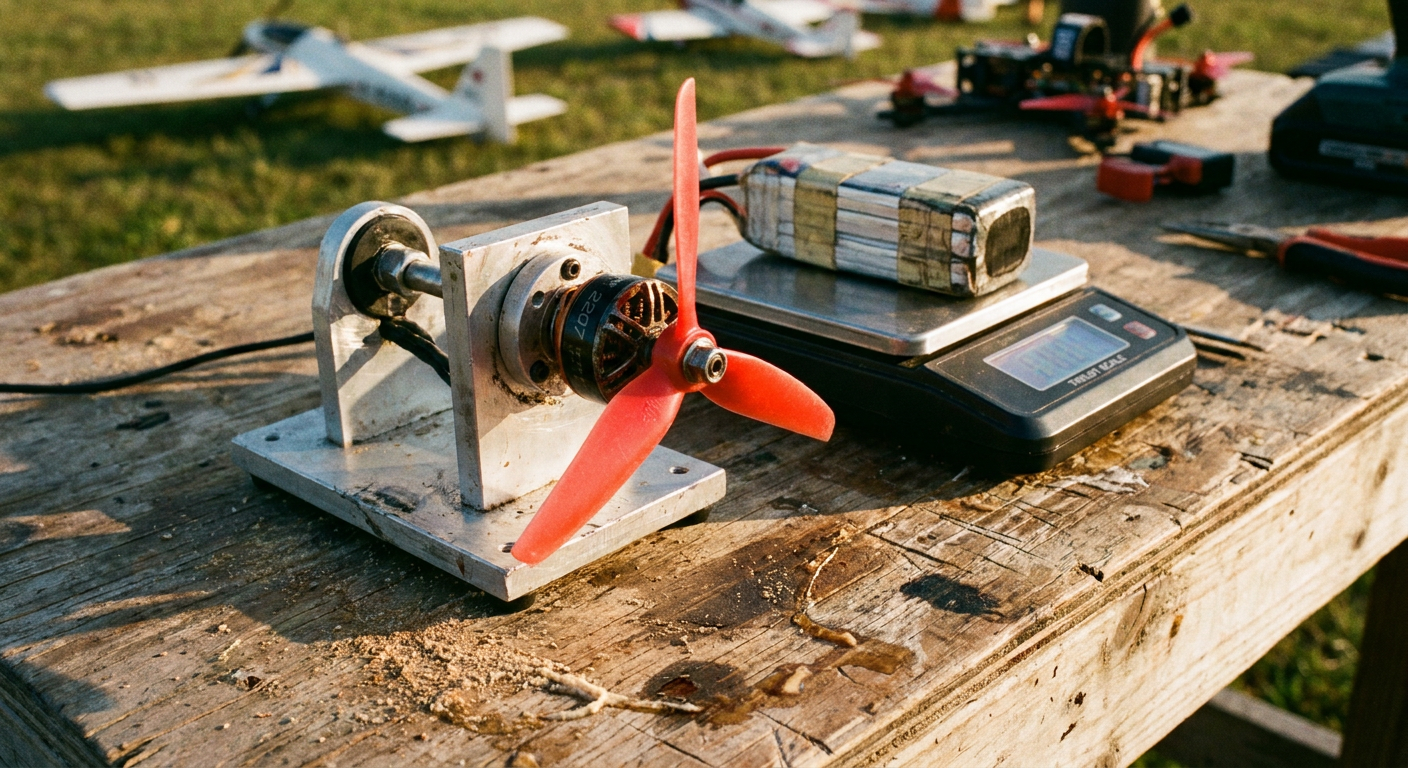
Now compare that to a standard 2207 brushless motor spinning a five-inch tri-blade prop on your bench. That setup easily delivers four to six grams of thrust per single watt of electrical power at hover or cruising throttle. Switch to an efficient fourteen-inch wooden prop on a low-KV motor for a slow-flying electric glider, and efficiency jumps past ten to twelve grams of thrust per watt.
In plain English, our off-the-shelf spinning props are hundreds of times more efficient at converting battery energy into usable pushing force than the most advanced solid-state propulsion prototypes.
Bench Reality: Lab Thrusters vs Brushless Motors
To put this into perspective, let us look at how different power setups compare on a standard thrust stand. The figures below combine representative laboratory data from published ionic flyer studies with well-documented bench measurements from standard hobby brushless motor and propeller combinations.
Note: The following table is an illustrative composite based on published research data and standard bench thrust measurements across hobby motor reviews.
| Propulsion Setup | Operating Voltage | System Weight | Electrical Power Input | Static Thrust Generated | Efficiency (Thrust per Watt) | Approx. Cost |
|---|---|---|---|---|---|---|
| Lab Ionic Thruster Rig (Untethered) | 20,000V - 40,000V | 2,400 g (including converters) | 500 W | 60 g - 90 g | ~0.15 g/W | $5,000+ (Custom) |
| Micro Ducted Acoustic Lab Thruster | 48V | 180 g | 120 W | 45 g | ~0.38 g/W | $800+ (Prototype) |
| Standard 2207 (2400KV) + 5x4.3 Prop | 14.8V (4S LiPo) | 34 g (motor only) | 150 W (mid-throttle) | 620 g | ~4.1 g/W | $14 - $22 |
| 2207 (2400KV) + 5x4.3 Prop (Full Throttle) | 14.8V (4S LiPo) | 34 g (motor only) | 480 W | 1,450 g | ~3.0 g/W | $14 - $22 |
| Sunnysky 2814 (900KV) + 11x5.5 Prop | 14.8V (4S LiPo) | 105 g (motor only) | 210 W (cruise) | 1,250 g | ~6.0 g/W | $25 - $32 |
| Large UAV 5010 (360KV) + 17x5.5 Prop | 22.2V (6S LiPo) | 120 g (motor only) | 180 W (hover) | 1,900 g | ~10.5 g/W | $35 - $48 |
Looking at the numbers makes the gap obvious. For the price of a takeout lunch, a standard hobby motor gives you over a kilogram of thrust from a palm-sized package that weighs less than a chocolate bar. To get equivalent thrust from an experimental solid-state propulsion system, you would need enough high-voltage grid surface to cover the hood of a car, along with hundreds of dollars in specialized converter hardware that would fry the instant moisture or morning dew touched it.
Why Modern Brushless Power Stays Ahead
It is easy to forget how spoiled we are by modern RC electronics. Twenty years ago, electric flyers wrestled with heavy brushed can motors, brass gearboxes, and heavy nickel-metal hydride battery packs that lost punch after three minutes in the air. Getting a foam plane to climb vertically was a rare achievement.
Today, modern brushless motors are precision machines. They use high-temperature neodymium magnets, oxygen-free copper stator windings, and lightweight CNC-machined aluminum bells. When paired with modern electronic speed controllers running thirty-two-bit microcontrollers and digital protocols like DShot, the system operates at electrical efficiencies between eighty and ninety percent.
Here are four practical reasons brushless motors remain unbeatable on the flying field:
1. Instant Throttle Response
When you are flying low through a tree line with an FPV wing or catching a sudden downdraft on final approach with a sport plane, you need immediate thrust. Modern ESCs can cycle motor RPM from twenty percent to one hundred percent in under fifty milliseconds. Solid-state ion drives and acoustic thrusters struggle with capacitive charging delays and slow thermal stabilization, meaning throttle response is sluggish and unpredictable.
2. Dirt, Tall Grass, and Field Abuse
Flying fields are dirty places. Your plane will belly-land in wet grass, kick up fine sand on a dirt runway, and occasionally nose-over into soft mud. A brushless outrunner motor is practically indestructible. If it gets packed with dirt, you pull the small C-clip on the base, slide the bell off, rinse the stator with rubbing alcohol or clean water, let it dry, add a drop of bearing oil, and go right back to flying. Try landing an open-grid high-voltage thruster in wet grass and you will get a loud pop, a puff of ozone smoke, and a dead aircraft.
3. Tuning Flexibility with Cheap Propellers
One of the best parts of our hobby is tuning how a plane feels in the air. If you want more top speed for racing, you swap from a 5x4.3 prop to a 5x5.1 prop for three dollars. If you want longer flight times on a trainer, you drop the pitch and add diameter. You can completely change the flight characteristics of your model in thirty seconds with a single nylon locknut at the flight bench.
4. Supply Chain and Universal Compatibility
You can buy a brushless motor from dozens of manufacturers worldwide, have it delivered to your door in three days, and plug it into an ESC made by a completely different company. Everything uses standard bullet connectors, standardized 16x16 mm or 19x19 mm mounting patterns, and universal servo pulse signals. You are never locked into a single proprietary lab ecosystem.
The Hidden Battery Factor
Propulsion efficiency is only half the battle. You also have to carry the fuel. Modern lithium polymer and lithium-ion batteries are great, but they are still heavy. A typical four-cell 1500mAh pack weighs around 180 grams.
Because brushless motors deliver high thrust-per-watt, we can dedicate twenty to thirty percent of our aircraft weight to the battery and comfortably enjoy six to twenty minutes of flight time, depending on the airframe.
If you tried to power an inefficient exotic thruster with existing LiPo chemistry, you would need five times the battery capacity just to stay airborne for two minutes. But that extra battery weight requires even more thrust, which demands an even bigger battery. You quickly hit a mathematical dead end where the plane cannot lift its own energy source. Until battery energy density increases by an order of magnitude, high-efficiency mechanical props are the only practical game in town.
How to Choose the Best Motor-Prop Setup for Your Build
Instead of waiting for exotic propulsion breakthroughs to hit the hobby market, you can get massive performance gains right now simply by matching your motor KV and prop selection correctly. Many club flyers leave thirty percent of their flight time or thrust on the table simply by guessing their power train.
Here is a simple checklist to dial in your next power setup without overcomplicating things:
- Determine your target flying style: High-speed park flyers need small props with steep pitch spinning at high RPM (high KV motors). Gliders, trainers, and cargo planes need large-diameter, shallow-pitch props spinning slower (low KV motors) to maximize static thrust and flight time.
- Check the manufacturer thrust charts: Reliable motor brands publish detailed bench test tables showing current draw, thrust in grams, and efficiency for three or four prop sizes on both 3S and 4S batteries. Look for the prop that gives you your desired thrust at fifty to sixty percent throttle, not one hundred percent.
- Leave headroom on your ESC: Always size your speed controller at least twenty to twenty-five percent higher than the maximum current shown on the motor thrust chart. If a prop pulls twenty-four amps at full bench throttle, use a thirty-amp or thirty-five-amp ESC. This keeps the controller running cool and prevents thermal shutdowns during hard climbs.
- Balance your props: Even a cheap ten-dollar brushless motor will run smooth and quiet if you take five minutes to balance your propeller with a small strip of tape on the light blade. Less vibration means cleaner gyro data, cooler motors, and longer bearing life.
What This Means for MyRC
When we build tools at MyRC (myrc.ai), we focus on the real challenges modelers face every weekend at the flying field rather than chasing theoretical lab hype. Whether you are building a custom twin-engine cargo plane out of dollar-tree foam or dialing in a long-range FPV wing, your success comes down to practical choices: matching motor KV to battery voltage, picking the right propeller pitch, and keeping your airframe light and repairable. Practical RC aircraft decisions grounded in real builds, available parts, and flying experience will always outperform paper designs that cannot survive a rough landing.
Real Answers on Motor and Prop Tech
Q: Will solid-state or ionic propulsion ever replace brushless motors in RC models? A: No, not for practical hobby flying. The physics of thrust generation require moving large volumes of air to remain energy-efficient. Solid-state systems require thousands of volts, produce negligible thrust per watt, and are far too fragile and heavy compared to modern brushless motors and cheap plastic propellers.
Q: How do I get more flight time out of my current brushless setup? A: Switch to a slightly larger diameter propeller with a lower pitch, and step down your motor KV if needed. Turning a larger volume of air more slowly generates higher thrust-per-watt efficiency, which drops your cruise current and adds minutes to your battery pack.
The Field-Tested Winner
The next time you see a flashy video claiming that spinning propellers will soon become obsolete relics of the past, smile and keep building. The physics of flight have not changed. The classic combination of copper wire, strong magnets, and molded plastic blades remains one of the most reliable, efficient, and cost-effective mechanical systems ever invented.
Grab your flight box, charge your packs, and enjoy the unmatched punch of a reliable outrunner motor. It works on the bench, it works in the wind, and when you accidentally clip a branch on a low pass, a two-dollar replacement prop will have you back in the air in five minutes.
Sources
- [1] Tech Briefs Aerospace Propulsion Trends: https://www.techbriefs.com/tb/topics/aerospace
- [2] Pilot Institute Drone Statistics and Industry Insights: https://pilotinstitute.com/drone-statistics/
- [3] eCalc Electric Powertrain Modeling and Motor Selection: https://www.youtube.com/watch?v=jclh4U3vw3A
- [4] Harvard ADS Motor and Propeller Thrust Stand Research: https://ui.adsabs.harvard.edu/abs/2021JPhCS2111a2005P/abstract
- [6] T-Motor Guide to Brushless Drone Motors and Efficiency: https://shop.tmotor.com/blog/brushless-vs-brushed-bldc-drone-motors
- [7] Tyto Robotics Brushless Motor and Propeller Testing: https://www.tytorobotics.com/blogs/articles/how-brushless-motors-work
- [10] Wikipedia Brushless DC Electric Motors and Operation: https://en.wikipedia.org/wiki/Brushless_DC_electric_motor
- [11] RCexplained Brushless Motor Efficiency and Constants: https://www.radiocontrolinfo.com/brushless-motor-efficiency/