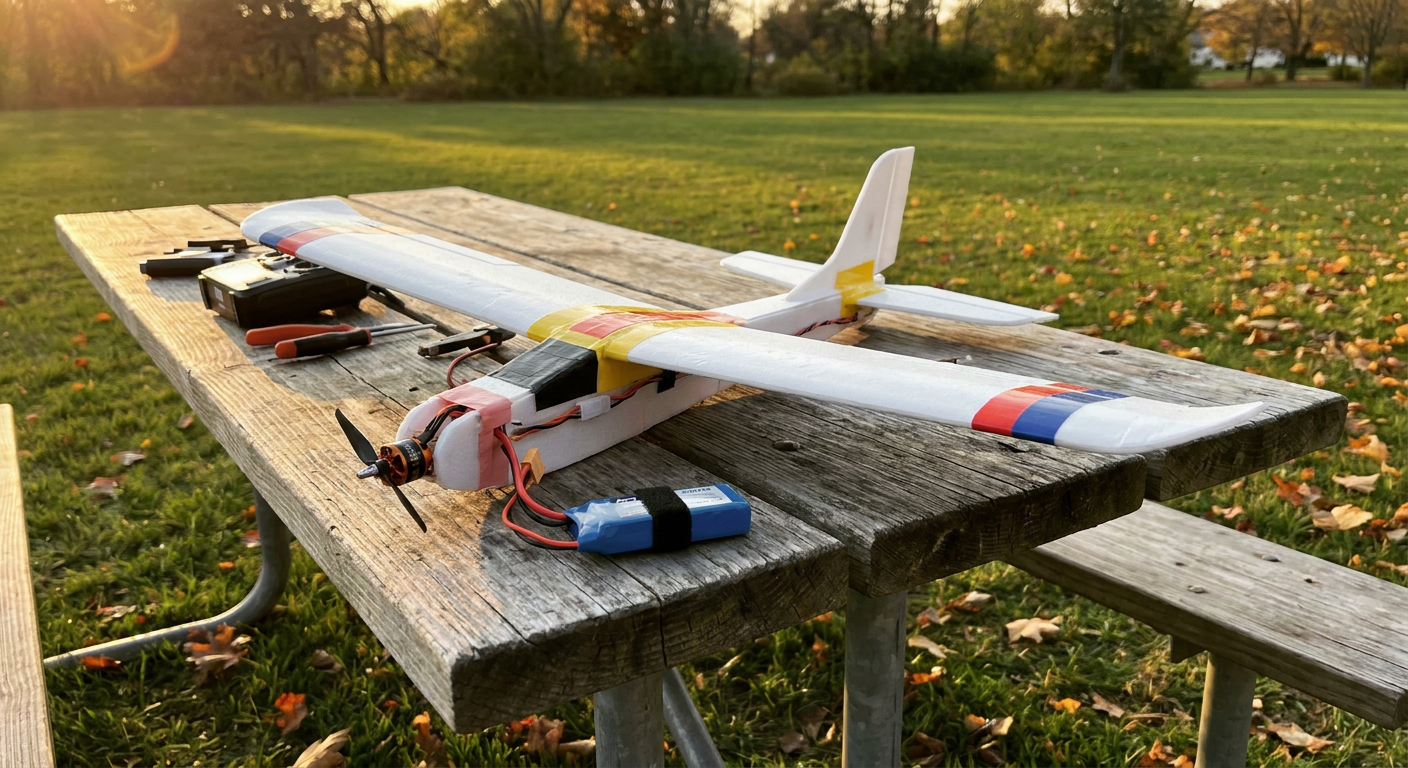
The 250-gram line has completely reshaped weekend flying. Under FAA rules in the United States and similar aviation guidelines across Europe and the UK, keeping a model aircraft below 0.55 pounds (250 grams) spares you from registration fees, paperwork, and the requirement to mount a costly, power-hungry Remote ID broadcast module. For anyone who just wants to toss an airplane into the back of the car and fly three packs at the local soccer pitch before dinner, staying under that weight limit is the simplest path to hassle-free flying.
Building an airframe that weighs less than 250 grams ready-to-fly is easy. The real challenge is building one that flies like a real airplane instead of a tumbling plastic grocery bag the second the wind picks up above five miles per hour.
Too many scratch builders and kit buyers focus solely on trimming grams without thinking about wing loading, propeller pitch speed, or structural rigidity. The result is usually a featherweight floater that gets pinned downfield in the slightest gust or flutters into a tree because the motor lacked the punch to penetrate dirty air. You do not have to settle for flying only on dead-calm summer evenings at dawn. By choosing the right motor size, pairing it with a realistic battery capacity, and using the right foam construction methods, you can build a 230-gram park flyer that tracks straight, cuts through breezy park air, and still stays comfortably legal.
Why Ultra-Light Airframes Get Bullied by the Breeze
When a model gets tossed around in choppy air, the problem is rarely just its total weight. The real issue is the relationship between wing area, airspeed, and inertia.
If you take a classic 36-inch wingspan slow-flyer design and build it down to 180 grams, the wing loading drops down into the basement, perhaps three or four ounces per square foot. That makes for an airplane that can take off in ten feet and loiter at walking speed inside a basketball gym. Take that same plane out to an open field with an eight-mile-per-hour breeze, and every thermal bubble or wind rotor coming off the tree line pushes the wingtips around. Because the plane has very little mass and a large surface area, the wind easily overpowers the control surfaces.
To make a sub-250g model handle real outdoor conditions, you need enough airspeed and wing loading to punch through turbulence. A smaller wing with a slightly higher wing loading (around 6 to 9 ounces per square foot) might stall a couple of miles per hour faster on landing, but it will track like it is on rails through bumpy air.
Power delivery plays an equally critical role. A large, slow-turning propeller producing tons of static thrust will launch a plane cleanly out of your hand, but it runs out of steam the moment you turn into a headwind. To maintain control in breezy conditions, your setup needs enough pitch speed to fly at least two to three times faster than the prevailing wind speed. If the wind is blowing at 12 mph, a setup with a 25 mph pitch speed will leave you creeping forward at full throttle with zero control margin. A setup designed for 45 mph pitch speed will slice through that same wind without breaking a sweat.
Airframe Materials: Counting Every Gram of Glue and Foam
Every build starts with the raw airframe, and this is where most weight budgets are won or lost. If your bare airframe weighs 140 grams before you install a single servo, you have already lost the battle. Electronics, linkages, motor, speed controller, and battery will easily consume another 100 to 120 grams, pushing you straight over the threshold.
Classic Dollar Tree foam board (Readi-Board) is cheap and accessible, costing around a dollar a sheet. However, the paper facing on standard foam board absorbs humidity and adds massive dead weight. A standard sheet of paper-faced foam weighs around 115 grams. If you peel the paper off both sides, the remaining 4.5mm polystyrene core drops to just 45 to 50 grams. Stripping the paper is the single fastest way to cut 50% of your raw airframe weight, though it leaves the bare foam more prone to snapping on rough landings. Adding a few strips of 1.5mm carbon fiber rod along the spar or applying light 1.5-mil document laminating film over bare foam restores rigidity without bringing back the heavy paper weight.
Extruded Depron and generic XPS (extruded polystyrene) sheets in 2mm and 3mm thicknesses are ideal for sub-250g builds. A 3mm Depron wing profile gives enough stiffness for 24-inch to 30-inch spans while keeping the bare airframe under 60 grams. Expanded Polypropylene (EPP) foam is nearly indestructible, making it the favorite for combat wings and backyard bashers, but standard density EPP is slightly heavier and flexes under high aerodynamic loads unless reinforced with thin carbon spars.
Glue discipline is where experienced builders separate themselves from beginners. A typical hot glue gun deposits thick, heavy beads of rubbery plastic. Building an entire 28-inch foamie with heavy hot glue can add 25 to 40 grams of pure, useless weight. Switching to contact adhesives like UHU Por, Foam-Cure, or thin CA (cyanoacrylate) with foam-safe activator cuts total adhesive weight down to less than 6 grams for the entire airframe. Every gram saved on glue is a gram you can put back into battery capacity or motor copper.
Motor Sizing: From Drone Micro-Motors to Fixed-Wing Pullers
A decade ago, park flyers relied on heavy 2822 or 2212 outrunners that weighed 35 to 50 grams by themselves. Today, the explosion of micro FPV drones has gifted fixed-wing builders an incredible lineup of powerful, lightweight brushless motors.
Micro drone motors in the 1104, 1204, 1404, and 1506 stator sizes offer remarkable thrust-to-weight ratios. A modern 1104 motor (around 4500kV to 5500kV) weighs only 5 to 6 grams and produces upwards of 120 grams of thrust on a small 3-inch propeller using a 2S pack. Stepping up to a 1404 or 1506 motor adds roughly 9 to 14 grams of weight, but lets you swing 4-inch to 5-inch props, delivering 250 to 350 grams of thrust with lower electrical current draw and better motor efficiency.
Selecting the right motor size depends on what you want your model to do:
- Ultra-Micro Cruisers (1103 to 1106): Best suited for lightweight 20-inch to 24-inch wings weighing under 130 grams total. They run high kV (4500kV to 6000kV) on 2S with 3-inch props. They are super light, but their small props lack the bite needed to punch heavy draggy airframes through turbulence.
- Sport and Flying Wings (1204 to 1404): The current sweet spot for sub-250g aircraft. Weighing between 6 and 10 grams, these motors handle 2S to 3S power and spin 3.5-inch to 4-inch props cleanly. They produce plenty of pitch speed for fast flying wings like the Dart 250 or scratch-built foam deltas, giving you the forward momentum to cut through 12 mph breezes.
- High-Torque Aerobats and Slow Tractors (1506 to 1806): Weighing 14 to 20 grams, these larger stator motors can turn larger 5-inch or 6-inch props at lower kV (2200kV to 3000kV). An old EMAX 1806 2280kV motor on a 2S pack spinning a 5030 or 6030 prop gives instant vertical punch and great low-end grip, making it fantastic for 30-inch high-wing bush planes or flat-plate 3D models.
Avoid the trap of over-propping micro motors. Running a prop that is too large for an 1104 or 1204 stator causes the motor to overheat within two minutes, causing voltage sag on your flight pack and dropping your flight times down to three frustrating minutes.
The Battery Balancing Act: Voltage, Flight Time, and Sag
The battery pack is the single heaviest component in any sub-250g airplane. In most balanced builds, the battery should account for roughly 25% to 35% of the total all-up weight, which translates to a pack weight between 45 and 75 grams.
A common mistake among new builders is attempting to run tiny 1S LiPo cells (like 300mAh packs from micro indoor helis) to keep weight as low as possible. While a 1S setup saves grams, running on 3.7 volts requires high current to generate usable wattage. High current leads to massive voltage sag, hot ESCs, and weak motor performance. The plane struggles to climb and wilts in the wind.
Moving to a 2S (7.4V nominal) or 3S (11.1V nominal) pack doubles or triples available power output for the same motor current. For most sub-250g park flyers, a 2S 450mAh to 650mAh LiPo is the ideal compromise. A typical 2S 550mAh 70C pack weighs approximately 32 to 36 grams. Paired with a modest 1404 motor drawing 5 to 7 amps at cruise, that battery easily delivers 7 to 10 minutes of spirited flying while providing enough burst current to punch out of trouble.
If you want raw speed and wind penetration on a small flying wing, running a 3S 350mAh to 450mAh pack (weighing around 38 to 45 grams) with a lower kV motor provides high pitch speed without overheating the electronics. Just keep in mind that high-C-rating packs come with thicker lead wires and heavier XT30 connectors, which chew into your remaining weight margin.
Component Budgets: Three Build Paths Under 250 Grams
To see how the numbers add up in the real world, the table below illustrates three common sub-250g configurations. These figures reflect real-world component weights sourced from popular micro drone electronics, foam scratch builds, and standard hobby hardware.
Illustrative Component Weight Breakdown (Grams)
| Component | 28" Sport Bush Plane (Calm/Light Wind) | 24" Flying Wing (Breeze Fighter) | 30" 3D Profile Aerobat (High Thrust) |
|---|---|---|---|
| Bare Airframe (Foam + Carbon) | 62 g | 54 g | 58 g |
| Brushless Motor | 1806 2300kV (18 g) | 1404 3800kV (9 g) | 1506 3000kV (14 g) |
| Electronic Speed Controller (ESC) | 12A Micro (6 g) | 15A Micro (7 g) | 20A Micro (9 g) |
| Propeller + Adapter | 6x3 Prop (5 g) | 4x2.5 Prop (3 g) | 5x3 Prop (4 g) |
| Servos | Three 5g Micro Servos (15 g) | Two 4.3g Micro Servos (9 g) | Three 5g Metal Gear (18 g) |
| Receiver (PWM or Serial) | 4-channel Micro PWM (3 g) | Micro ELRS / SBUS (1.5 g) | 4-channel Micro PWM (3 g) |
| Pushrods, Horns, Linkages | 0.8mm Wire + Plywood (4 g) | 1.0mm Carbon + Z-Bends (3 g) | 0.8mm Wire + Guides (5 g) |
| Battery Pack | 2S 650mAh LiPo (42 g) | 3S 450mAh LiPo (44 g) | 2S 550mAh LiPo (34 g) |
| Glue, Tape, Wiring Leads | 8 g | 6 g | 8 g |
| Total All-Up Weight (AUW) | 163 g | 136 g | 153 g |
| Remaining Margin Under 250g | 87 g | 114 g | 97 g |
Note: This data is an illustrative composite based on typical weights of standard commercial components (such as EMAX and BetaFPV motors, generic micro servos, and Depron/foam builds).
As the numbers show, when you pick modern components, you do not need to scrape for fractions of a gram just to squeak under the 250g mark. All three setups leave between 85 and 115 grams of safety margin below the legal limit. You can use that extra margin to reinforce the motor firewall, add landing gear, use slightly thicker foam for durability, or step up battery capacity for extended flight times.
Linkages, Hardware, and Hidden Weight Penalties
Where builders usually blow their weight budgets is not the motor or the wing, it is the small hardware choices made during final assembly.
Consider traditional blue 9-gram servos. They cost about three dollars each and sit in every hobbyist's spare parts bin. But three 9g servos, complete with their thick wires and mounting screws, add nearly 35 grams to the airframe. Swapping them for reliable 3.7g or 5g micro servos instantly drops 18 to 20 grams off the tail and nose. That weight saving alone is equivalent to half the weight of your flight battery.
Heavy mechanical linkages are another hidden penalty. Standard 1.5mm threaded steel pushrods with metal clevises and brass pushrod connectors are completely unnecessary for a 200-gram model. Using 0.8mm (0.031-inch) music wire with simple Z-bends, supported halfway down the fuselage by a tiny segment of plastic coffee stirrer tube to prevent flex, weighs less than two grams total and eliminates control slop.
Pay attention to your electrical wiring as well. Long servo leads, heavy 16-gauge battery wires, and bulky connectors add dead weight. Trimming servo leads to length and soldering the ESC directly to the motor leads removes bulky bullet connectors, saving another four to six grams while cleaning up the fuselage layout.
Surviving 10 MPH Gusts Without High-Tech Flight Controllers
You do not need an expensive flight controller running complex stabilization software to fly a sub-250g plane in windy conditions. Clean aerodynamic design and proper setup will give you a rock-solid plane using a standard receiver.
First, make sure your Center of Gravity (CG) is dialled in correctly. A tail-heavy plane is a nightmare in calm air, but in turbulent wind, it becomes completely unmanageable. Setting the CG slightly forward (around 3% to 5% forward of your neutral calm-air balance point) will make the nose track into gusts and naturally damp out pitch oscillations. You will need a touch of up-elevator trim to cruise, but the airplane will feel dramatically more locked-in when cutting across a crosswind.
Second, keep your control surface hinges stiff. Thin foam hinges that flex or flutter in high-speed airflow rob you of control authority exactly when you need it most. Use high-tack hinge tape (like 3M Blenderm) applied along the entire length of the hinge line on both top and bottom surfaces. A tight, slop-free hinge prevents flutter and ensures that small control inputs translate into immediate attitude corrections.
Third, design with low parasitic drag. Boxy fuselages and blunt leading edges act like sails in a breeze. Rounding off the leading edges of your foam wings with sandpaper, tapering the trailing edges, and keeping the cross-section of the fuselage slim will reduce the drag that wind can push against.
What This Means for Practical RC Design
Building under the 250-gram mark does not mean you are stuck flying fragile, underpowered toys that can only leave the hangar on perfectly calm days. The vast availability of efficient micro brushless motors, high-discharge 2S packs, and stripped foam techniques has turned the sub-250g class into some of the most capable, durable park flyers available.
When you use tools like MyRC to verify your wing area, motor thrust ratios, and flight surface geometries before cutting foam, you eliminate the guesswork that leads to sluggish, tail-heavy builds. Designing within the sub-250g envelope is all about making deliberate choices: trading excessive wing area for higher pitch speed, swapping heavy hot glue for contact adhesive, and choosing modern micro drone motors over bulky outrunners. The payoff is a durable, legal park flyer that fits on your backseat and flies wherever and whenever you want.
A Field-Tested Sub-250g Build Checklist
Before taking your next lightweight scratch build or micro kit out to the field, run through this quick setup checklist:
- Verify True All-Up Weight: Weigh the model on a digital kitchen scale with the actual flight battery installed, not an estimated weight. Aim for 220 to 235 grams to leave room for future field repairs.
- Check Pitch Speed vs Wind: Ensure your motor and prop combination provides a calculated pitch speed of at least 35 to 45 mph for outdoor flying. Small high-RPM props beat large slow-flyer props in breezy conditions.
- Secure the Battery firmly: Wind turbulence creates sudden G-forces. Never rely solely on a weak strip of Velcro; use a small hook-and-loop strap to prevent the battery from shifting the CG in mid-air.
- Seal the Hinge Lines: Ensure elevator and aileron hinges are sealed end-to-end with Blenderm or quality hinge tape to eliminate aerodynamic blowback and flutter.
- Set Dual Rates and Expo: Gusty conditions require quick, authoritative control inputs. Program high rates with 30% to 40% exponential so you have strong throw for corrections without making the center stick twitchy.
Pick a simple foam design, strip the heavy paper, drop in a 1404 motor with a 2S pack, and enjoy stress-free park flying this weekend.
Sources
- Unmanned Aircraft Systems (UAS) - Drones - FAA: https://www.faa.gov/uas
- US Drone Laws 2026: Rules by State & Where to Fly: https://www.flyusi.org/guides/drone-laws
- FliteTest Forum - Part Picking for 250g Fixed Wing: https://forum.flitetest.com/index.php?threads/could-a-sub250-edf-park-flyer-be-a-thing.77197/
- RC Groups - FAA Regulations and Park Flyers: https://www.rcgroups.com/forums/showthread.php?4088559-FAA-and-park-flyers
- GetFPV - Micro Motors and Drone Hardware: https://www.getfpv.com/micro-quadcopters/micro-motors.html