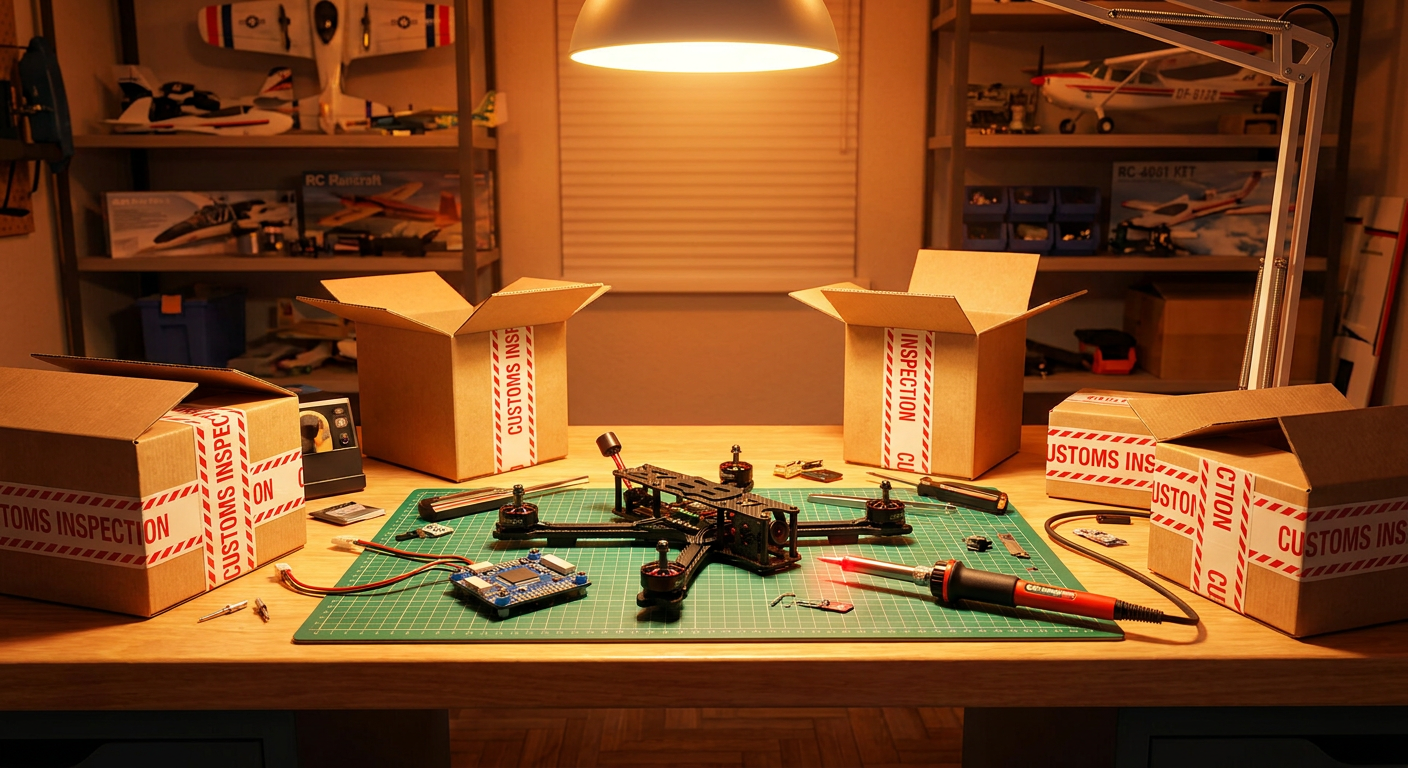
If you ordered a ready to fly quad or a fresh camera platform over the last few months, you might have watched your tracking status freeze. It lands at an intake hub in Los Angeles, Indianapolis, or JFK, flips to clearance delay, and sits there for three weeks without an update.
What started as a targeted customs hold on commercial camera platforms, notably shipments of the DJI Air 3S and Neo models arriving directly from overseas factories, has created ripple effects across flying fields and hobby forums. Pilots waiting on Bind-N-Fly (BNF) freestyle quads, micro cinewhoops, and all-in-one flight controller boards are suddenly asking whether their personal orders are going to be seized at the border.
Sorting through the rumors on club benches and social groups takes a bit of clarity about what customs agents are actually looking for, why pre-built aircraft are treated differently than a bag of motors, and how you should handle your gear purchases this season.
What Is Actually Happening at the Ports
The current wave of delays began in mid-October when U.S. Customs and Border Protection (CBP) started detaining specific shipments from major drone manufacturers under the provisions of the Uyghur Forced Labor Prevention Act (UFLPA). This law requires importers to prove that every tier of their supply chain, from raw materials to sub-assembly factories, meets strict labor and origin standards.
When a commercial giant like DJI ships container loads of consumer drones, CBP can issue a detention notice requiring detailed supply chain documentation. Until the manufacturer provides component level sourcing paperwork for batteries, chassis plastics, and optical modules, those containers sit in bonded warehouses.
The problem for individual hobbyists is that air freight hubs run on automated risk algorithms and shared shipping manifests. When customs flags a specific manufacturer or harmonized tariff code for intensive documentation reviews, entire cargo pallets get pulled aside for manual inspection. If your BNF quad or package of radio receivers happens to be packed on the same pallet as a detained commercial shipment, your package enters the same administrative queue.
This is not a blanket ban on radio control gear, and Congress has not banned the import of hobby electronics. It is an administrative and regulatory bottleneck. But for a builder waiting on parts to finish a weekend build, the result feels exactly the same.
The Difference Between Complete Drones and Loose Components
To understand why some packages glide through customs in forty-eight hours while others languish for a month, you have to look at how items are categorized when they clear international shipping hubs.
When you buy a fully assembled drone, whether it is a retail camera ship or a pre-tuned 5-inch BNF quad with an installed digital video transmitter, the shipping paperwork typically lists it under Harmonized Tariff Schedule (HTS) code 8806, which covers unmanned aircraft. That single tariff line immediately signals to automated customs screening systems that the package contains a complete, functional aircraft. As a result, it gets routed into inspection protocols designed for finished aviation hardware, remote ID compliance checks, and country of origin documentation.
Contrast that with an order containing raw parts: four brushless motors, a bare carbon fiber frame, a pack of propellers, and a bag of silicone wire. Those items enter customs under completely different tariff codes, such as electric motors (HTS 8501) or general electronics components (HTS 8542).
Customs agents rarely inspect small parcels of passive electronic components or bare carbon plates unless the declared value looks suspicious or the outer packaging is damaged. That is why builders ordering bare frames and soldering their own stacks are seeing their packages arrive on schedule, while friends ordering factory assembled RTF kits from the same overseas storefronts are staring at clearance delays.
Why BNF Quads Sit in the Gray Zone
Bind-N-Fly models occupy an awkward middle ground in international shipping. A BNF quad is a complete aircraft in every mechanical sense, but it lacks a direct consumer remote controller and often ships without a flight battery.
Overseas sellers categorize BNF quads inconsistently. Some vendors label a 3.5-inch BNF quad as a "toy model aircraft kit" or "hobby replacement parts" on the customs declaration form. Others use the standard unmanned aircraft classification.
When an overseas vendor under-declares or misclassifies a fully built quad to bypass standard tariff inspections, they take a gamble. If customs inspectors pull the box, open it, and find an assembled drone with a high-definition video transmitter and high-output ESC stack instead of plastic model pieces, they can hold the package indefinitely while requesting commercial invoices and origin paperwork.
If the seller fails to supply the requested documentation within thirty days, CBP can return the parcel to sender or flag it for abandonment. You end up caught in customer service ping-pong between a foreign seller claiming the item shipped and a domestic carrier stating that customs will not release the box.
The True Price of Direct Overseas Shipping
For years, ordering direct from overseas clearing houses or manufacturer direct webshops was the default move for many club flyers. You saved $30 to $60 compared to domestic retail prices, skipped local sales taxes in some jurisdictions, and had access to models before domestic distributors stocked them.
That trade-off has fundamentally shifted over the last six months. The calculus between price and delivery certainty looks very different when customs holds stretch into several weeks.
Consider what happens when you buy a standard 5-inch BNF freestyle drone through two different purchasing routes:
+-----------------------+-----------------------------+-----------------------------+
| Factor                | Direct Overseas Order       | Domestic Hobby Distributor  |
+-----------------------+-----------------------------+-----------------------------+
| Base Price            | $280 - $310                 | $330 - $360                 |
| Typical Shipping Time | 8 to 25 business days       | 2 to 4 business days        |
| Customs Delay Risk    | High (10 to 45 extra days)  | None (Already cleared)      |
| Carrier Support       | Limited to automated email  | Direct phone or local chat  |
| Return / Refund Path  | Chargeback / Postal dispute | Standard domestic return    |
+-----------------------+-----------------------------+-----------------------------+
The table above shows an illustrative composite based on typical retail pricing and delivery experiences reported across hobby forums and domestic suppliers like GetFPV, Pyrodrone, and MyFPVStore. When an overseas package gets hung up in customs, the $40 you saved up front quickly vanishes into lost flying weekends, unreturned support emails, and the stress of tracking an unresponsive container.
Domestic distributors import their inventory via bulk freight. When a domestic distributor encounters a customs hold, their commercial logistics team and customs brokers handle the paperwork directly with CBP. They absorb the delay before the product ever lists as in stock on their web storefront. When you buy from a domestic warehouse, the parcel moves via domestic ground shipping, meaning it never touches an international customs facility.
What Happens When Your Tracking Shows a Hold
If you already have a package sitting in a customs warehouse, knowing what the carrier notifications mean will save you time and frustration.
Most shipping carriers (such as DHL, FedEx, or standard postal services) provide tracking events that fall into three stages:
- Arrived at Port of Entry / Inbound into Customs: The package has been offloaded from the cargo aircraft and placed into a customs holding area. This is routine and typically takes 24 to 72 hours.
- Clearance Delay / Held in Customs / Exception: The automated clearance failed, or the shipment was selected for a physical audit or documentation check.
- Notice to Importer / Information Requested: The carrier has opened a formal case file and requires additional information to release the shipment.
If your tracking enters the clearance delay phase, do not panic immediately. Many packages clear within five to seven business days after an initial manual check. However, if the status remains unchanged for more than ten consecutive days, the hold is usually documentation related.
If you receive an email or letter from a carrier like FedEx or DHL asking for an FCC form, manufacturer registration, or proof of forced-labor compliance, remember that as an individual retail consumer, you cannot generate factory-level origin certificates. Contact the seller immediately and provide them with the tracking number and the exact text of the carrier notice. The legal responsibility for providing commercial origin and compliance documentation rests on the shipper of record.
If the seller refuses to assist or tells you to resolve it yourself with U.S. Customs, you should document every message. If the 30-day delivery window expires and tracking confirms the parcel is detained with no resolution from the seller, file a payment dispute with your payment provider or credit card issuer. Most payment processors treat indefinite customs detentions caused by seller documentation failures as non-delivery.
How to Plan Your Builds Around Customs Inspections
If you want to keep your fleet in the air without worrying about port inspections, adjust how you purchase your gear.
1. Build from Stacks and Frames Instead of Full BNFs
Building your own quad from discrete parts remains the most reliable way to avoid shipping snags. Flight controllers, 4-in-1 ESC boards, video transmitters, receiver modules, and carbon frames almost always clear international customs without incident because they are classified as generic sub-assemblies and replacement electronics. Assembling your own gear gives you total control over wiring quality and firmware configuration while sidestepping complete aircraft import scrutiny.
2. Buy Assembled Aircraft from Domestic Shelves
If you do not want to solder and prefer a factory tuned BNF model, buy it from a domestic vendor that holds inventory inside the country. Verify that the product listing specifically states that the item is in stock at a domestic warehouse rather than drop-shipped from an overseas facility. Paying a 10 to 15 percent markup is worthwhile insurance against customs limbo.
3. Keep Batteries and Radios on Separate Invoices
Lithium polymer flight packs and radio transmitters have their own strict transport regulations. LiPo batteries shipped internationally face hazardous materials packaging restrictions, while radio transmitters require FCC ID documentation. If you bundle a BNF quad, three LiPo packs, and a new radio transmitter into a single overseas shopping cart, you triple the chances that customs flags your box. Split your orders: buy batteries and complete transmitters domestically, and order small hardware or replacement arms from overseas if necessary.
4. Watch for Verified Shipping Methods
Some major overseas vendors use consolidated logistics lines that clear customs in bulk via dedicated freight forwarders before handing packages off to domestic ground carriers. When ordering from overseas manufacturers, choose established express lines over bottom-tier economy postal options. Economy postal items are often dumped into massive sorting bins where individual package holds can delay an entire container for weeks.
What This Means for MyRC
At MyRC, we believe the best RC aircraft decisions are always grounded in real builds, available parts, and hands-on flying experience. Navigating international supply snags is a practical reality of modern aeromodeling, but it should never keep you grounded.
When you understand how parts, frames, and power systems go together, you are never held hostage by a single backordered ready to fly kit or a delayed shipping container. Building your own models from accessible components gives you the freedom to repair your gear quickly, choose the best components for your flying style, and keep your planes and quads in the air regardless of what is happening at the ports.
Direct Answer: Why Are Drone Imports Being Held?
Q: Why is U.S. Customs holding up imported drones and BNF quads?
A: U.S. Customs and Border Protection is actively enforcing supply chain origin regulations (specifically the Uyghur Forced Labor Prevention Act) and compliance audits on complete imported unmanned aircraft. While targeted primarily at large camera drone manufacturers, these holds cause automated inspection delays for any fully assembled aircraft or BNF quad sharing freight manifests, while individual components like motors, frames, and flight controllers generally clear without issue.
Practical Steps for Your Next Order
Before you hit the checkout button on your next project, run through a quick mental checklist. If you are buying a complete, pre-assembled aircraft, check whether a domestic hobby shop has it on the shelf first. If you choose to order direct from an overseas manufacturer, use a credit card with reliable buyer protection, avoid bundling batteries with the aircraft, and anticipate a potential two to four week buffer on delivery.
If you prefer not to wait on shipping logistics, take it as an opportunity to warm up your soldering iron. Ordering a bare carbon frame, an all-in-one flight controller stack, four motors, and a digital camera unit will almost always arrive faster than a factory built BNF ship. You will learn the layout of your electronics, know how to replace an arm when you hit a gate, and spend your weekend at the flying field instead of refreshing a dead tracking link.
Sources
- Dronelife - The Trusted Source for Drone Industry News
- What We Know About the DJI Customs Issue - Dronelife
- Navigating U.S. Customs: Demonstrating DJI's Commitment - DJI Viewpoints
- Commercial UAV News - No DJI Ban Yet, But US Customs Already Stopping Some Drones
- Pyrodrone BNF / PNP / RTF Collection
- GetFPV RTF and BNF FPV Drones